 Imagen
Free
Imagen
Free
Imagen is a series of text-to-image generation models launched by Google DeepMind (formerly Google Research Brain Team), known for its high fidelity, deep language understanding and cascade diffusion architecture. The latest Imagen 4 provides three levels of Fast/Standard/Ultra, supporting 2K resolution, enhanced text rendering and SynthID digital watermarking. This series will be officially shut down on **August 17, 2026**, and it is officially recommended to migrate to the Gemini Nano Banana series.
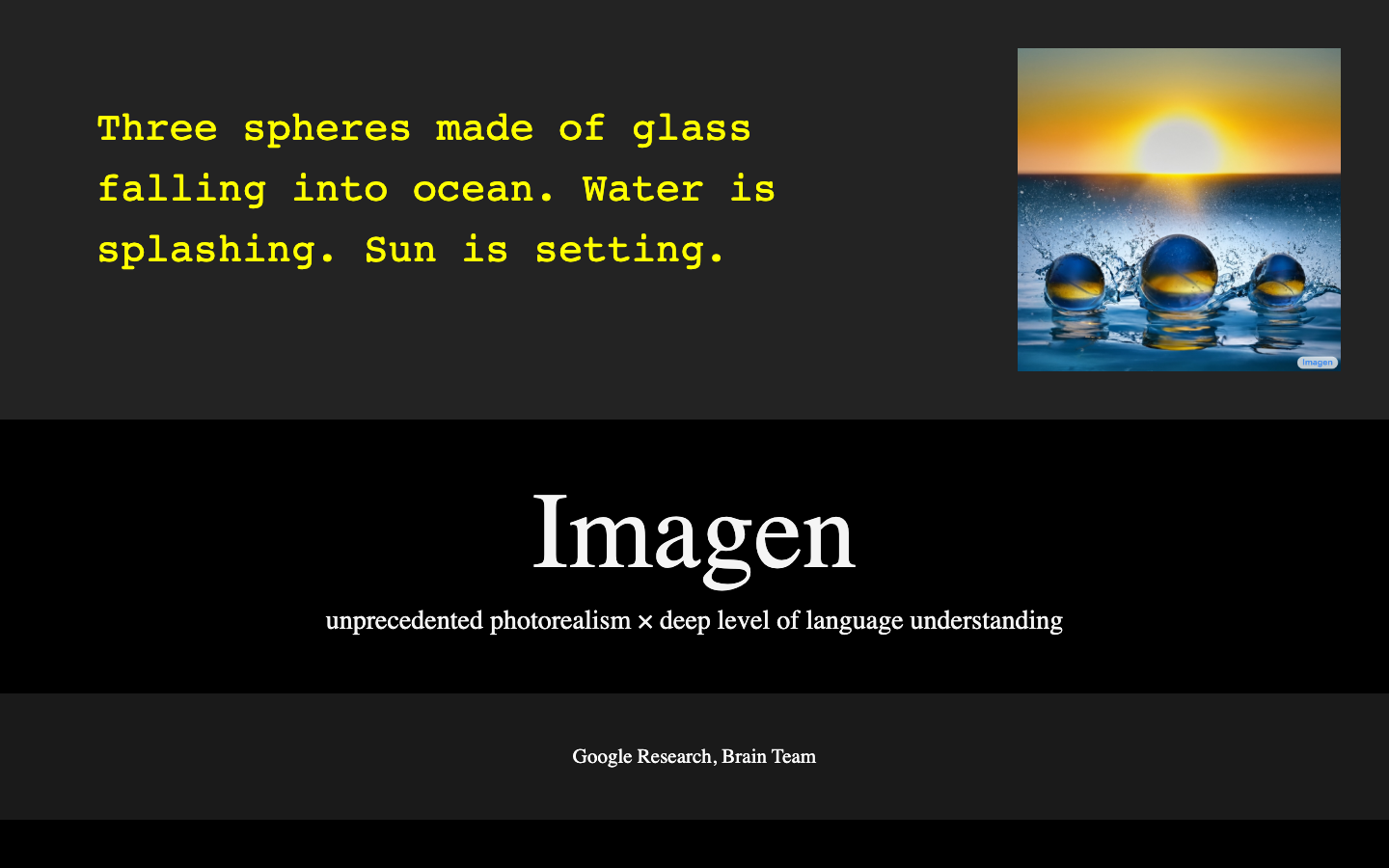
Imagen
Imagen’s core parameters and statistics
Imagen is a text-to-image generation model series (Type B - basic large model/API infrastructure) launched by Google DeepMind (formerly Google Research Brain Team), which is famous for its high fidelity, deep language understanding and cascade diffusion architecture. The current latest version, Imagen 4, provides three-level models: Fast, Standard, and Ultra, which can be called through Gemini API and Google Cloud Vertex AI.
| Projects | Public Information |
|---|---|
| Official positioning | Text-to-Image Generation Model |
| Core technology route | Cascade diffusion model + T5-XXL text encoder |
| Model series | Imagen (first generation), Imagen 2, Imagen 3, Imagen 4 |
| Imagen 4 model code | imagen-4.0-generate-001 (Standard), imagen-4.0-ultra-generate-001 (Ultra), imagen-4.0-fast-generate-001 (Fast) |
| Output resolution | Up to 2K (2048×2048), supporting 5 aspect ratios (1:1, 3:4, 4:3, 9:16, 16:9) |
| Maximum prompt word length | 480 tokens |
| Number of pictures generated in each batch | 1–4 pictures |
| Watermark mechanism | SynthID invisible digital watermark (enabled by default) |
| Deployment platform | Gemini API, Google AI Studio, Google Cloud Vertex AI, Gemini application Whisk |
| Home | US |
| Business model | Research results are public; APIs are billed per image through Gemini API and Vertex AI |
| Current status | Deprecated, shut down on August 17, 2026, recommended to migrate to Gemini Nano Banana series |
Brief review in one sentence: Imagen is not a terminal consumer product, but Google's core technology route verification and capability output platform in the field of Vincentian graphics - its architectural ideas (using large-scale language models for text encoding + cascade diffusion to improve resolution) have profoundly affected the evolution direction of subsequent Gemini series image generation models.
Important Statement: Imagen models (including the entire Imagen 4 series) have been officially marked as Deprecated by Google and will be officially shut down on August 17, 2026. Users who are still using the Imagen API need to migrate to the Gemini Nano Banana series (gemini-2.5-flash-image and above) as soon as possible. All feature, pricing and access information below are based on the status in effect before the shutdown.
Imagen’s users and market recognition
Imagen's market recognition mainly comes from academic influence and embeddedness in the Google ecosystem, rather than public end-user volume or revenue data (the latter is not public).
Academic influence: Imagen's original paper (Saharia et al., CVPR 2022) refreshed the best level in the field of Vincentian graphs with a score of COCO FID 7.27 when it was released, and the model was not trained on the COCO training set. Compared with DALL-E 2 (10.39), GLIDE (12.24) and other solutions at the time, it was significantly improved. The paper also proposed DrawBench, a set of comprehensive benchmarks for systematically evaluating Vincent graph models (covering compositionality, quantitative relationships, spatial relationships, long texts, rare words, and challenging prompts), which is still cited in subsequent research.
Developer Adoption: Imagen 3 / Imagen 4 is open to developers through Gemini API and Vertex AI, with transparent pricing and pay-as-you-go billing, which has natural advantages in enterprise-level scenarios that require Google Cloud compliance certification (such as SOC2, HIPAA). External developers such as Cartwheel (3D character animation) and Viggle (AI video creation) have also disclosed integration cases based on Imagen.
Prerequisites for implementation: The value of Imagen is highly dependent on the Google Cloud ecosystem - if the team is already running on Google Cloud, integrating the Imagen API only requires additional model call authorization; on the contrary, purely competitive product evaluators need to consider the costs of cross-cloud data migration and compliance audits.
Imagen’s cost advantage
Imagen's cost advantage is not reflected in its absolute low price, but in its deep binding to the Google Cloud ecosystem - for teams that already have Google Cloud subscriptions, the marginal cost of accessing Imagen is lower than independently purchasing a third-party API.
C-side/Personal: You can experience the image generation capabilities of Imagen 4 for free through Google AI Studio, with usage quota restrictions (subject to the Google AI Studio real-time page). The Gemini application and Whisk (Labs.Google) also have built-in Imagen's image generation capabilities, which are free and open to individual users but are limited by Gemini's free quota.
API / Developer: Imagen 4 provides three levels of pricing through the Gemini API, and is charged based on the number of images generated:
| Model variants | Price per image | Applicable scenarios |
|---|---|---|
| Imagen 4 Fast | $0.02 | High-throughput, low-latency prototype iteration and batch testing |
| Imagen 4 Standard | $0.04 | Daily content production, balancing quality and cost |
| Imagen 4 Ultra | $0.06 | Delivery scenarios with the highest image quality requirements |
It is estimated that the Standard model generates 10,000 images per month, and the monthly fee is about $400, which is lower than the price of some competing APIs at the same resolution. But please note: Imagen API only supports English Prompt, with a maximum of 480 tokens. Non-English scenarios require additional translation costs.
Enterprise/Private: Imagen does not support private deployment or offline use, and enterprises can only get it through Google Cloud Vertex AI or Gemini Enterprise Agent Platform. Enterprise contracts usually include higher frequency control, exclusive channels, and business discounts. Please contact Google Cloud sales for specific pricing confirmation. Vertex AI editions may have additional Cloud infrastructure charges (e.g. storage, network egress).
Hidden costs: ① Imagen will be shut down soon and will no longer be available after August 17, 2026. Integrated services will face migration and transformation costs; ② The pricing structure bound to Google Cloud means that the entire image generation pipeline needs to be replaced during cross-cloud migration, not just the API endpoint; ③ Each output image carries a SynthID watermark by default, which imposes restrictions on commercial use scenarios that require watermark-free output.
Imagen’s main functions
- Text-to-Image Generation: Generate high-quality images from natural language descriptions. Imagen 4 is outstanding in styles such as realistic photography, artistic illustrations, and product still life, and supports controlling the output style through refined photography terms (aperture, lens, film type). Applicable tasks: Advertising creativity, social media visuals, concept design.
- In-image text rendering: Imagen 4 can embed English text (such as poster slogan Logo text) in the generated image. It is recommended that the text length should not exceed 25 characters and up to 3 phrases. Applicable tasks: poster design, packaging rendering, infographic production.
- Multi-aspect ratio output: Supports five aspect ratios of 1:1, 3:4, 4:3, 9:16, and 16:9, covering mainstream formats such as social media (1:1, 4:5), horizontal screen film and television (16:9, 4:3), and vertical short video (9:16). Applicable tasks: multi-platform content distribution, batch generation of advertising creatives.
- Prompt parameterized template: Supports building reusable image generation workflows through parameterized templates, such as
A {style} logo for a {industry} company on a solid color background. Include the text {company_name}., which encapsulates model capabilities into tools that can be used by the business side on their own. Applicable tasks: standardized visual material production, brand asset management. - SynthID Digital Watermark: All generated images are embedded with an invisible digital watermark by default, and it can be verified whether the image was generated by Imagen through Google's SynthID tool. Applicable tasks: Content traceability AI generates content identification compliance.
Expert Viewpoint: The functional design of Imagen 4 is centered around the "workflow of professional visual creators" rather than "popular entertainment" - the combination of the three capability lines of multi-aspect ratio + text rendering + parametric templates can support a semi-automated visual production line of "template definition → parameter input → batch rendering → multi-platform output", which is especially valuable for high-frequency content scenarios such as e-commerce promotions and social media matrix operations. But the shutdown schedule means the line has less than a month left to live.
Imagen’s model and version evolution
Imagen has gone through four major iterations from its debut as a research paper in 2022 to Imagen 4 in 2025/2026. The main line of evolution is "research verification → productization → performance layering → replaced by Gemini native capabilities."
Mainline release
- Imagen (May 2022): The first generation research version, published in CVPR 2022 paper format. The core finding is that “scaling the language model improves image quality and text alignment more than scaling the diffusion model.” Refreshed SOTA with COCO FID 7.27 (not trained on COCO), and released the DrawBench comprehensive evaluation benchmark. Google did not open public demo or API at that time, and only provided paper Gallery and DrawBench.
- Imagen 2 (~May 2024): The second generation, providing API access to developers through Google Cloud Vertex AI for the first time. More art style support, post-generation editing capabilities, and portrait generation control parameters (
personGeneration) have been added, but Google has not disclosed the exact release date. - Imagen 3 (approximately December 2024): The third generation, image quality, text alignment and inference speed are comprehensively improved, provided through Gemini API and Vertex AI dual channels. Introducing more sophisticated style control, reaching the then-leading level in realistic photography and complex prompt understanding. There is no official precise release date yet.
- Imagen 4 (about June 2025): The latest version currently, model code
imagen-4.0-generate-001(Standard) /imagen-4.0-ultra-generate-001(Ultra) /imagen-4.0-fast-generate-001(Fast). Key upgrades: three-level performance tiering (Fast/Standard/Ultra), 2K resolution output, enhanced text rendering capabilities, support for 5 aspect ratios. Fast mode is claimed to be 10 times faster than the previous generation. Last updated in June 2025. This version has been marked as Deprecated and will be shut down on August 17, 2026.
Version substitution relationship
| Version | Approximate time | Key changes | Current status |
|---|---|---|---|
| Imagen (first generation) | 2022-05 | CVPR paper, T5-XXL + cascade diffusion, COCO FID 7.27 | Research public, API is no longer available |
| Imagen 2 | ~2024-05 | First API, support style expansion and editing | Deprecated |
| Imagen 3 | ~2024-12 | Comprehensive improvements in quality and speed, dual-channel API | Deprecated |
| Imagen 4 | ~2025-06 | Three-level layered 2K output, text rendering enhancement | Deprecated, shut down on 2026-08-17 |
Imagen’s technical advantages
Imagen's core technical route is a combination of "large-scale pre-trained language model + cascade diffusion model", which is differentiated from other Vincentian graph models (potential diffusion of DALL-E's CLIP latent space prior Stable Diffusion).
Mechanism → Effect → Applicable Scenarios:
-
T5-XXL text encoder: Imagen uses frozen T5-XXL (~11B parameters) as text encoder instead of CLIP or BERT. Google's ablation experiments show that increasing the size of the language model improves image quality and text alignment far more than increasing the size of the image diffusion model. This discovery directly affected the architectural design of subsequent Gemini series multi-modal models. Effect: More accurate understanding of complex abstract prompts (such as combining multiple objects, spatial relationships, special effects descriptions). Applicable scenarios: Advertising copy visualization and product concept design that need to accurately follow complex descriptions.
-
Cascade diffusion architecture: Imagen uses a three-level cascade - ① The basic diffusion model generates a 64×64 low-resolution image from pure noise; ② The text conditional super-resolution model increases 64×64 to 256×256; ③ The second super-resolution model further increases to 1024×1024 (2K for Imagen 4). Compared with traditional single-stage diffusion, the cascade architecture spreads the computational load across multiple dedicated models, allowing the super-resolution stages to be optimized independently. Effect: Achieve high-resolution output without sacrificing inference speed. Applicable scenarios: Publishing-level high-resolution visual assets are required (prints, advertising images, product detail pages).
-
Efficient U-Net and Threshold Diffusion Sampling: Imagen introduces a new Efficient U-Net architecture, which is superior to standard U-Net in terms of computational efficiency and memory usage; it also proposes a new threshold diffusion sampling method that supports larger classifier-free guidance weights, allowing the model to achieve a better balance between image diversity and Prompt alignment. Effect: training converges faster and sampling quality is higher. Applicable scenarios require professional creation scenarios that require both quality and diversity.
Competitive product comparison table:
| Dimensions | Imagen 4 | DALL-E 3 | Stable Diffusion 3 |
|---|---|---|---|
| Text encoder | T5-XXL (~11B parameters) | CLIP + text prior | Improved CLIP/T5 |
| Architecture route | Cascade diffusion (pixel space) | Cascade diffusion (CLIP latent space) | Potential diffusion (MMDiT) |
| Maximum resolution | 2K (Imagen 4) | 4K (DALL-E 3) | Depends on community model |
| Open source | No | No | Partial open source weight |
| Deployment method | Cloud API only | Cloud API only (ChatGPT Plus) | Self-hosted / Cloud available |
| Watermark mechanism | SynthID (default invisible) | Visible watermark (C2PA metadata) | No default watermark |
| Shutdown status | 2026-08-17 Shutdown | Normal operation | Normal operation |
How to use Imagen
Imagen's usage entrance is divided into four levels, from zero-threshold experience to production-level API:
Google AI Studio (free trial): Visit aistudio.google.com → Select "Generate Image" → Select Imagen 4 model → Enter English Prompt → Generate and download the image. No API Key is required to experience it, and there is a free quota limit.
Gemini API (Developer): Get the Gemini API Key (aistudio.google.com/apikey) and call the Imagen 4 model through google-genai SDK. Please note that the way the Imagen API is called is different from Gemini's native image generation (Nano Banana) - Imagen uses the models.generate_images method, while Nano Banana uses client.interactions.create.
# Gemini API / Imagen 4 calling example (valid before shutdown)
from google import genai
from google.genai import types

client = genai.Client()

response = client.models.generate_images(
    model='imagen-4.0-generate-001',
    prompt='A photorealistic image of a cat on a beach at sunset',
    config=types.GenerateImagesConfig(
        number_of_images=4,
        aspect_ratio='16:9',
        person_generation='allow_adult',
    )
)
for i, img in enumerate(response.generated_images):
    img.image.save(f'output_{i}.png')
Key parameter description: number_of_images (1–4), aspect_ratio (1:1/3:4/4:3/9:16/16:9), person_generation (dont_allow/allow_adult/allow_all), image_size (only Standard/Ultra supports 1K and 2K). Prompt only supports English, with a maximum of 480 tokens.
Google Cloud Vertex AI (Enterprise Grade): Enable the Vertex AI API through the Google Cloud console, using the vertexai.preview.vision_models.ImageGenerationModel SDK. Ideal for teams with existing Google Cloud infrastructure, VPC, audit logs, and IAM permissions can be configured as needed.
Gemini / Whisk (consumer level): The Gemini application (gemini.google.com) and Whisk (labs.google/fx/tools/whisk) also have built-in image generation capabilities of Imagen, which are free and open to ordinary users, but cannot precisely control model parameters and resolution.
Migration path: Since Imagen is about to be shut down, Google officially recommends migrating to the Nano Banana series. Core migration changes: ① The model name is changed from imagen-4.0-*-001 to gemini-2.5-flash-image (or higher version); ② The calling method is changed from models.generate_images to client.interactions.create; ③ The response processing is changed from response.generated_images to parsing interaction.output_image. For specific migration examples, see the Google Gemini API document "Image generation guide".
Product Pricing for Imagen
Imagen 4 pricing is divided into two systems based on model variants and service channels:
Gemini API Pricing (Pay As You Go):
| Model Variants | Price Per Image | Remarks |
|---|---|---|
| Imagen 4 Fast | $0.02 | High throughput scenario, suitable for prototype iteration |
| Imagen 4 Standard | $0.04 | Daily content production, balancing quality and cost |
| Imagen 4 Ultra | $0.06 | Delivery quality requirements |
There is no additional input token fee for API calls (only the number of output images is charged). The free plan does not support Imagen 4 (Gemini series models only), and you need to upgrade to a paid plan to use Imagen 4. Batch API (batch processing) is available at approximately 50% discount, but processing time is up to 24 hours.
Vertex AI Pricing: When using Imagen through Google Cloud Vertex AI, in addition to the model calling fee, you also need to bear Cloud infrastructure fees (such as Cloud Storage, network outbound traffic Cloud Logging, etc.). The specific price is subject to real-time calculation by Google Cloud Pricing Calculator.
Price comparison with competing products (unofficial, for reference only):
| Solution | Single image reference price (1K resolution) | Remarks |
|---|---|---|
| Imagen 4 Standard | $0.04 | Google Gemini API |
| DALL-E 3 (OpenAI API) | ~$0.04–$0.08 | Standard / HD resolution difference |
| Stable Diffusion 3 (self-hosted) | GPU computing cost only | Own infrastructure |
| Midjourney (subscription) | ~$0.01–$0.05 (split equally) | Monthly fee $10–$120/month |
Application scenarios of Imagen
- High-frequency social media visual content production: With the multi-aspect ratio support and parameterized templates of Imagen 4, the operation team can batch generate visual materials suitable for different platforms (such as Xiaohongshu 3:4 vertical version, WeChat public account 16:9 cover, Douyin 9:16 short video cover). Acceptance concerns: After templating Prompt, it is necessary to verify the output quality and consistency under different parameter combinations, especially the stability of brand color and logo rendering.
- E-commerce product concept and detail image rendering: Quickly visualize product concept images of clothing, home furnishing, food and other categories, supporting rapid iteration of multiple angles, multiple scenes, and multiple color schemes. Acceptance concerns: Imagen still has flaws in slender structures (such as jewelry necklaces, glasses frames) and small-area text rendering. Manual refinement is recommended for high-precision product rendering.
- Advertising creative brainstorming and proposals: The creative team can generate multiple versions of visual plans in a short period of time for client proposals, greatly reducing the cycle of "conception → rough draft → revision". Acceptance Concerns: Imagen performs well in realistic style and artistic illustration style, but there are risks of skin color bias and body deformity in character generation. Advertising proposals involving character images require manual review.
- AI Model Research and Education: As the classic baseline in the field of Vincentian graphs, Imagen's paper and DrawBench benchmark are still widely cited by the academic community for comparative experiments and teaching demonstrations. Acceptance concerns: The original Imagen paper has been published for more than four years. New researchers should also pay attention to subsequent improvement plans (such as Parti and Gemini native image generation).
Applicable groups of Imagen
- Development teams within the Google Cloud ecosystem: Enterprises that are already using Google Cloud have the lowest marginal cost of integrating Imagen API. Suitable for industries (medical, financial, government affairs) that require SOC2, HIPAA and other compliance certifications. Prerequisites: You need to have a Google Cloud account and enable Vertex AI API.
- High-frequency visual content production team: Teams that require batch standardized production of visual materials such as social e-commerce operations, advertising, and new media design. Imagen 4's parametric templates and multi-aspect ratio capabilities can significantly compress the average production time of a single footage. Prerequisite: The team must have the ability to write English prompts, or be equipped with a translator.
- AI researchers and model evaluators: Scholars and engineers who study Vincent graph models can learn about the design principles and evaluation methodologies of cascade diffusion architectures through Imagen papers and DrawBench. Prerequisite: Have certain theoretical foundation of image generation and diffusion model.
Does not fit boundaries:
- Not suitable for scenarios requiring offline deployment: Imagen completely relies on Google Cloud API and does not support private deployment, self-hosting or offline operation. Industries that have strict requirements on data sovereignty and data residency (such as military industry, government, and financial core systems) cannot adopt it.
- Not suitable for non-English-based creative processes: Imagen API only supports English Prompt, and Prompt input in Chinese and other languages requires additional translation. The quality of generation in Chinese context is strongly related to the quality of English Prompt translation.
- Not suitable for production systems that require stable and continuous services: The Imagen series will be shut down on August 17, 2026, and any production system built on Imagen will face forced migration. New projects should no longer choose Imagen as the image generation solution, and existing old projects should prioritize migrating to the Gemini Nano Banana series.
- Not suitable for high-frequency real-time applications with sub-second generation speed requirements: The inference delay of the cascade diffusion architecture is at the second level and is not suitable for scenarios that require real-time interactive feedback (such as real-time graffiti completion, instant image editing).
Summary and Outlook
Imagen started from a research paper in 2022 to the three-level hierarchical productization of Imagen 4, and has completely gone through the four stages of "academic verification → productization → ecological integration → replacement". Its core technical contribution - a combination of cascade diffusion architecture + large-scale language model text encoding - has been absorbed and continued by the Gemini series' native image generation capabilities. In the history of Vincentian graph technology, Imagen is an important milestone in proving that "language understanding is the key bottleneck for image generation."
Current Limitations and Uncertainties:
- The Imagen series will be officially shut down on August 17, 2026, less than a month before the writing of this document (July 21, 2026). Google official documentation has clearly marked Deprecated, and Gemini API and Vertex AI will stop processing requests for any Imagen model after this date.
- Imagen 4 still has foreseeable generation quality flaws: artifacts are prone to face details and elongated structures in complex compositions, it is not stable enough for off-center aligned compositions (such as perfectly centered circles), and the output of meaningless prompts (such as pure emoji or random strings) is unpredictable.
- In terms of character generation, Imagen has bias issues that have been disclosed in the paper - it tends to generate characters with lighter skin and presents Western gender stereotypes in the depiction of professional roles. Although Google says it continues to invest in data cleaning and model fine-tuning, the issue of bias has not been fully addressed across the Imagen family.
Procurement/Adoption Risk Assessment: At the point in time leading up to the shutdown, assessing adoption of Imagen was no longer a "choice" but a "migration task." For businesses that are already using Imagen API: ① Immediately evaluate the current Prompt template and calling code, and formulate a plan to migrate to Gemini Nano Banana; ② Compare the Nano Banana series (gemini-2.5-flash-image / gemini-3.1-flash-image / gemini-3-pro-image) with Imagen in terms of generation quality and pricing (Nano Banana 2 Lite is about $0.034/picture Nano Banana 2 about $0.067/picture Nano Banana Pro about $0.134/picture) and the difference in response format; ③ Complete the migration verification of at least one business pipeline before shutting down and retain the migration window. For new projects that have not yet adopted Imagen: directly choose the Gemini Nano Banana series and do not need to consider Imagen again.
Related tools: midjourney, stable-diffusion
Version Info
- Imagen 4 :The fourth-generation version adds Fast/Standard/Ultra three-speed models, supports 2K resolution output, enhanced text rendering, supports 5 aspect ratios, and integrates SynthID invisible digital watermarks. This model has been marked as Deprecated in 2026 and will be shut down on August 17, 2026.
- Imagen 3 :The third generation version, with significant improvements in image quality, text alignment and generation speed, is available through Vertex AI and Gemini APIs. There is no official precise date yet.
- Imagen 2 :The second-generation version supports more art styles and post-generation editing capabilities. There is no official precise date yet.
- Imagen (first generation) :The first-generation research version, published as a CVPR 2022 paper, introduced the cascade diffusion architecture and T5-XXL text encoder, and achieved a SOTA score of 7.27 on COCO FID.
User Reviews