 Insilico Medicine
Insilico Medicine is the world's leading end-to-end AI drug research and development company. Its core platform Pharma.ai covers target discovery (PandaOmics), generative chemistry (Chemistry42) and clinical trial prediction (inClinico). The flagship drug Rentosertib (IPF indication) has completed Phase IIa clinical trials and entered Phase III, and has established strategic cooperation with top pharmaceutical companies such as Eli Lilly ($2.75B), Takeda, and Sanofi. In 2024, it was named the world's most innovative biotechnology company by Fast Company.
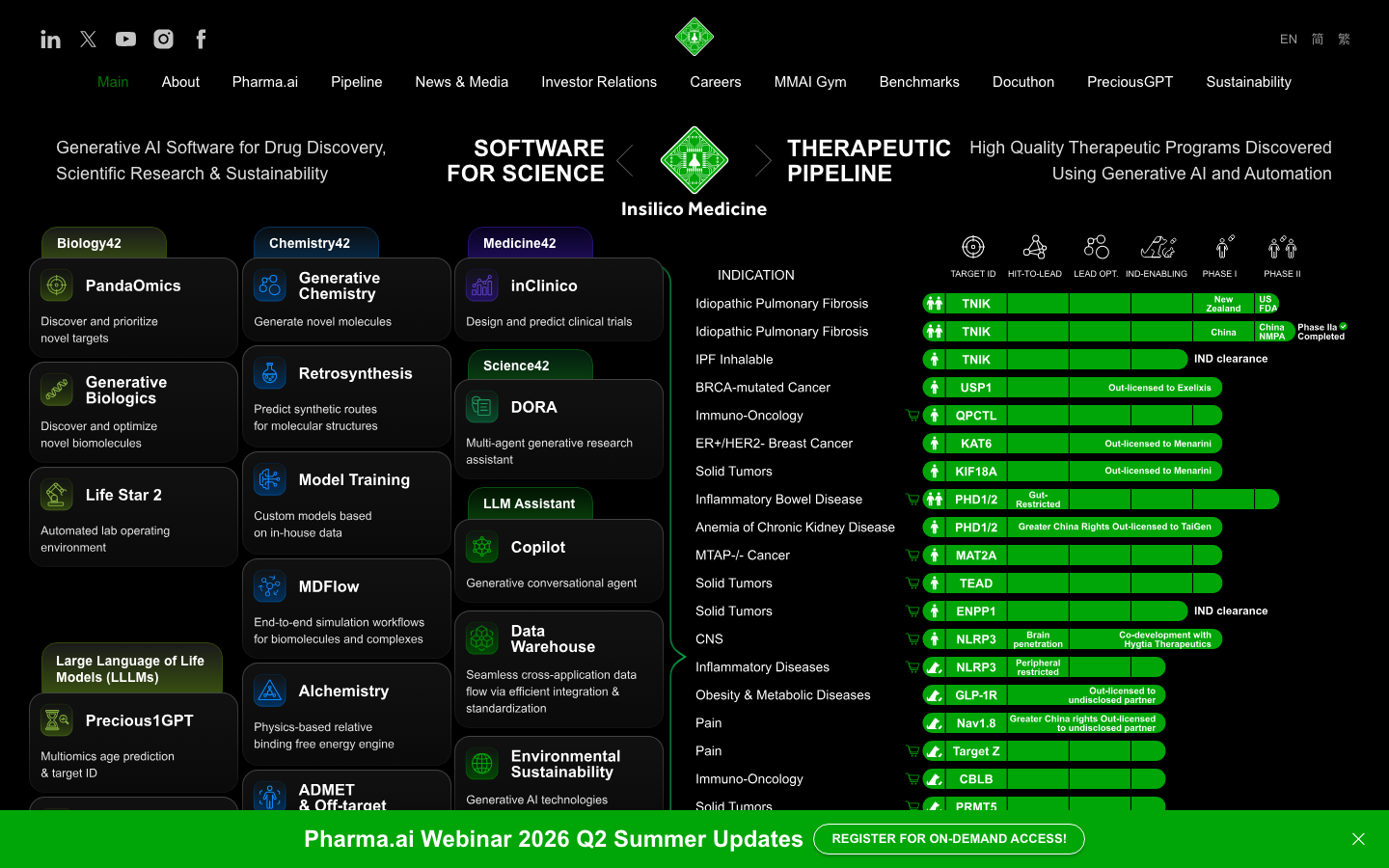
Insilico Medicine tool text
Core parameters and statistics
| Parameter items | Public information |
|---|---|
| Product Positioning | End-to-end AI-driven drug discovery and development platform |
| Core platform | Pharma.ai (including PandaOmics, Chemistry42, inClinico, etc.) |
| Listing Information | Hong Kong Exchange Listing |
| Flagship pipeline | Rentosertib (ISM001-055) - IPF indication, has entered Phase III clinical trials |
| Top Partnerships | Eli Lilly ($2.75B), Takeda, SK Biopharm ($2.5B), Sanofi |
| 2026 H1 results | Profit warning (positive profit) |
| Global Offices | Hong Kong, Boston, Shanghai, Abu Dhabi |
| Established | 2014 |
| Founder | Alex Zhavoronkov |
| Industry Honors | Fast Company's 2024 World's Most Innovative Biotech Companies |
Insilico Medicine is one of the few companies in the field of AI pharmaceuticals that possesses the three elements of "full platform technology + own clinical pipeline + cooperation with top multinational pharmaceutical companies". In 2026, the path of its flagship drug Rentosertib from AI discovery to Phase III clinical trials verified the feasibility of the end-to-end AI drug discovery model, and at the same time achieved commercial monetization through cooperation with giants such as Eli Lilly and Takeda.
User and market recognition
- Phase III clinical milestone: Rentosertib (ISM001-055, for the treatment of idiopathic pulmonary fibrosis IPF) is Insilico's core pipeline asset. The drug is entirely driven by the Pharma.ai platform from AI target discovery (PandaOmics) to AI molecular design (Chemistry42). Phase III clinical trials will be launched in July 2026. It is one of the leading pipelines discovered by AI platforms and entering Phase III clinical trials in the world.
- Eli Lilly $2.75B strategic cooperation: In March 2026, Eli Lilly signed a global R&D cooperation agreement with Insilico, with an initial payment of US$115 million and a total potential value of US$2.75 billion. The collaboration focuses on developing oral therapeutics using the Pharma.ai platform. This is one of the largest single collaborations in AI pharmaceuticals and the highest level of commercial validation of Insilico’s technical capabilities.
- Top pharmaceutical company cooperation network: In addition to Lilly, many top pharmaceutical companies such as Takeda (announced cooperation in July 2026), SK Biopharmaceuticals ($2.5B cooperation, focusing on neuroimmune diseases), Sanofi and other top pharmaceutical companies have established R&D cooperation with Insilico. Partners cover Asia, Europe and North America.
- Academic Impact: Insilico has published a large number of AI drug discovery-related papers in top journals such as Nature Reviews Drug Discovery, ACS Central Science, and Nature Communications. The "Prompt-to-Drug" concept co-proposed with Lilly was published in ACS Central Science, describing the vision of fully autonomous AI drug development.
- Institutional Recognition: Fast Company names Insilico a 2024 World's Most Innovative Biotechnology Company.
Cost advantage
C-side/Individual: Not applicable. Insilico does not provide products or services to individuals.
Developers/API: The Pharma.ai platform does not open API access to independent developers. Academics may gain partial access to the platform through collaborative research agreements. For researchers in computational chemistry and bioinformatics, some of the papers and codes published by Insilico provide reference technical paths.
Enterprise/Private: Pharma.ai is used by pharmaceutical companies through strategic partnerships or platform licensing models. The cooperation framework includes: pay-per-project platform access (AI analysis services for specific targets or disease areas), end-to-end pipeline collaboration (co-development of drug candidates for specific indications, usually including an upfront payment + milestone + sales share), and platform technology licensing (such as per-seat or per-project licenses for Chemistry42). The $2.75B collaboration with Eli Lilly is a classic example of end-to-end pipeline collaboration. Enterprises need to verify before cooperation: the historical prediction accuracy of the Pharma.ai platform in the target disease field, the terms of cooperation IP and data usage rights, and technology transfer and knowledge handover plans.
Main functions
- PandaOmics (target discovery): Integrate multi-omics data (genome, transcriptome, proteome, epigenome) and literature mining, and use deep learning and knowledge graphs to discover new targets related to diseases. Supports disease-target-drug association analysis, target drugability assessment and prioritization. The TargetPro-TargetBench framework, launched in March 2026, provides a standardized target validation benchmark.
- Chemistry42 (Generative Chemistry): A molecular design platform based on generative AI (GANs, reinforcement learning Transformer). Enter target structure or pharmacophore constraints and automatically generate new molecular structures with desired pharmacological properties. Supports multi-parameter optimization (activity, selectivity ADMET, synthesizability), and can simultaneously optimize molecular properties in 10+ dimensions. Several molecules designed through Chemistry42 have entered the clinic.
- inClinico (clinical trial prediction): AI predicts the probability of success of drug candidates after they enter clinical trials. Integrate multi-source data such as disease biology, pharmacology, and clinical trial design to output transition probability estimates from Phase II to Phase III. Assist pharmaceutical companies in screening high-risk projects at the preclinical stage.
- Generative Biologics: Use AI to design macromolecule drugs such as antibodies and fusion proteins. Starting from target epitope information, macromolecule candidates with optimized affinity and exploitability are generated.
- PandaClaw & LabClaw (Agentic AI + Automation Laboratory): The newly launched AI agent platform (PandaClaw) in 2026 can independently design experimental plans, analyze results, and propose the next round of hypotheses. LabClaw is an intelligent laboratory system that connects AI decision-making with automated experimental hardware to realize the integration of "AI design-robotic experiment".
Model and version evolution
Main line milestones
- 2014 — Insilico Medicine Founded: Alex Zhavoronkov founded the company in Hong Kong.
- 2016 — Started applying generative AI: One of the first teams to apply GAN (Generative Adversarial Network) to molecule generation.
- 2020 — Chemistry42 Release: The generative chemistry platform is officially launched and becomes one of Insilico’s core products.
- 2021 — First AI candidate molecule enters clinical trials: Rentosertib becomes Insilico’s first drug candidate fully discovered by AI and entered clinical trials.
- 2023 — Pharma.ai v4.0: Integrate inClinico clinical trial prediction module, the platform covers target discovery to clinical prediction.
- 2024 — Fast Company Innovative Company of the Year: Named the world’s most innovative biotech company.
- March 2026 — Eli Lilly $2.75B Cooperation: Signed the largest cooperation with Lilly, and released the "Prompt-to-Drug" concept paper at the same time.
- June 2026 — PandaClaw & LabClaw released: Agentic AI + automated experiment platform is online.
- July 2026 — Phase III launch of Rentosertib: The world's leading AI-discovered drug enters Phase III clinical trials.
Technical advantages
- Mechanism - Effect - Scenario: Insilico's technology chain covers the three areas of "target discovery (AI infers causality) -> molecule generation (generative AI explores chemical space) -> clinical prediction (ML assesses success rate)". Take Rentosertib as an example: PandaOmics identified TNIK (Traf2- and Nck-interacting kinase) as a key driving target of fibrosis by analyzing omics data of IPF patients; Chemistry42 generated thousands of candidate molecules under the constraints of the active site of TNIK and screened out ISM001-055 through multi-parameter optimization; this molecule has demonstrated lung function improvement in preclinical models and Phase IIa clinical trials. Effectively, it takes about 18 months from target discovery to clinical candidate compound (PCC), while traditional methods usually take 3-5 years. Applicable scenarios: complex diseases (fibrosis, neurodegenerative diseases, rare diseases) that lack clear drug targets, as well as new drug projects that need to quickly find lead compounds.
- A deep combination of generative AI and reinforcement learning: Chemistry42 uses generative adversarial networks (GANs) and reinforcement learning (RL) to navigate chemical space. GANs are responsible for generating new molecules with desired properties, and RL is responsible for optimizing multidimensional properties (activity, DMPK selectivity, toxicity) among millions of candidate molecules. This combination allows the algorithm to explore chemical space of more than 10^30 molecules in a very short time.
- "Prompt-to-Drug" Autonomous Drug Discovery: Conceptual framework co-proposed with Lilly describing a fully autonomous AI pipeline from input disease description ("Prompt") to output clinical candidate compounds. Although it is still far from being fully realized, it reflects Insilico’s technical vision and architectural direction for the ultimate form of AI pharmaceuticals.
- Cross-modal data integration: The Pharma.ai platform integrates more than ten data modalities such as genomics, transcriptomics, proteomics, chemical structure, clinical trial data, and medical literature. Cross-modal feature alignment and knowledge fusion are core technical challenges of the platform
and barriers to competition.
How to use
- Web client: You can use it by visiting the official website and registering an account. Most functions do not require installation.
- API access: Provides RESTful API, developers can obtain the API Key and integrate it into their own applications.
Product Pricing
Insilico does not offer standard pricing and its business model is based on pipeline value and partnership revenue:
- Owned Pipeline: The value of owned pipelines such as Rentosertib will be realized through future commercialization, and expected pricing is not disclosed.
- Down payment for cooperation: The down payment for large-scale cooperation is usually in the tens of millions to hundreds of millions of dollars (such as Lilly's $115 million down payment).
- R&D and commercial milestones: Phased payments for cooperation pipelines, such as triggered payments at nodes such as entering clinical trials and being approved for marketing.
- Sales Share: Share of net sales of a commercialized product (usually high single digits to low double digits percentage).
- Platform License Fee: Fixed annual fee for a limited-term platform license (undisclosed price level).
Application scenarios
- Drug Discovery in Fibrotic Diseases: Insilico’s success in IPF demonstrates the effectiveness of AI target discovery in the field of fibrosis. Rentosertib's journey from target discovery to Phase III clinical trials provides an "AI first" model for the fibrosis track. Deduction: TNIK, a new target discovered by AI, has not previously received sufficient attention from the pharmaceutical industry in the field of IPF, indicating that AI can discover disease drivers from omics data that human experts have ignored.
- Molecular design of difficult-to-drug targets (such as KRAS): Insilico's pan-KRAS inhibitor ISM6166 has demonstrated preclinical inhibition of "undruggable" KRAS-mutated tumors. Chemistry42's generative chemistry can start from protein structures to generate novel molecular scaffolds targeting flat binding sites, a typical feature of KRAS. Traditional medicinal chemistry approaches have made slow progress on such targets.
- Aging and Longevity Research: Through PreciousGPT (a fundamental model of aging) and the Longevity Board, Insilico is applying AI drug discovery to aging-related diseases. The industry's first longevity science AI foundation model, developed in partnership with Human Longevity, explores the discovery of new targets for therapeutic intervention from the biology of aging.
Applicable people
- R&D and business development teams at large pharmaceutical companies: Acquire AI-driven target discovery and molecular design capabilities to accelerate internal pipelines through collaboration with Insilico. Prerequisites: Partners must have internal capabilities in target validation and clinical development.
- Biotech company's management team: Leverage Insilico's AI platform to accelerate the process from target to PCC, reducing the time and cost of early-stage R&D. Not applicable: Small virtual biotech companies lacking target validation and in vitro/in vivo experimental capabilities.
- Researchers in the field of AI drug discovery: The papers and technical reports published by Insilico (such as TargetPro-TargetBench, Prompt-to-Drug) provide valuable references for the academic community. But it is different from using the platform directly.
Unfit boundary: Insilico’s platform does not provide standardized APIs or self-service SaaS services; for optimization projects with clear targets and mature lead compounds, traditional medicinal chemistry methods may be faster; candidate molecules predicted by AI still require extensive experimental verification in terms of synthetic feasibility, in vivo efficacy and safety, and no experimental steps can be skipped.
Summary and Outlook
Insilico Medicine has established leadership in end-to-end AI drug discovery through the Pharma.ai platform and clinical advancement of Rentosertib. Top-level cooperation with Eli Lilly and Takeda and a positive profit warning for the first half of 2026 indicate that its technical capabilities have been fully verified by the market and industry. The complete process from target discovery to phase III clinical trials proves the feasibility of "AI first" drug discovery from concept to reality.
Current limitations and uncertainties: Rentosertib Phase III clinical results have not yet been unblinded, and the final clinical value of AI-discovered drugs has not yet been fully verified; the prediction accuracy of the Pharma.ai platform in different disease areas requires more data accumulation; fluctuations in the overall valuation of the AI pharmaceutical industry may affect Insilico's capital market performance and financing capabilities. Potential partners should clarify the ownership of intellectual property rights (especially ownership of AI-generated molecules), data usage terms, and final commercialization rights distribution plan before signing an agreement.
Related tools:  Hugging Face, replicate
How to use Insilico Medicine
Pharma.ai is for internal and partner use and does not provide public self-service registration:
- Internal R&D: Insilico’s scientific team uses Pharma.ai for target discovery, molecular design and clinical prediction of its own pipeline.
- Corporate Cooperation: Pharmaceutical companies access Pharma.ai through cooperative development agreements. Partners propose disease areas and needs, and the Insilico team runs analyzes on the platform and delivers target recommendations or candidate molecules.
- Platform License: Some modules (such as Chemistry42) can be licensed to partner scientists for direct use through a limited-term platform license (training and support required).
- Academic collaboration: Academics access some of the platform’s capabilities through joint research projects, usually focusing on target discovery or molecular design validation for specific diseases.
Version Info
- Pharma.ai 2026 Q2 Update :Added PandaClaw (Agentic AI biology platform), LabClaw (intelligent laboratory system), and generative biology module upgrades. There is no official precise date yet.
- pharma.love 2025 :Integrate PreciousGPT (AI for aging research) and add Science42:DORA (generative research and development assistance). There is no official precise date yet.
- Pharma.ai v4.0 :Chemistry42's ability to generate chemicals has been significantly upgraded, and the inClinico clinical trial prediction module has been launched. There is no official precise date yet.
User Reviews