 Instrumental
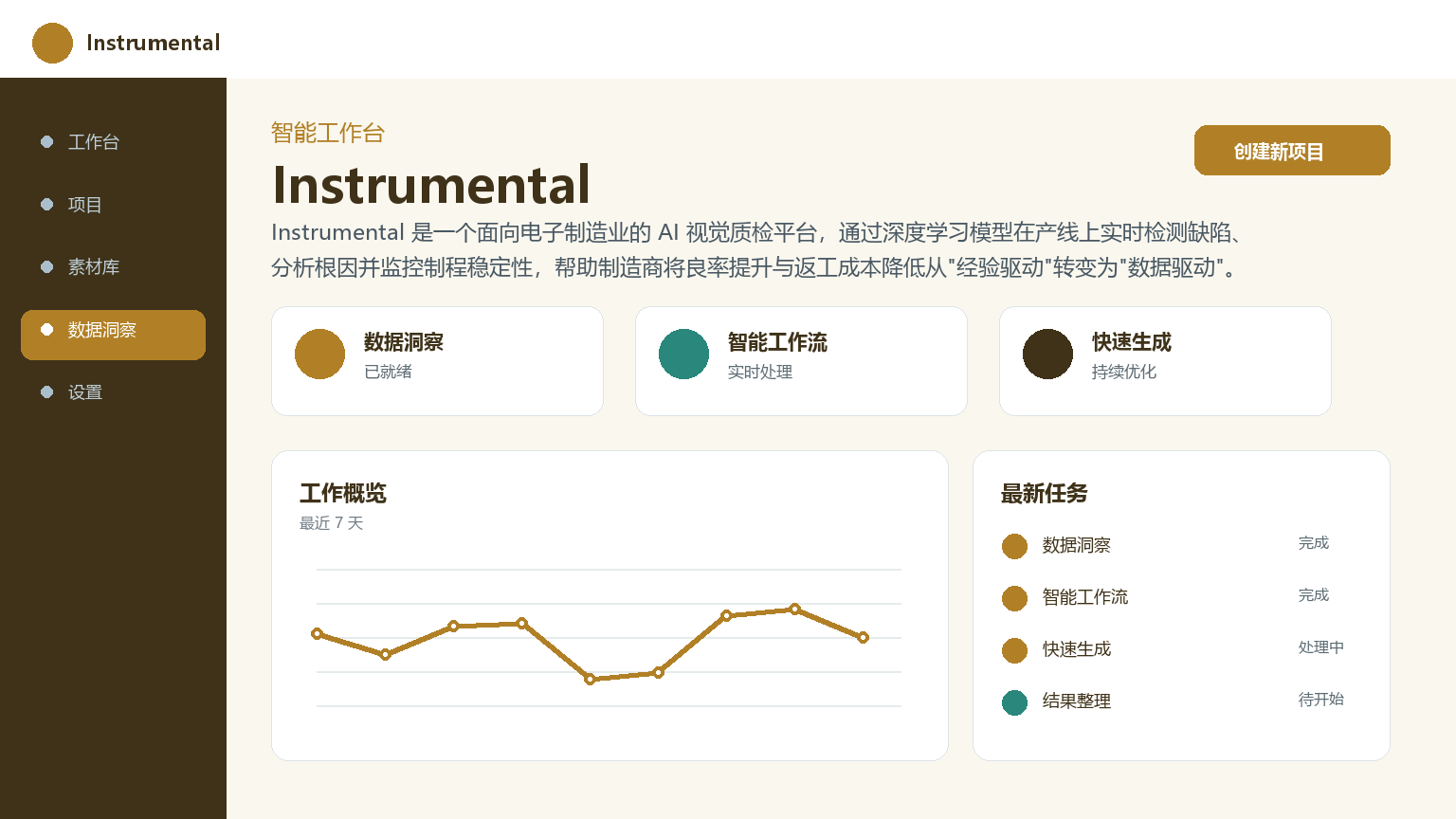
Instrumental is an AI visual quality inspection platform for the electronics manufacturing industry. It uses deep learning models to detect defects in real time on the production line, analyze root causes and monitor process stability, helping manufacturers transform yield improvement and rework cost reduction from "experience-driven" to "data-driven".
In-depth review of Instrumental: How AI can evolve electronic manufacturing quality inspection from "spot inspection" to "full inspection"
Core parameters and statistics
| Project | Specifications |
|---|---|
| Product Positioning | Electronic Manufacturing AI Visual Inspection Platform (AI Visual Inspection Platform) |
| Core Technology | Deep Learning Computer Vision Model (CNN + Anomaly Detection) |
| Target Industries | Electronics manufacturing, consumer electronics OEM, PCB assembly, semiconductor packaging, automotive electronics |
| Deployment Mode | Cloud SaaS + Local Edge Inference |
| Detection Capabilities | Real-time defect detection, root cause analysis, process monitoring, yield analysis |
| Founder/CEO | Anna-Katrina Shedletsky (former Apple product design engineer) |
| Headquarters | Mountain View, California, USA |
| Investors | First Round Capital, Root Ventures, E14 Fund, Bloomberg Beta, etc. |
| Cumulative Funding | ~$21M (Series A as of 2021) |
| Latest version | Instrumental Platform — 2026.0 |
| Pricing Model | Contact Business for a quote |
| Support Form | SaaS + Edge Deployment |
Instrumental does not belong to the category of "AI image generation" or "AI design tools". It is an AI quality inspection and yield optimization platform for electronic manufacturing production lines. Its core value lies in upgrading the traditional quality inspection process that relies on manual visual inspection and rule-based AOI (automatic optical inspection) to a deep learning-driven "real-time full inspection + automatic root cause analysis" system.
User and market recognition
- Founder’s background forms natural trust endorsement: CEO Anna-Katrina Shedletsky once worked as a product design engineer at Apple, was deeply involved in the manufacturing and quality inspection process of iPhone, and has personal experience of "late discovery of defects, high rework costs, and difficulty in locating root causes" in the electronics manufacturing industry. This background makes Instrumental's product designs a natural fit for the real pain points of electronics manufacturing.
- Co-investment by top venture capital investors: First Round Capital (early investors in Uber and Square), Root Ventures (focused on industrial deep technology), E14 Fund (MIT-affiliated fund) and Bloomberg Beta’s co-investment shows that the capital market recognizes the "AI + advanced manufacturing" track.
- Actual deployment in the electronics manufacturing industry: Instrumental has been adopted by many electronics manufacturing OEMs and EMS (electronic manufacturing services) manufacturers, covering consumer electronics, automotive electronics PCB assembly and other fields. The product has clear and quantifiable customer cases in improving First Pass Yield (FPY) and reducing rework costs.
- Industry events and technology sharing: The company frequently appears at industry conferences such as IPC (International Electronic Industry Connectivity Association) and SMTA (Surface Mount Technology Association), and publishes a large amount of technical content on "AI quality inspection and manufacturing yield" on its blog, establishing a professional voice in the field of electronic manufacturing AI.
Cost advantage
C-side/individual
Instrumental is not intended for individual users and does not offer a personal version or free subscription. Its products are intended for entire production lines or factory-level deployment of electronic manufacturing companies, and cannot be purchased individually by individuals or small studios.
Developer/API
The platform provides API interfaces for system integration, but APIs are not sold independently, but as an authorized component of the enterprise platform. Developers need to obtain an enterprise account before they can call the API for data access, callback of test results, or connection with MES (Manufacturing Execution System). The detailed documentation and call restrictions of the API must be obtained through official channels, and there is no public Token pricing.
Enterprise/Privatization
Instrumental's pricing is a typical enterprise-level SaaS + edge deployment model. Please contact the sales team for pricing. The following are typical dimensions that affect pricing:
- Production line scale: The number of production lines, the number of work stations, and the frequency of inspections that need to be connected directly affect the computing resources and model deployment complexity.
- Deployment Formats: Pure cloud SaaS versus hybrid deployment with edge inference nodes, which involves hardware costs and on-site implementation fees.
- Functional modules: Core AI detection models, root cause analysis engines, process monitoring dashboards, historical data tracing and other modules may be authorized in layers.
- Data storage period: The length of time that product images and inspection results need to be stored (for subsequent analysis and model iteration) affects storage costs.
Purchase Suggestion: Since there is no public price list, companies should confirm before purchasing: (1) whether the training and updating of the AI model is included in the annual fee, or billed on a per-time basis; (2) whether it supports overlay deployment on existing AOI equipment, or it must be equipped with Instrumental's dedicated hardware; (3) data privacy and compliance terms, especially the ownership of product image data.
Hidden Costs:
- The AI model requires a certain amount of historical defect data as a training basis. The new production line introduction stage may require several weeks of data accumulation to achieve the optimal detection rate.
- Hardware procurement and IT operation and maintenance costs for edge inference nodes may exceed pure SaaS budgets.
- Model switching (such as switching from iPhone 15 to iPhone 16) requires model re-adaptation, and quality inspection efficiency may temporarily decrease during the transition period.
Main functions
- AI real-time defect detection: Based on the visual inspection model of deep convolutional neural network, product images are analyzed in real time at the production line station to automatically identify various appearance and functional defects such as scratches, dents, offsets, foreign objects, poor solder joints, and assembly dislocations. Different from the rule-based detection of traditional AOI, the AI model can handle "never-seen" defect forms and significantly reduce the missed detection rate.
- Intelligent Root Cause Analysis: Automatically associate detected defects to specific workstations, fixtures, operators, material batches and other dimensions, and automatically infer the most likely root cause through statistical analysis. Engineers can quickly locate the source of the problem along the chain analysis of "defect type → production line location → occurrence time → material batch" instead of manually troubleshooting one by one.
- Process Monitoring and Trend Warning: Track key quality indicators (such as pass rate, defect density, defect Pareto distribution) in real time, and automatically issue early warnings when there is a significant deviation in the indicators. Supports drill-down analysis by product model, production line, shift and other dimensions to help quality engineers intervene and make adjustments before the yield rate declines.
- Yield Analysis Dashboard: Provides an intuitive visual interface to display the overall yield trend of the production line, defect classification statistics, station-level CPK (process capability index) and other key quality indicators. Supports automatic generation of weekly/monthly quality reports, reducing engineers’ data collection workload.
- MES and equipment integration: Supports connection with mainstream manufacturing execution systems (MES) and enterprise resource planning systems (ERP), automatically obtains contextual data such as product BOM, process routes, work order information, etc., so that inspection results can be seamlessly linked with the production process. It also supports data integration with existing AOI/SPI devices.
Expert point of view
The real value of Instrumental lies in opening up the concept of "detection → analysis → improvement". In the traditional electronic manufacturing quality inspection process, AOI equipment can only answer "Does this product have defects?", and root cause analysis of defects requires quality engineers to spend hours or even days manually troubleshooting - viewing historical data of the same work station, comparing material batches, and checking fixture wear. Instrumental condenses this process into automated "defect discovery → dimension association → root cause inference", essentially turning quality management from "post-facto analysis" to "during the event". This capability is especially critical on high-speed electronics production lines, because every additional hour of defective product production increases the cost of rework exponentially.
Model and version evolution
Mainline release
- 2019 — Platform public release: Instrumental officially launched the AI visual quality inspection platform to the electronics manufacturing industry. The initial version focuses on real-time defect detection in consumer electronics assembly.
- August 2021 — Series A Financing and Product Acceleration: Announced the completion of a $20 million Series A round of financing, which will be used to expand the engineering team, accelerate product iteration and enter more vertical market segments (such as automotive electronics, semiconductor packaging).
- 2024 — Platform architecture upgrade: Reconstruct the core detection engine to enhance detection capabilities for complex backgrounds and highly reflective surfaces; launch a more intelligent root cause analysis module and introduce multi-dimensional correlation analysis.
- 2026.0 — Latest iteration: Continuously optimize the accuracy and inference speed of deep learning models, enhance pre-built integration capabilities with mainstream MES, and improve process monitoring and trend warning functions.
Version features
The evolution of Instrumental's version reflects the rhythm of "from general detection of consumer electronics → deep cultivation in vertical industries → platform expansion": in the early stage, consumer electronics assembly was used as the entry point to polish algorithm accuracy. In the mid-term, it accelerated its expansion to automotive electronics PCB and other subdivisions through financing. Recently, it strengthened the depth of integration with customers' existing systems through platform capabilities.
Technical advantages
Deep learning vs traditional AOI: Why AI is more suitable for modern electronics manufacturing
Traditional automatic optical inspection (AOI) relies on predefined rules and thresholds to determine defects, which works well for regular components with a single background. However, it faces three major challenges in modern electronic manufacturing: (1) The spacing between components on high-density PCBs is getting smaller and smaller, and the false alarm rate of traditional AOI is extremely high; (2) The diversity of surface treatments (mirror, frosted, gold-plated, solder mask) leads to frequent failures in fixed thresholds; (3) New types of defects (such as micro cracks, virtual welding, cold welding) lack historical rule templates. Instrumental's deep learning model is trained on a large number of images of good and defective products to automatically learn to distinguish the feature boundaries between "normal process fluctuations" and "real defects" without the need to manually write rules one by one.
Root cause analysis engine: from "knowing there is a problem" to "knowing where there is a problem"
Instrumental’s core differentiator is its root cause analysis capabilities. The system not only determines whether the product is qualified, but also automatically associates the defect event with the production context (station ID, fixture number, operator, material batch, ambient temperature and humidity, etc.), and infers the most likely root cause through statistical significance testing. For example, the system can automatically report: "Today's solder joint defect rate at SMT station 3 increased from 0.8% to 2.3%, and there is a strong correlation (p<0.01) with the replacement of fixture A" - this level of insight would require hours of manual analysis by senior quality engineers in a traditional AOI process.
Edge Reasoning: Low Latency + Data Sovereignty
Production line inspection is extremely sensitive to latency—if every inspection request requires uploading images to the cloud and waiting for inference results to be returned, the production line cycle time will be seriously affected. Instrumental's architecture supports the deployment of edge inference nodes at production line stations to complete real-time detection locally, and only upload detection results and abnormal images to the cloud for further analysis and model iteration. This design not only ensures production line rhythm, but also reduces cloud bandwidth and storage pressure.
Continuous learning and model adaptation
The manufacturing industry is characterized by rapid product iteration (consumer electronics models are usually changed once a year), and each model switch means that the "adaptation formula" of the quality inspection model needs to be updated. The continuous learning mechanism of the Instrumental platform allows the existing model to be fine-tuned using a small amount of image data of the new product after the new model is put into production without retraining from scratch. This significantly shortens the quality inspection model readiness cycle during the New Product Introduction (NPI) phase.
How to use
Deployment entry
Instrumental does not provide a public self-service registration entrance. The usage path is usually:
- Consultation and Assessment: Submit company information and demand description on the official website, and the Instrumental team will conduct assessment and arrange technical communication.
- PoC (Proof of Concept): Select a representative production line as a pilot. The Instrumental team accesses the production line image data and trains the initial model, which usually lasts 2-4 weeks.
- Model verification: Run the AI detection model on the pilot production line, conduct comparative evaluation with existing AOI or manual quality inspection, and verify key indicators such as accuracy, missed detection rate, and false alarm rate.
- Production line deployment: After passing the verification, deploy edge inference nodes (or deploy inference software on the customer's existing equipment) at each station of the target production line and officially go online.
- Continuous Optimization: After going online, the continuously generated detection data is used to continuously optimize the model accuracy, and at the same time, the root cause analysis dashboard is used to promote process improvement.
APIs and Integration
Instrumental provides REST API and SDK, supporting docking with the following systems:
- MES: Automatically obtain work order BOM and process route information
- ERP: Synchronize material, batch, supplier data
- AOI/SPI Device: Fusing existing optical inspection data into an AI analysis link
- Data Lake/Data Analysis Platform: Export test results and yield data for secondary analysis
API authentication methods and detailed endpoints need to be obtained after opening a corporate account.
Product Pricing
Instrumental's pricing is an enterprise-level non-public model. The following is a structure based on public information:
| Dimensions | Description |
|---|---|
| Free Trial | No public free version available, but PoC proof-of-concept model is supported |
| SaaS Subscription | Pricing based on production line quantity and inspection volume, business communication required |
| Edge Deployment | Add edge inference node hardware and operation and maintenance costs based on SaaS |
| Model Training | Initial model training may be included in the implementation fee, subsequent model updates need to confirm the billing method |
| Data Storage | The storage period of images and detection results affects the total cost |
| Technical Support | Typically included with standard support, premium SLA may cost extra |
Corporate procurement recommendations are detailed in "Summary and Outlook."
Application scenarios
- Consumer Electronics Assembly Quality Inspection: Assembly lines for mobile phones, tablets, laptops and other consumer electronics products. The AI model can detect appearance defects such as scratches on the casing, offset screen fit, improper button assembly, and bent interface pins, as well as assembly defects such as missing internal screws and missing cables. Typical benefits: Reduce the factory defective rate from hundreds of PPM to dozens of PPM levels, while increasing the detection rate from 70-80% of manual inspection to nearly 100%.
- PCB and SMT welding inspection: In SMT (surface mount) production lines, welding defects such as solder joint bridging, tin deficiency, offset, tombstones, and empty soldering are detected. The false positive rate of traditional AOI remains high on advanced packaging and high-density PCBs. Instrumental's AI model can significantly reduce the false positive rate (from 30-50% to less than 5%), significantly reducing the manual re-judgment workload caused by false positives. Typical benefits: Reduce the number of manual visual inspection personnel and improve the throughput rate of the production line.
- Automotive Electronics Quality Control: Automotive electronics has extremely high quality requirements (usually requiring zero-defect supply). Instrumental can be used to detect the welding quality, coating integrity and housing sealing of automotive electronic components such as ECUs (electronic control units), sensor modules, and power modules. Typical benefits: Meet automotive industry quality standards such as IATF 16949 and reduce the risk of recalls due to quality issues.
- Semiconductor package appearance inspection: There are cracks, burrs, pin deformations, plastic packaging defects, etc. in the chip package. The AI model can handle the detection of tiny defects under high-magnification microscopic images, replacing traditional manual microscopic visual inspection. Typical benefits: Improved packaging detection efficiency and consistency.
Applicable people
- Quality Engineer (QE): the most direct beneficiary. Instrumental's automatic root cause analysis function frees quality engineers from the inefficient work of "looking through data, manually doing Pareto analysis, and site-by-site inspections" and allows them to focus on the high-value work of "analyzing trends and formulating improvement plans."
- Manufacturing Engineer (ME): Understand the status of the production line in real time through the process monitoring dashboard, and intervene to adjust parameters immediately when the yield indicator deviates abnormally, instead of waiting until the quality report after the batch is completed to discover the problem.
- Production line managers: View the production line throughput rate, defect distribution and root cause analysis results in real time, make production scheduling adjustments and resource allocation decisions based on data, and reduce quality fluctuations caused by empiric judgment.
- NPI (New Product Introduction) Team: During the trial production phase of new products, Instrumental's rapid model adaptation capabilities help the NPI team accelerate the readiness of the quality inspection plan and shorten the transition period from trial production to mass production.
Not suitable for the crowd:
- Research teams who only need general image classification or object detection (Instrumental’s closed industrial quality inspection model does not allow custom network structures or training scripts).
- Highly flexible production lines with extremely large product types (tens of products per day) and extremely small batch sizes (tens of pieces) (the maintenance costs of frequent model switching may exceed the benefits).
- Factories that are deeply bound to specific AOI hardware manufacturers and have no intention of integration (If Instrumental's AI capabilities cannot be integrated with existing hardware, it will increase device complexity).
- Small electronics foundries with limited budgets and no data infrastructure (PoC to go-live implementation time and expense may be prohibitive).
Summary and Outlook
Instrumental's core competitiveness lies in the manufacturing quality management system formed by "AI real-time detection + automated root cause analysis + process monitoring". It unifies the three discrete tasks of traditional electronic manufacturing, which are AOI equipment, manual visual inspection, and manual analysis by quality engineers, into an intelligent platform, realizing end-to-end digitization from "defect discovery" to "root cause location" to "process improvement." The founder's practical experience accumulated from Apple's manufacturing frontline makes product design highly consistent with the real needs of the electronics manufacturing industry, rather than a generalized "AI vision" solution.
Current Limitations and Uncertainties:
- Pricing is completely opaque, and enterprise procurement needs to go through a complete chain of evaluation-PoC-business negotiation, which is not suitable for short-term and fast introduction needs.
- There are certain requirements for the customer's existing data infrastructure: a complete image acquisition system, production line network coverage and MES foundation are required, otherwise the implementation complexity will increase significantly.
- The model requires an adaptation period when introducing a new model. The yield index during the transition period may fluctuate temporarily, and the quality department needs to reserve a buffer for this.
- The support capabilities for non-English-speaking markets have not been disclosed, and there is uncertainty about localized services and channel coverage in the Asia-Pacific region.
- The product mainly focuses on electronic manufacturing, and its adaptability to other manufacturing industries (such as food, pharmaceuticals, and textiles) has not been verified.
Procurement/Adoption Risk Assessment: For electronic manufacturing companies considering introducing Instrumental, it is recommended to adopt the strategy of "single line verification and step-by-step promotion": (1) Select a typical production line (preferably a mature model with large output and stable quality) to conduct PoC to verify the accuracy, missed detection rate and false alarm rate of the AI detection model; (2) Clarify the authorization scope of each functional module, data ownership terms and billing method for model updates during the PoC stage; (3) Confirm the hardware compatibility and operation and maintenance support system of edge inference nodes to avoid promotion delays due to hardware adaptation issues; (4) Pay attention to the company's financing pace and product iteration frequency, and evaluate the stability of long-term cooperation. Overall, Instrumental has clear technical advantages in AI quality inspection scenarios for consumer electronics and automotive electronics. However, for small and medium-sized foundries that lack data infrastructure or have extremely frequent product model switching, ROI and implementation costs need to be more carefully evaluated.
Related tools: midjourney, stable-diffusion
Version Info
- Instrumental Platform :The continuously iterative AI visual quality inspection platform enhances real-time defect detection models, root cause analysis engines and process monitoring capabilities. There is no official precise date yet.
- Instrumental Public Launch :Instrumental officially launches AI visual quality inspection platform for the electronics manufacturing industry. There is no official precise date yet.
- Series A Platform Expansion :Completed Series A financing of US$20 million to accelerate product research and development and market expansion. There is no official precise date yet.
- 2024 Platform Update :Major updates to the platform, enhancing deep learning model capabilities and production line integration depth. There is no official precise date yet.
User Reviews