 Jasper
Jasper is an enterprise-level
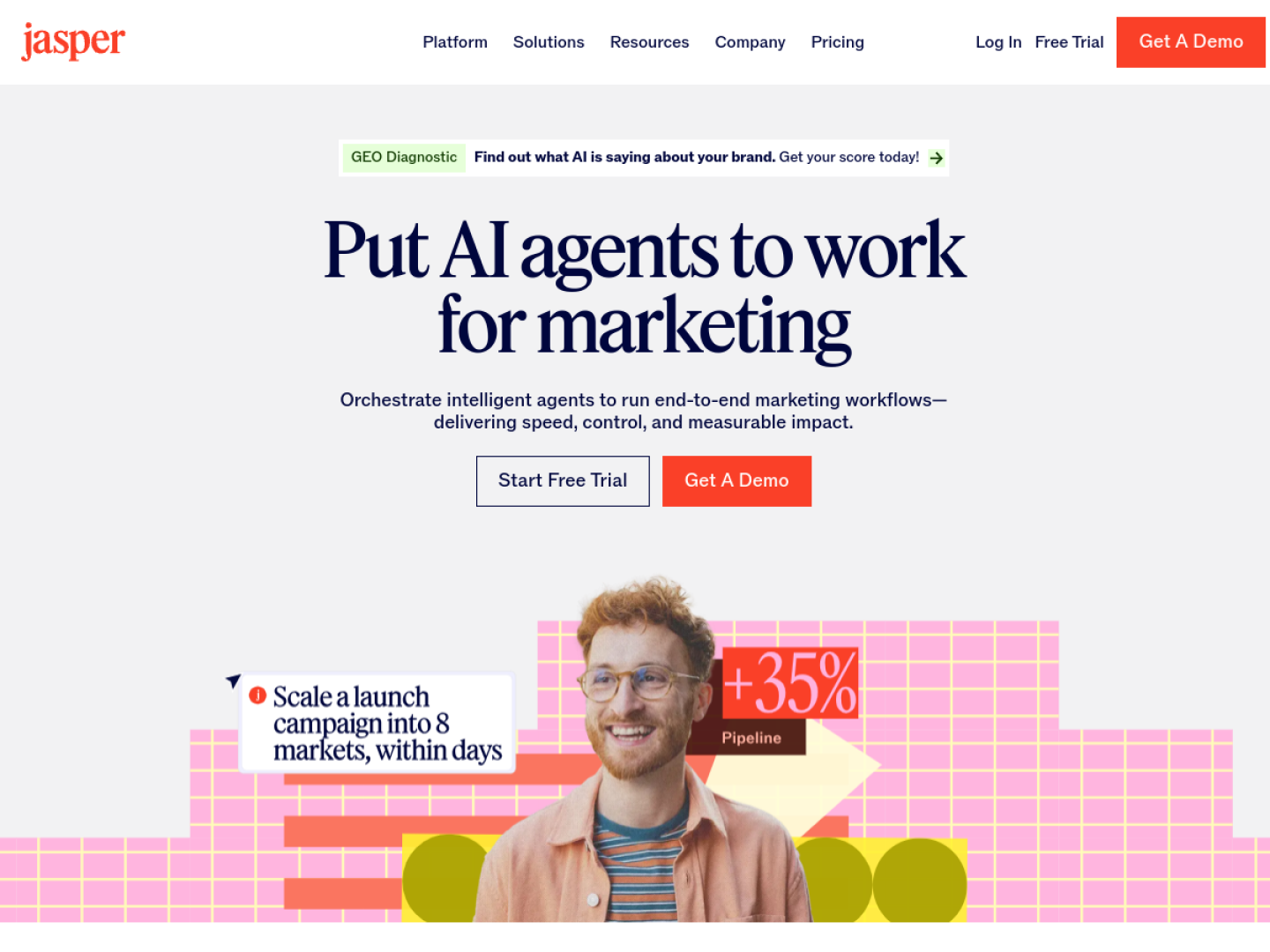
Jasper - In-depth tool analysis
Core parameters and statistics
Jasper's main delivery form is a web platform used directly by the marketing team, rather than a model API sold separately to developers, so the main type should be classified as Productivity/Business-side Application (Rule D). Agents, MCP, API, and Image API are all real secondary capabilities, but the core goal of their services is still to allow the marketing team to integrate brand management, content generation, channel distribution, and large-scale execution into one work surface.
| Projects | Public Information |
|---|---|
| Main type determination | Productivity/business application |
| Judgment basis | The main official website is externally described as “marketing agents platform” and “agent workspace built for modern marketing teams”. The main entrance is the marketing platform rather than the developer console |
| Secondary capabilities | Agents, Content Pipelines, Jasper IQ, Jasper Grid, Jasper MCP, Jasper APIs, Image APIs |
| Platform form | Web, API |
| Public pricing | Pro is $59/month/seat (annual payment basis); FAQ on the same page discloses monthly payment $69/month; Business is custom pricing |
| Public scale signal | The official website brand page writes 100k+ global customers, 5B+ words written by Jasper; the brand/news page also appears with nearly 20% of the Fortune 500 and 900+ enterprise customers and other calibers |
| Security and compliance standards | SOC 2, GDPR, SSO, SCIM, 99% uptime, customer data is not allowed to be trained by third-party models |
| Support language capabilities | The pricing page discloses 30+ languages, mainly refers to content generation and rewriting capabilities, which is not equivalent to the complete product interface localization scope |
A brief comment: Jasper is now more like the AI executive of a marketing organization, rather than the early writing assistant that "spits out copy after being given a prompt".
Promotion verification: The focus of its promotion is not "smarter models", but "making brand context, approval rules and scaled content execution work together." Judging from the public structure of the official website, this selling point is valid because Jasper puts Brand Voice, Style Guide, Knowledge, Governance, Grid, Canvas, and MCP on the same main product line instead of scattered into plug-in functions.
User and market recognition
Gradually build user awareness in the field, and product capabilities are used by content creators and teams to improve work efficiency. Some industry users have incorporated it into their daily workflow. It is recommended to refer to the latest official disclosures for specific user scale and industry adoption rate data.
Cost advantage
Jasper's cost structure has been clearly stratified. The public page can at least clearly see that "there is a personal trial entrance, but the real main battlefield is the enterprise version."
| Cost layer | Public information | True meaning |
|---|---|---|
| C-side/individual | Pro: $59/month/seat annual payment; FAQ written on the same page as monthly payment $69/month; includes 1 seat, Canvas, Essential Agents, 2 Brand Voices, 5 Knowledge assets, 3 Audiences, and 7-day trial entrance |
Can be used by individuals, but the upper limit of functions is obviously to guide you to team collaboration and business |
| Developer/API | Business only publicly includes API access; the official website does not disclose the independent API price per volume | Jasper is not a typical infrastructure product that "swipes the card first and then adjusts the API by token". Development and access are more of an extended capability after enterprise procurement |
| Enterprise/Team | Business is custom pricing, which publicly includes Advanced Agents, Jasper Grid, Unlimited IQ customization, API access, admin controls, priority support, secure deployment | The real big deal is seats, governance, training, process reconstruction and brand knowledge maintenance, not the superficial monthly fee |
Free truth: Jasper is not without low-threshold entry, but Pro’s 1 seat, 2 Brand Voices, 5 Knowledge assets, and 3 Audiences have clearly told you that this solution is more like a single person verification or a small team pilot, and is not suitable for directly moving in multi-brand, multi-market, and multi-department collaboration.
Hidden benefits/costs: If the team's main pain point now is "the same campaign brief is repeatedly copied and pasted between content SEO, social media, and localization", Jasper's benefits mainly come from reducing rework and brand review rounds; if the team does not even solidify brand rules, audience definitions, and content acceptance standards, Jasper will amplify internal chaos because AI will produce inconsistent content faster.
Quantitative deduction of cost reduction and efficiency improvement (unofficial commitment):
- For the content marketing team, the first draft of the blog + SEO rewriting + social media splitting can usually be compressed from the manual serial process of 4-6 hours to the "AI first generation, manual review" process of 60-120 minutes.
- For multi-market campaign teams, a single regional copywriting adaptation can be compressed from 2-3 weeks of cross-team round-trip to 2-3 days, provided that Brand Voice, Audience, and Style Guide have been configured.
Compliance and Risk: Business exposes APIs, governance, groups, and secure deployment, but this does not mean that all high-risk processes can be unattended. Manual confirmation points should still be retained when it comes to legal approvals, financial commitments, healthcare wording, public company disclosures, and content sent externally by high-value customers.
Main functions
Jasper's current product is no longer a single editor, but is divided into multiple capability layers around marketing execution. The most noteworthy thing is not the individual function points, but whether these layers can actually work in succession.
- Agents: The official website discloses
100+ specialized AI agents, which are subdivided into Optimization, Research, Translation, etc. Its real value is not in "being able to write", but in bringing SEO, research, and translation, which were originally separate tools, back into a unified platform. - Canvas and Content Pipelines: Canvas is responsible for putting campaign brief, research, generation, rewriting, translation, and export into the same visual space; Content Pipelines emphasize repeatability and scale. The former addresses contextual continuity during creation, and the latter addresses replicability during large-scale production.
- Jasper IQ: Includes Brand Voice, Style Guide, Visual Guidelines, Knowledge, and Audiences. It is the core bastion of Jasper because all subsequent builds, rewrite agent executions, and cross-tool output invoke this layer of brand context.
- Jasper Grid: The official website is defined as a no-code, spreadsheet-like system, used for 1:1 personalization, product description, global campaign, SEO/AEO/GEO and other large-scale content production. It corresponds to the "batch orchestration aspect" of marketing operations.
- MCP, API and Integrations: The developer documentation exposes the remote address of the Jasper MCP Server
https://mcp.jasper.aiand listsget-jasper-brand-voices,get-jasper-audiences,search-knowledge-base,get-jasper-style-guides,get-jasper-agents,run-jasper-agent,generate-contentand other tools. It allows Jasper’s brand context to be brought to external AI clients, rather than locking all work within Jasper’s own interface.
Hidden linkage: The real cool thing about Jasper is not "writing a copy faster", but the link Brand Voice / Knowledge -> Agent -> Canvas / Grid -> Export / API. Brand rules are first solidified at the IQ layer. Agent calls these rules to generate content, then expands the content into campaign assets through Canvas or Grid, and finally exports it to existing channels or external tools. What this solution reduces is not the 10 seconds of prompt input, but a lot of review, rework, and cross-post alignment time.
Not suitable for boundaries: If the team only occasionally writes a few paragraphs of advertising copy, without brand management, no multi-market collaboration, and no large-scale content needs, Jasper’s platform capabilities will appear to be too heavy.
Model and version evolution
Continuous iterative updates, the latest version introduces performance optimization and new features. Historical version information can be viewed on the official release page. There is no complete public version evolution timeline yet. It is recommended to pay attention to the official announcement to understand the rhythm of feature updates.
Technical advantages
Jasper's technical advantage lies not in "self-developed the most powerful model", but in how it combines multiple models, brand knowledge, marketing task templates and organizational governance into a more stable execution system.
Mechanism 1: LLM-optimized architecture. The pricing page clearly states that Jasper's AI Engine leverages several large language models, and calls this set of multi-model routing capabilities LLM-Optimized Architecture. It solves the problem of marketing teams not wanting to do model selection and maintenance themselves. The effect is to hide "model switching" at the platform layer, allowing the team to pay more attention to delivery quality and uptime.
Mechanism 2: Jasper IQ as governed context layer. Jasper officially describes Jasper IQ as the governed marketing decision surface embedding context, rules, and brand logic. In other words, IQ is not a material library, but turns brand caliber, style, audience and knowledge into callable rules. The effect is that the same brief is easier to maintain consistency in blogs, emails, landing pages, and localization.
Mechanism 3: Grid and Content Pipelines are responsible for structured scaling. Many AI tools seem fast in the demo stage, but get out of control once they reach mass production. Jasper Grid's spreadsheet-like system and Content Pipelines' repeatability design are essentially using structured input to constrain large-scale generation. The effect is that it is more suitable for high-volume tasks such as SKU copywriting, regional campaigns, and SEO page refresh.
Mechanism 4: MCP brings brand context to external AI tools. Jasper MCP is not another chat box, but exposes Brand Voice, Audience, Style Guide, Knowledge and Jasper agents as standardized tools to external clients. In this way, even if the team works in environments such as Claude, Copilot, OpenAI, etc., they do not have to completely lose the brand management layer.
Adaptation Boundary: Jasper's technical design is obviously biased towards "scaled execution by marketing organizations", and it is not suitable to use it as an underlying general model platform, nor is it suitable to use it to do long-tail knowledge work that has nothing to do with marketing.
How to use
The correct way to open Jasper is not to "buy accounts first and then explore", but to first run through a high-frequency marketing process, then complete the brand management layer, and then expand the scale.
- Build the IQ layer first: Prioritize the entry of Brand Voice, Style Guide, Audiences, and Knowledge. Without this step, Jasper will simply degenerate into a more expensive generic generator.
- Choose a single pilot scenario: Suitable for high-frequency and acceptable tasks such as blog production, campaign brief, email sequence, product description, and localization.
- Using Canvas to run and close: Complete research, create, transform, translate, and export on the same work surface to avoid the team still using Jasper to generate and then manually assemble it in other tools.
- Use Grid or Pipelines when batching: Only when the input structure is stable and the acceptance rules are clear can Grid truly exert its value at scale.
- Open MCP or API in cross-tool scenarios: If the team is already working in Claude, Copilot or a self-built agent, the brand context can be brought out through Jasper MCP. The official developer documentation discloses two typical configurations:
{
  "mcpServers": {
    "jasper": {
      "command": "npx",
      "args": ["-y", "@gojasper/mcp-server"],
      "env": {
        "JASPER_API_KEY": "<your-jasper-api-key>"
      }
    }
  }
}
from openai import OpenAI
client = OpenAI()
resp = client.responses.create(
model="gpt-4.1",
input="Create a tweet promoting Duolingo for students using my social media voice and a relevant target audience",
tools=[
{
"type": "mcp",
"server_label": "jasper",
"server_url": "https://mcp.jasper.ai",
"headers": {
"X-API-KEY": "$JASPER_API_KEY"
}
}
]
)
print(resp.output_text)Human-machine collaboration boundary:
- Can be highly automated: SEO rewriting, batch product descriptions, localization first draft, multi-channel draft removal, and content reorganization.
- Manual confirmation must be retained: brand crisis response, major PR caliber, financial or medical and other strong regulatory statements, external commitment-type sales materials, irreversible release actions.
Product Pricing
Jasper’s public pricing is not complicated, but when really budgeting, be aware that “the public unit price only covers a small portion of the total cost.”
| Plan | Public Price | Public Included Capabilities | Requires Continued Confirmation |
|---|---|---|---|
| Pro | $59/month/seat Annual payment standard; FAQ written on the same page monthly payment $69/month |
1 seat, Canvas, Essential Agents, 2 Brand Voices, 5 Knowledge assets, 3 Audiences, 7-day trial | Excess seats, more brand assets, team collaboration boundaries |
| Business | Custom pricing | Advanced Agents, Grid, Unlimited IQ, API access, admin controls, Groups, priority support, secure deployment | Minimum seats, contract duration SSO/SCIM, audit and enforcement services |
Public information: There are Pro, Business, Free trial, and Demo entrances; the public unit price and capacity limit of Pro are clear; Business requires sales.
Undisclosed information: API independent billing method, enterprise minimum purchase threshold, private/flexible deployment pricing details, implementation service fees. The above shall be subject to the official real-time page and business terms.
Purchasing Reminder: Jasper is more like "platform purchasing", not a simple SaaS point card. When budgeting, factor in brand knowledge maintenance, content management, training time, and refactoring of existing processes.
Application scenarios
The most suitable scenario for Jasper is not sporadic writing, but marketing tasks with "strong brand constraints, high output, and long delivery links."
- Global campaign production: When a brief needs to be split into multi-region, multi-channel, and multi-language assets, Jasper's combination of Brand Voice, Audience, Canvas, Translation, and Grid will be more convenient than a general chat tool. The benefit lies in reducing repeated cross-market alignments.
- SEO / AEO / GEO content optimization: The official website currently puts GEO & AI Optimization at the core and is equipped with GEO Diagnostic. Suitable for the content team to make old pages, rewrite FAQ, expand AI search, and enhance citation content. The focus of verification is whether the content can really increase citations, traffic and conversions, rather than just whether the copywriting is good-looking.
- Scale product descriptions and e-commerce content: The Grid page clearly displays high-volume scenarios ranging from
1,000 product descriptionsto50,000 personalized campaign emails. Suitable for teams with many SKUs, variants, and markets. - Brand Governance Content Collaboration: When legal, brand, content, and regional teams need to collaborate around the same set of style guides and approval logic, Jasper's governance layer makes more sense than a stand-alone writing tool.
Dimensionality reduction attack scenario: high-frequency campaigns, localized batch output SEO content refresh, corporate marketing teams with strict brand compliance requirements.
Not suitable for scenarios: one-time writing, purely creative experiments, temporary projects without standard materials and rules, and tasks that rely heavily on in-depth academic reasoning or general R&D collaboration.
Applicable people
Jasper's adaptability is highly related to whether the team has entered the "marketing process productization" stage.
- Content Marketing Leader: Suitable for people who need to manage blogs, SEO, newsletters, social media drafting and brand consistency at the same time. Jasper brings together generation speed and brand control.
- Brand and Market Operations Team: Suitable for organizations that already have clear brand voice, style guide, and audience segmentation, because Jasper IQ can directly consume these rules.
- Enterprise Marketing Operations and RevOps Team: When there is a need for contextual linkage with CRM, forms, automation platforms, and external agents, MCP, API, and integrations will be more valuable.
- Technical support team: If the marketing team needs to follow Jasper's brand rules in external AI clients, developers or platform teams can use MCP and API to complete the embedding.
Dissuaded/not applicable to people:
- A team that has no brand rules, no content acceptance criteria, and just wants to “try AI first”.
- Teams with small budgets who want direct access to multi-seat governance, auditing, and large-scale integration capabilities.
- People who purchase Jasper as a general enterprise search, pure code assistant or basic model platform.
Summary and Outlook
Jasper's core value has been upgraded from "AI can write quickly" to "how marketing organizations can execute at scale under brand constraints." What it is good at is not replacing the creative team, but integrating brand knowledge, generation capabilities, batch orchestration, cross-tool calls and corporate governance into a more stable execution chain. For teams that have entered multi-brand, multi-market, and multi-channel operations, it is closer to the real workflow than a general chat product.
Its boundaries are equally clear. Jasper is not the cheapest one-person writing tool, nor is it a universal model infrastructure, nor is it a fully automated system that can replace the judgment of a brand team with a single installation. Organizations without brand rules, content SOPs, or manual review mechanisms can easily turn platform procurement into expensive prompt warehouses.
Procurement/Adoption Risk Assessment: First, there is a time lag in the disclosure of customer size and number of companies on different official pages. When purchasing materials, the latest official page must be used as the standard. Second, the cost and implementation scope of the Business Terms API are not fully disclosed and must be verified during the business stage. Third, Jasper's ROI is highly dependent on whether the team has first configured Brand Voice, Knowledge, Audience, and approval boundaries. A more prudent way to adopt it is to first use Pro or a small-scale Business to pilot a high-frequency scenario to verify whether the review rounds, content rework rate and delivery cycle are substantially reduced, and then decide whether to expand to Grid, MCP and larger-scale organizational governance.
Related tools: notion-ai,  Jasper
Version Info
- Canvas + Agents + GEO platform stage :The official website currently uses Canvas, Agents, GEO & AI Optimization, Jasper IQ and MCP as the main public lines, and the unified product version number and precise release date have not been disclosed.
- Grid + MCP platform stage :The official website and developer documentation have disclosed Grid, MCP, API and enterprise governance capabilities, but have not provided a unified product version number and precise release date.
User Reviews