 Jenni
Free
Jenni
Free
Jenni is an
Jenni - In-Depth Tool Analysis
Core parameters and statistics
| Parameters | Public information |
|---|---|
| Tool type determination | Productivity/business applications |
| Judgment basis | The Web writing workspace directly serves researchers, editors and team collaboration. It does not provide independent API products to the outside world, nor is it a knowledge base base or automation framework |
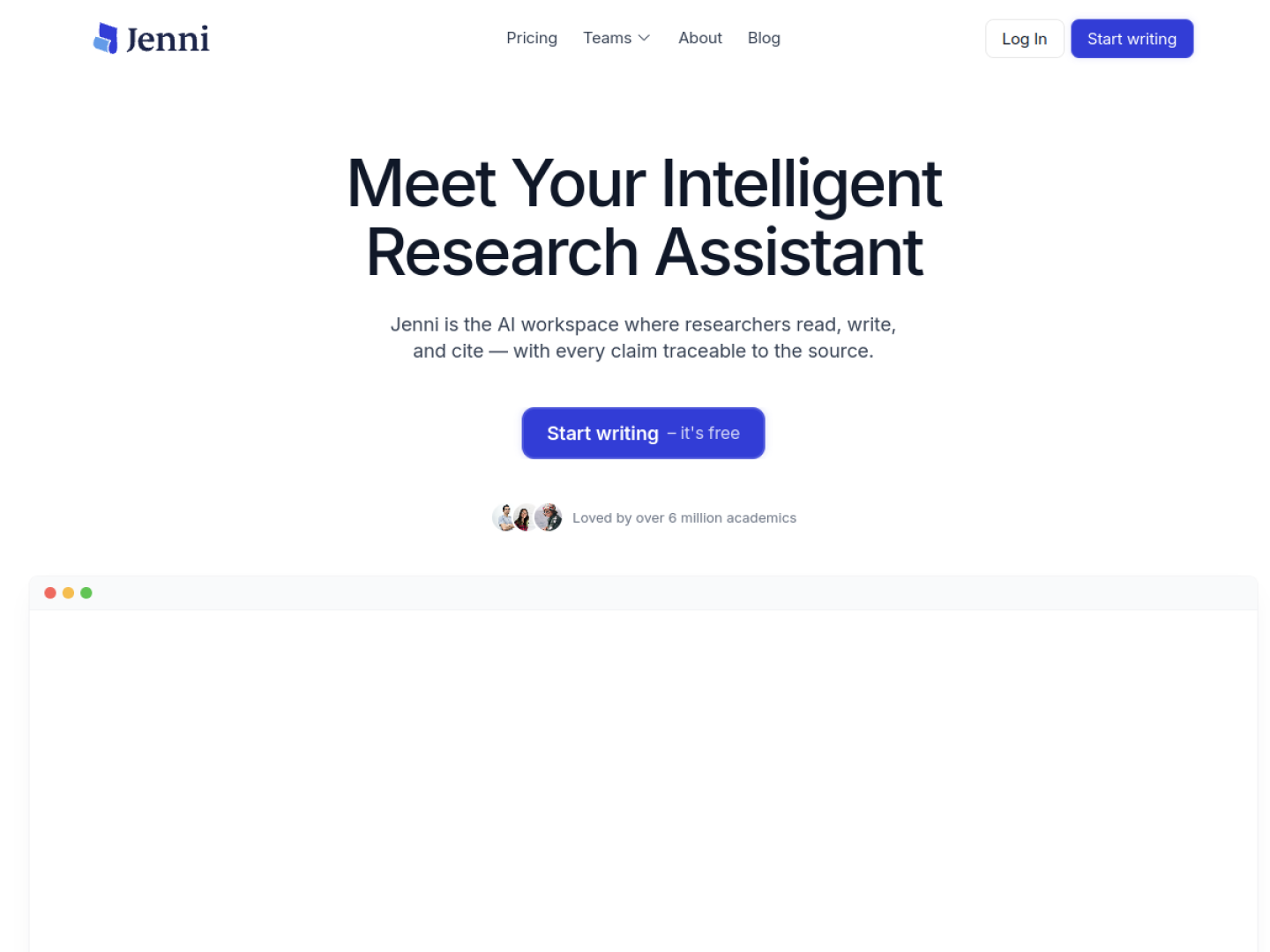
| Official positioning | AI workspace where researchers read, write, and cite |
| Platform form | Web |
| Supported languages | The official FAQ only publicly supports multilingual, and the specific language coverage is subject to the official real-time page |
| Home | US |
| Latest public version | Citation Localization, 2026-06-03 |
| Disclosure of scale signals | The home page of the official website states over 6 million academics; the pricing page states over 5 million empowered writers |
| Disclosure of efficiency signals | The official website states average 5.2 hours saved per paper |
| Academic data scale | 200M+ papers search, 10m+ full text Open Access papers, 2600+ citation styles |
Brief review in one sentence: Jenni is not a general chat box for all writing tasks, but an academic productivity application that puts document import, evidence tracking, citation formatting, and pre-peer review self-checking into the same research writing workspace.
Publicity Verification: Its core selling point is that “each AI-generated or rewritten suggestion can be traced back to a specific source.” This is not an abstract propaganda, but directly falls on the product capabilities of “claim links to the exact page and paragraph”, “AI that writes from your papers, not from the web” and “verify any claim against the original PDF”. What hits the mark is the most expensive part of real research writing: not writing sentences, but binding sentences and evidence.
User and market recognition
Public user size: Use "Loved by over 6 million academics" on the home page of the official website, and use "Join 5 million empowered writers" on the pricing page. The two calibers are not completely consistent, indicating that the scale signal can be used as a reference for popularity, but when making serious purchases, it is more suitable to regard it as "millions of academic writing users" rather than precise audit numbers.
Public scenario recognition: The official website displays usage scenarios such as Graduate students, PhD candidates, Universities & research labs, Pharma & medical, Policy & government analysts, Market research & consulting, etc., indicating that its main battlefield is not pan-content marketing, but serious writing tasks that "require citations, require evidence links, and require submission".
Result Signal: The official website discloses "published papers in 100+ journals" and "over 15m papers written on Jenni". The former is more worth watching, because it shows that the platform has at least formed a visible implementation on the paper delivery side; the latter is more like a usage indicator, suitable for judging activity, but not suitable for proving quality alone.
Word-of-mouth structure: The official page displays identity endorsements such as PhD, Senior Researcher, Editor-in-chief, etc., indicating that its communication focus is "improving the efficiency of scientific research workflow" and not "a low-threshold composition generator". This kind of word-of-mouth has reference value for universities and research teams, but it still cannot replace internal pilot verification.
Cost advantage
C Client/Individual: The free file has been released to the trial level, including 10 AI autocompletes per day, 10 PDF uploads, 3 AI edits, 5 AI chats, 3 Reviews, 2,600 citation styles, unlimited citations, and editor export. For students or authors of single papers, the free version is enough to judge "whether citation tracking and literature Q&A are really more convenient than general chat tools."
The free truth: The free file allows you to experience Jenni’s research workflow, but it is not a free plan that can “write a complete paper just by using it”. Autocomplete, AI chat, AI edits and Reviews all have hard quotas. Once they enter high-frequency revision, cross-chapter writing or large-volume PDF retrieval, users will soon encounter the upper limit difference between Plus or Pro.
Individual paid upgrade: Plus is US$12/month, which gives you 5000 autocompletes, unlimited PDF uploads, 500 AI edits, 500 AI chats, 10 Reviews and full document export; Pro is US$29/month, and the core AI quota and Reviews become unlimited. This price structure clearly divides users into two categories: occasional writing users are suitable to stay on Free or Plus first, while high-frequency paper authors, ghostwriting collaboration teams or intensive contributor groups have reason to go to Pro.
Developer/API: There is no official independent API, per-call billing or model billing page, so Jenni is not an infrastructure product for secondary packaging for the development team. For teams that want to embed academic writing capabilities into their own systems, the cost of this layer is not "whether it is expensive", but "there is currently no standardized procurement entrance."
Enterprise/Institution: The official website provides access to Teams & Institutions, but does not disclose seat prices, permission levels, compliance terms or SLA on the public page. If universities, research institutes, and medical teams want to make institutional purchases, their budgets cannot be extrapolated based on just $12 or $29 per month. The real costs also include account management, training, unified writing standards, and the connection between mentors and reviewers.
Hidden benefits/costs: The real time-saving point of Jenni is not to "write a paper with one click", but to integrate literature search PDF Q&A, citation formatting, and pre-review weakness troubleshooting into one window. For typical research writers, this can usually compress the steps of "finding evidence + inserting citations + manually checking the original text" from hours to dozens of minutes; conversely, if the team already uses Zotero, Word, Overleaf, and manual citation review as mature processes, migration and training are its hidden costs.
Quantitative deduction for cost reduction and efficiency improvement (unofficial commitment): For a course paper or journal draft of 3,000 to 8,000 words, if the original process requires 2 to 3 hours to complete the literature review, unified citation format, and preliminary logical polishing, Jenni’s more reasonable value range is to reduce this part to 30 to 60 minutes, rather than replacing the research design itself.
Main functions
- Literature Import and Database: Supports uploading PDFs, importing from Zotero or Mendeley, and allows assigning PDFs to specified collections when uploading, solving the most common problems of "scattered data and too many context switches" in research writing.
- Literature-based AI autocomplete: Officially emphasizes that autocomplete can draw exclusively from your curated library, not generic training data. This means that its generation is not a blind guess, but gives priority to the output of the user-selected literature library, suitable for writing literature reviews, discussions and evidence-backed summaries.
- Locatable citation links: Each claim can be linked to exact page and paragraph. With 2600+ citation styles and inline citations, "generating a sentence" and "finding evidence for this sentence" are combined into one thing.
- Cross-document Q&A and research assistant: AI chat can read the entire library of literature and answer questions about methods, findings, or concept comparisons. It is suitable for screening a round of materials when doing literature review and research design.
- Reviews pre-review self-check: New Reviews in 2026 will give in-line feedback from categories such as claim confidence, misrepresented, unsupported, overstated, proofread, etc., which is closer to "pre-review before submission" than ordinary grammatical polishing.
- Collaboration and Version History: Supports real-time collaboration comments, suggest edits and version history, indicating that it has been extended from a single writer to a common workspace among tutors, collaborators and editors.
Expert opinion: The most valuable thing about Jenni is not an isolated function, but the combination of "import documents -> let AI write only from these documents -> directly insert references -> then use Reviews to check for argument loopholes". This problem ties together the three things that are most likely to be reworked in research writing: the first draft often has no evidence chain, the citation typesetting often explodes before submission, and the feedback from the supervisor or editor often comes too late. Jenni moves these rework points forward into the writing process, which is its hidden linkage with general chat tools.
Model and version evolution
Jenni does not disclose a semantic version number system, but is more like a continuous online version based on function nodes. What is more meaningful to users is not chasing the version number, but seeing which main product line it has strengthened in the past year.
2026 Public Milestones
- 2026-06-03 Citation Localization: Added complete citation localization support and specified collection for PDF during the upload process. This update shows that Jenni is strengthening both the "citation management" and "database organization" ends, rather than just doing the superficial writing experience.
- 2026-05-20 Table Captions: Allowing tables and titles to move synchronously is an optimization of typical paper layout details, indicating that the product begins to cover the structural elements in the officially delivered manuscript.
- 2026-05-06 Peer Review: Provides simulated peer review and inline feedback, which means Jenni begins to extend from "writing assistant" to "pre-submission quality control".
- 2026-04-22 Tone of Voice Review: Supports reviewing tone consistency based on presets or custom tones in the thesis library, suitable for thesis or multiple people to co-write manuscripts.
- 2026-04-08 Smart LaTeX Equations: Supports generating LaTeX by describing or uploading equation images, obviously targeting STEM research writing scenarios.
Version Trend Judgment: The direction of updates in 2026 is very concentrated, almost all around "a more verifiable evidence chain, a more formal paper structure, and closer to pre-submission review". This shows that Jenni is not expanding into a general writing platform, but continuing to strengthen the vertical workflow of academic writing.
Technical advantages
Mechanism 1: Library constrained generation: Turn user-uploaded PDFs, Zotero and Mendeley collections into generation contexts. The effect is that AI suggestions are closer to "evidence-based drafts" rather than general corpus continuations. Applicable scenarios are literature review, related work, policy brief and other long articles that require citing references.
Mechanism 2: Position the citation to the page number and paragraph: Not only gives the citation, but also points the claim to the original text position. The effect is that researchers can check with one click without having to manually search for passages in the PDF. Applicable scenarios are tutor review, pre-submission checking, medical and policy manuscripts, tasks that cannot tolerate misrepresentation.
Mechanism 3: Reviews are pre-reviewed by machine: Before formally submitting to tutors, collaborators or journals, scan them with tags such as unsupported, contradicted, and overstated. The effect is to expose many problems that were “not paid attention to during writing and exposed only during review” in advance. The applicable scenarios are systematic review of the first draft of the paper and academic manuscripts that require multiple rounds of review.
Mechanism 4: Complete retrieval, writing, and collaboration in the same workspace: Document search AI chat, comments, and version history are all in one interface, reducing jumping back and forth between Word, browsers, document managers, and chat tools. For a single author, it saves switching costs, and for a team, it keeps the context in a unified space.
Capability Boundary: The official FAQ mentions "Which AI models does Jenni use," but the current publicly crawled content does not give a clear list of models, so it should not be written as a basic capability selling point "based on a certain large model". Its differentiation lies more in workflow design than underlying model branding.
How to use
- After registering on the web, first import a set of real documents, and give priority to a course paper, proposal report, or manuscript that is being revised as a pilot, instead of using a blank document to test the writing style.
- Upload the PDF to Zotero or Mendeley and import it to create the current project database, and then use collections to archive documents on the same research question.
- Use AI autocomplete, AI chat, and inline citations to complete the outline, paragraph expansion, and evidence insertion in the document, and then click on the page number and paragraph corresponding to the claim one by one for verification.
- Run Reviews to check unsupported, misrepresented, overstated, and proofread suggestions before handing them over to your mentor, editor, or collaborator, and manually decide which changes are accepted.
- Export to .docx, LaTeX or HTML when formal delivery is required; if the target journal or school has strict templates, it is still recommended to do a final round of format review with an external tool.
Boundary of human-machine collaboration: Literature sorting, first draft writing, citation formatting, and first round of weakness checking can be highly automated; research problem definition, experimental design, final conclusion expression, ethics and academic standards responsibilities must retain manual confirmation points and cannot be left to the system to automatically close.
Product Pricing
| Package | Official public price | Core quota |
|---|---|---|
| Free | $0/month | 10 AI Autocompletes/day 10 PDF uploads, 3 AI Edits, 5 AI Chat, 3 Reviews |
| Plus | $12/month | 5000 Autocompletes/month Unlimited PDF uploads, 500 AI Edits, 500 AI Chat, 10 Reviews |
| Pro | $29/month | Unlimited AI Autocomplete, Unlimited PDF uploads, Unlimited AI Edits, Unlimited AI Chat, Unlimited Reviews |
Disclosure of additional information: The pricing page states Pricing in USD, Local currency available in app, and emphasizes that No credit card required, Cancel anytime, and Annual billing can save 60%. However, the official crawled content does not display the complete annual payment settlement figures. The precise discounted price after annual payment is subject to the real-time page.
Procurement Interpretation: Jenni’s public pricing is clear to individual users, but not enough to institutional purchases. Any purchases that require unified account management, tutor review processes, institutional payments, and permission isolation are subject to separate review of the Teams & Institutions page and terms of sale.
Application scenarios
- Literature review and related work: First find materials in the index of 200M+ papers, and then let AI organize paragraphs according to the paper library imported by the user. It is suitable for graduate students to write topic proposals, reviews and course papers.
- Pre-submission quality inspection: Use Reviews to scan unsupported, contradicted, overstated and proofread issues first to reduce the probability of sending obvious argumentation loopholes directly to the desk of the instructor or editor.
- Multi-author paper collaboration: Unify the context through comments, suggest edits, version history and real-time collaboration, suitable for tutor-students, research groups or editorial teams to jointly revise manuscripts.
- Medical, policy, and consulting evidence writing: When the text needs to be quickly traced back from the PDF original text to the evidence paragraph, Jenni's page number and paragraph positioning capabilities are more useful than ordinary chat tools.
Dimensionality reduction attack scenario: The most exciting scenario is not "I want to write a long article on any topic", but the writing task of "I already have documents, must include citations, and have to revise the draft repeatedly". In this kind of task, Jenni's workflow design is more relevant than the general large model.
Applicable people
- Graduate students and doctoral students: Those who need to deal with course papers thesis, literature review and submission of first drafts frequently are the most likely to directly feel the value of citation positioning and Reviews.
- University Tutors and Research Teams: Teams that need multiple people to write together, leave comments, check version history, and discover argument loopholes in advance are more suitable to use it as a collaborative writing space.
- Editors, Journal Authors and Research Support Positions: For those who need to quickly check citation formats, evidence correspondence, and the strength of underlying arguments, this can be used as a pre-submission layer.
- Pharmaceutical, policy, consulting analyst: The text must be based on documentary evidence, and when the PDF original text is often checked back, Jenni is closer to the business process than general writing tools.
Persuasion Scenario: If the work content is mainly marketing copywriting, novel creation, social media scripts, and brand tone creativity, Jenni's academic constraints will become a burden; if the team wants an API platform that can be embedded in self-developed systems, it is not currently suitable.
Unfit Boundary: It is not suitable for replacing research design, statistical analysis, experimental execution or final academic responsibility; nor is it suitable for requiring AI to directly produce a serious paper that can be submitted without any literature preparation.
Summary and Outlook
Jenni's real competitiveness is not "whether she can write", but "whether she can deliver the written words together with the chain of evidence." It packs document import, citation generation, original text review, pre-peer review self-checking and multi-person collaboration into a research writing workspace, which makes it more like an academic production line than a conversation than a general chat product.
The current restrictions are also very clear: the official does not disclose details of API routes, enterprise-level permissions and compliance terms. There is a 5m and 6m gap in the size of public users on different pages, and the underlying model information is not expanded in the captured public pages. This means it is suitable for piloting on a small scale with students, research teams and editorial processes before deciding whether to expand to institutional-level procurement. Procurement/Adoption Risk Assessment: If the team has high requirements for academic compliance, citation accuracy, and instructor approval chain, Reviews and citation positioning must be regarded as "auxiliary review" rather than "automatic endorsement"; if school-level single sign-on, fine-grained permissions, legal terms, and data processing commitments are required, the current public page information is insufficient and must be supplemented by the official before purchasing.
Related tools: notion-ai,  Jasper
Version Info
- Citation Localization :Added support for full citation localization and direct assignment of PDFs to specified document collections during the upload process.
- Peer Review :Online simulated peer review and industry feedback capabilities are launched to identify argumentation and citation issues before submission.
- Smart LaTeX Equations :Supports generating LaTeX equations from text descriptions or equation pictures in PDF.
User Reviews