 Judicata
Judicata uses AI and machine learning technology to deeply analyze the structure of case documents and provide a legal research experience that goes beyond keyword matching.
judicata
Tool introduction
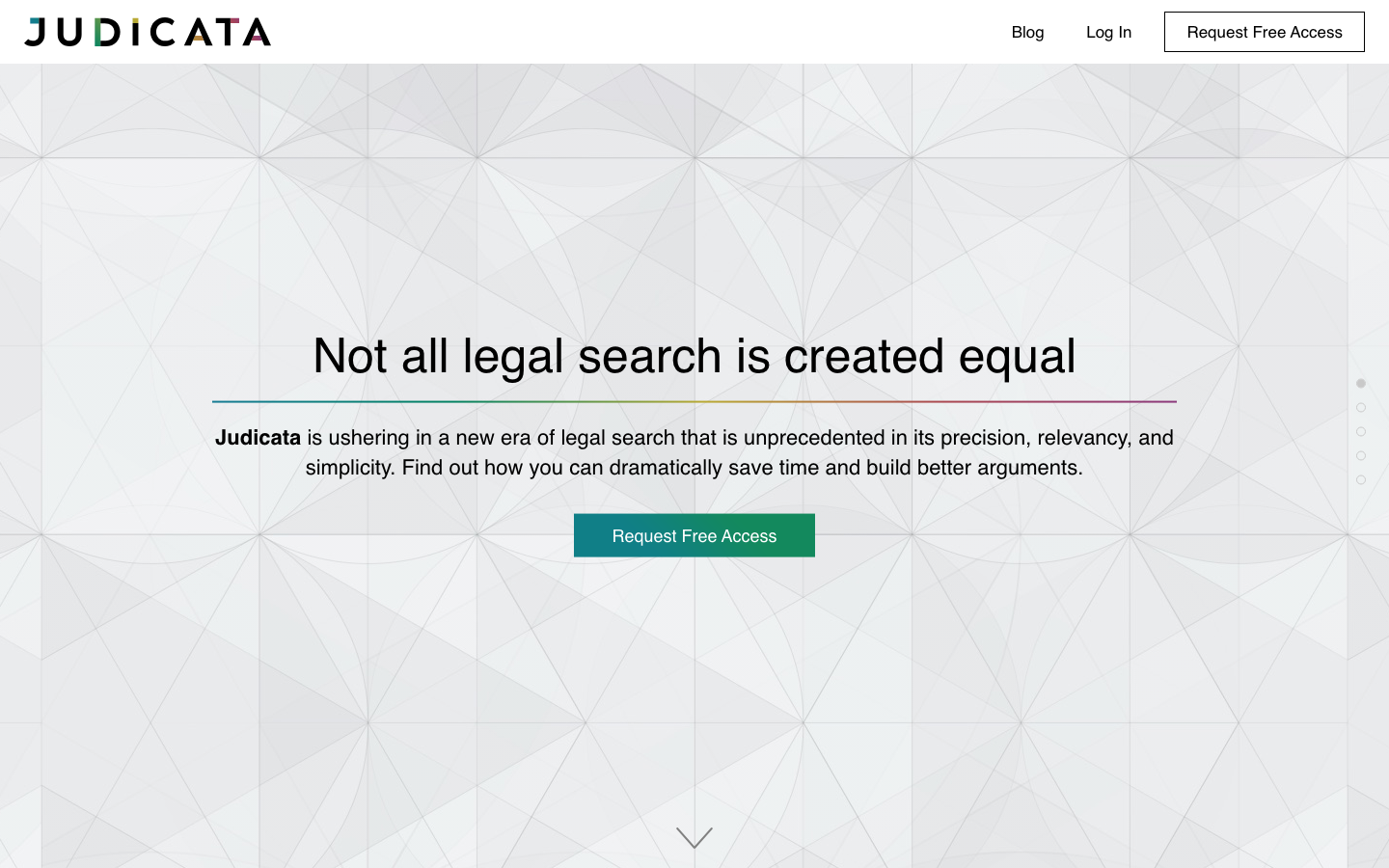
Judicata is an AI legal search technology company headquartered in San Francisco, USA, founded in 2013 by Itai Gurari and Cleve Lendon. The company's team, comprised of lawyers and engineers from Google, Stanford, Columbia, and the Ninth Circuit Court of Appeals, is dedicated to fundamentally improving the legal research experience for lawyers. Judicata's core product is an AI-assisted legal search platform for California litigators, focusing on "accuracy, relevance, and simplicity" - using natural language processing and machine learning technology to upgrade the broad and inefficient keyword matching in traditional legal search engines into intelligent searches based on semantic understanding and structured conditions. As of the latest information on the official website, Judicata currently only covers the California state legal system, but is actively expanding to more states. Users can submit an application through the official website to obtain a free trial (Request Free Access). There is information that Judicata has been acquired by LexisNexis, but it has not been officially confirmed; its terms of service (updated in 2017) are still operated as an independent entity by Judicata, Inc., and the place of arbitration is San Francisco, California.
Brief review in one sentence: Judicata is not a general legal database, but a set of "AI search enhancement layers" for California litigation lawyers - it does not sell data, but sells a layer of search accuracy that is smarter than Westlaw/LexisNexis.
| Projects | Public Information |
|---|---|
| Developer | Judicata, Inc. |
| Established | 2013 |
| Headquarters | San Francisco, California, USA |
| Official positioning | AI legal search platform |
| Current coverage | California state law only (expanding) |
| Core technology route | NLP semantic search + Query Assist intelligent prompt |
| Target Users | Litigation lawyers, law firms, and law schools in California |
| Delivery form | Web SaaS (need to apply for trial) |
| Latest version | 2026.7 |
| Legal Statement | Search results do not constitute legal advice (Source: Judicata Terms §10) |
Promotion Verification: Judicata's official website promotes "unprecedented accuracy, relevance, and simplicity." Judging from public information, the spelling correction, case name identification and filter suggestions of its Query Assist function can indeed reduce the time of blind searching, but "unprecedented" is a marketing term - Westlaw's AI functions (such as WestSearch Plus) and LexisNexis' Precision are also improving search accuracy. Judicata’s real differentiator is that it rebuilt its search relevance engine from the ground up, rather than adding an AI layer on top of an existing database. However, the current limitation of only covering California severely weakens its market persuasion.
Core functions
Query Assist
This is the core function point of Judicata’s external publicity. When a lawyer enters a query in the search box, Query Assist automatically provides: suggestions for commonly used legal phrases, correction of spelling errors, identification and completion of specific case names, and multi-dimensional filter suggestions such as courts/judges/fields of law. Its goal is to eliminate the pain point of "entering wrong keywords resulting in missing key cases".
Semantic relevance sorting
The core of Judicata's technology lies in the sorting algorithm of search results - it does not rely on simple TF-IDF or Boolean matching, but understands the legal intent of query statements through an NLP model dedicated to the legal field, and sorts cases by "legal issue matching degree" rather than "keyword hit rate". This means that when you enter "duty of reasonable care in breach of contract", the system understands that it is searching for criteria in a certain area of tort law, rather than mechanically matching each word.
Precise filtering and navigation
Supports multi-dimensional combination filtering by court level (California Supreme Court, Court of Appeals, Superior Court), judge, legal field, ruling year and other metadata. The actual value of this kind of structured navigation in legal research is to compress the steps of "full-text search and then manual screening" into "one query to reach the target".
Context-aware search result display
Judicata displays a summary of the key legal points and a summary of the decision for each case in the list of search results, rather than just the standard citation format. Lawyers can quickly determine the relevance of precedents without opening the full text, reducing the frequency of repeated clicks.
Account and Subscription Management
Supports unified registration of law firm teams, automatic renewal of monthly subscriptions, and multi-user rights management. The platform provides standard basic functions such as account information maintenance, search history viewing, and password encrypted storage.
Expert view: There is an "implicit collaborative link" between the above five capabilities - Query Assist lowers the input threshold → semantic sorting improves the first hit rate → precise filtering narrows the scope → contextual summary reduces clicks → account management enables team reuse. After these five sections are connected in series, what is actually compressed is the complete cognitive link "from raising the question to positioning to the authoritative case", rather than the speed of a single step.
Pricing strategy
Judicata does not disclose standard pricing on its official website and adopts a Request Free Access model. After the lawyer submits the application, the sales team will contact the sales team for a quotation. The following information is synthesized from its terms of service and industry speculation:
- Personal version: There is currently no independent personal version available, only for practicing lawyers and legal professionals.
- Law Firm Subscription Version: Monthly subscription, automatic renewal, prepaid fees. The specific price has not been disclosed, please contact sales for a quote. Pricing is speculated to be aimed at small and medium-sized law firm budgets and lower than the enterprise-level packages from Westlaw and LexisNexis. (Source: Judicata Terms §2)
- Free Trial: The official website provides the "Request Free Access" entrance. After passing the test, you can obtain limited-time free trial rights.
- Payment Method: Only supports USD payment, and accepts standard payment channels such as credit cards.
- Refund Policy: All fees are non-refundable unless otherwise stated in the Terms of Service (Source: Judicata Terms §2).
Free Facts: Free trials require an application form to be filled out and reviewed by the Judicata team, and are not self-service out-of-the-box. This means that the trial threshold is higher than typical SaaS products - Judicata is actively screening users for quality, but also reflects its current limited coverage (California only) and not wanting to handle a large number of trial requests from unrelated regions.
Hidden Costs:
- Learning Cost: Lawyers who are accustomed to Westlaw Boolean search need to adapt to the new search paradigm, and initial efficiency may decrease.
- Switching Costs: Once a law firm incorporates Judicata into their workflow, there will be retraining and data migration costs to switch back to a legacy platform.
- Cost of Coverage: Only available in California, lawyers practicing across state lines still need to maintain subscriptions to other platforms, resulting in parallel overhead for multiple platforms.
Reference to prices of similar products (estimated based on industry public information):
| Products | Typical Pricing Models | Monthly Fee Estimates (Small Law Firms) | Data Coverage |
|---|---|---|---|
| Judicata | Quotation (estimate $50-200/user/month) | $50-200 | California only |
| Westlaw Edge | Tiered subscription | $200-500+ | Federal + states across the United States |
| LexisNexis Advance | Tiered subscription | $200-500+ | Federal + states across the United States |
| Casetext (Thomson Reuters) | Per user annual fee | $100-300 | US federal + state |
| ROSS Intelligence (discontinued) | Monthly fee system (historical reference) | $100-250 | United States federal + state |
Note: Judicata pricing is a recommended value based on industry experience, unofficial data, and the official real-time quotation shall prevail. The pricing of traditional platforms varies greatly depending on the size of the law firm, the scope of the data package, and additional services.
Advantages and Disadvantages Analysis
Advantages
- Essential improvement in search accuracy: Judicata builds a semantic search engine from the ground up, rather than adding a filtering layer on top of an existing database. This means that the tolerance for "fuzzy queries" and "imprecise representations" is much greater than that of traditional Boolean systems.
- Query Assist lowers the barrier to entry: Especially friendly to junior lawyers and interns - no need to be proficient in Westlaw's search syntax to conduct effective searches.
- Depth brought by team focus: Focusing on the California legal system, the data quality and search optimization in a single jurisdiction may be better than a general platform covering the United States.
- Lightweight Delivery: Pure Web SaaS, no local installation or VPN connection required, just log in and use.
- No long-term contract pressure: monthly subscription, automatically renewed but can be canceled at any time, more flexible than the annual contract of traditional legal databases.
Disadvantages
- Extremely limited coverage: As of the latest information on the official website, it only supports California state law and does not cover federal cases, other state cases, administrative regulations and secondary documents. This is a fatal shortcoming in practice—most litigation cases involve federal or multi-state legal issues.
- Low Brand Recognition: Judicata remains a niche player in the legal tech space compared to Westlaw and LexisNexis’ decades of market dominance.
- Lack of in-depth legal analysis tools: Shepard's citation analysis Brief writing assistance, trial strategy analysis and other advanced functions are not provided, only at the search level.
- Low pricing transparency: The "Request Free Access" model increases time cost and uncertainty in B2B procurement, which is not conducive to quick decision-making.
- Insufficient data volume and historical accumulation: Traditional platforms have decades of data accumulation and non-public exclusive content sources, and Judicata is difficult to match in terms of data breadth.
- Potential acquisition risk: If it is indeed acquired by LexisNexis or its technology is integrated, Judicata may face the risk of discontinuation or marginalization as an independent product, and purchasers need to evaluate long-term availability.
Applicable scenarios
- California State Law Special Study: When the case is based entirely on California law, Judicata's narrow coverage becomes an advantage - the search results are more focused and less noisy.
- Legal Search Introduction for Junior Lawyers/Legal Assistants: There is no need to master complex search syntax. Query Assist can assume part of the role of "search mentor" and reduce training costs.
- Quickly verify legal hypotheses: Before writing a motion or brief, use Judicata to quickly verify how a legal standard is articulated in the latest California court precedents—2-3 times faster than a pan-search of traditional databases.
- Law Search Course: Used as a teaching tool to demonstrate to students the difference in results between "semantic search" and "keyword search", and to cultivate the modern search habits of the next generation of lawyers.
Does not fit boundaries:
- Attorneys practicing across state lines or involved in federal law - Judicata is currently unable to meet their data coverage needs.
- Scenarios that require citation analysis (Shepard's/KeyCite) for quantitative assessment of precedent validity - Judicata does not provide this function.
- Legal writing that requires the support of a large amount of secondary literature (law reviews, papers, monographs) - Judicata mainly covers the body of jurisprudence.
- Legal practitioners from non-common law countries - civil law systems are dominated by statutory law, and the rigid demand for case search is much lower than that in the United States.
Efficiency improvement comparison (including tables)
The following deduction is based on common efficiency indicators in the legal technology industry and is not officially claimed by Judicata. Hypothetical scenario: "A California litigator searches for three key precedents on California contract law":
| Youjie | Traditional platform (Westlaw/LexisNexis) | Judicata | Efficiency change deduction |
|---|---|---|---|
| Build search query | Need to design Boolean keyword combination, takes 5-10 minutes on average | Query Assist automatic completion and spelling correction, average 2-3 minutes | Time shortened by about 60% |
| Preliminary screening results | Browse 20-50 results, read the summary to judge relevance, 10-15 minutes | Semantic sorting + contextual summary, browse 5-10 results, 5-8 minutes | Time shortened by about 50% |
| Verify the validity of precedents | Use Shepard's/KeyCite to view citation history, 5-8 minutes | Need to switch to other platforms, or manually verify, 10-15 minutes | About 50% more time (due to lack of this feature) |
| Locate specific legal standards | Full-text search + manual reading to locate relevant paragraphs, 15-20 minutes | Structured summary + highlighted positioning, 8-12 minutes | Time shortened by about 40% |
| Full search task (total) | 35-53 minutes | 25-38 minutes | About 28% reduction in total time |
Comprehensive evaluation of efficiency: In terms of search and positioning, Judicata has obvious advantages; however, in terms of verification of case validity, the lack of citation analysis tools requires the need to switch to other platforms, offsetting part of the efficiency gains. Overall, for pure search tasks, Judicata can save about 25-30% of time; but for comprehensive research tasks that require citation analysis, the overall process efficiency advantage may be reduced to 10-15%.
Hidden efficiency gains:
- Reduce duplicate searches: The hit rate of a semantic search is higher than multiple Boolean trials and errors, reducing the cycle of "can't find the case, so change the keyword and search again".
- Reduced cognitive load: There is no need to frequently switch attention between searching for grammar and legal knowledge, and lawyers can focus more on the legal analysis itself.
- Newcomers can get started faster: It usually takes junior lawyers 2-4 weeks to master search skills on traditional platforms. Judicata has a shorter learning curve and is expected to reach basic proficiency in 3-5 days.
Automation Boundary
The AI search technology represented by Judicata has clear applicable boundaries in legal workflows:
It can be automated (≈80-100% replaces manual operation):
- Spelling correction and search term suggestions: Query Assist can completely replace the manual trial and error process in traditional Boolean search, automatically completing spelling correction and legal terminology standardization.
- Relevance pre-screening of search results: The semantic ranking model can replace the first round of manual screening of search results by lawyers and directly put the most relevant cases at the top.
- Structured extraction of case metadata: AI automatically identifies and presents structured information such as courts, judges, and ruling years, eliminating the need to manually click on the full text to view each one.
There are sections that require human-machine collaboration (50-80% automation, the rest requires manual confirmation):
- Judgment of legal issue matching of precedents: AI can give a list of highly relevant precedents, but lawyers still need to read key paragraphs to confirm whether the precedent actually supports their legal arguments - AI cannot understand "strategic precedent selection" (for example, some precedents are relevant but weakened by subsequent judgments).
- Organization and classification of research notes: Tools can provide search history and annotations, but organizing scattered notes into an organized legal analysis framework still relies on the professional judgment of lawyers.
Non-automatable sections (must be completed by an attorney):
- Final assessment of precedent validity: Determining whether a precedent is still binding (good law) - this requires citation analysis tools such as Shepard's/KeyCite or human legal judgment, and Judicata does not provide this capability.
- Writing and Argument of Legal Documents: Search results are material, but converting the material into persuasive legal arguments is still the core value of lawyers.
- Formulation of court appearance strategies: AI can efficiently retrieve similar cases, but it cannot replace lawyers’ comprehensive judgment on case strategies.
- Strong compliance approval is regulated: Legal documents involving the final delivery by customers must be reviewed by practicing lawyers and assume professional responsibility. AI tools are only used as auxiliary references.
Boundary summary from an engineering perspective: Judicata is essentially a tool to improve the efficiency of the "information acquisition" section, but there are blank areas in the two sections of "information verification" and "information conversion into arguments". Purchasers need to use citation analysis tools (such as Fastcase or Shepard's module of traditional platforms) to form a complete research portfolio.
Security and Compliance
Based on the privacy policy and terms of service disclosed on Judicata’s official website, the following is verifiable security and compliance information:
- Data Transfer and Storage: User Data may be stored and processed in the United States or any country in which Judicata and its agents maintain facilities. Judicata states that Internet transmissions cannot be completely private and secure (Source: Judicata Terms §7).
- Data Encryption: User passwords are encrypted and stored in the database. Credit card and other information is processed through a third-party payment processor. Judicata says it uses "industry standard security technology" to protect personal information (Source: Judicata Privacy Policy §6).
- Scope of data collection: Collect information such as name, email address, phone number, professional title, company name, practice field, etc. At the same time, server log data such as IP address, browser type, page visit records, etc. are automatically collected (Source: Judicata Privacy Policy §2).
- Third-Party Services: Use third-party analytics services such as Google Analytics to collect anonymous aggregate data (Source: Judicata Privacy Policy §2).
- Data Sharing: Judicata states that it does not sell, trade or rent user personal information. May be shared among parent companies, subsidiaries or jointly controlled affiliates. If the company is acquired, user data will be transferred with the assets (Source: Judicata Privacy Policy §4).
- Cookie usage: Use of session cookies and persistent cookies, which the user can disable via browser settings (Source: Judicata Privacy Policy §2).
- Data Breach Notification: In the event of a personal information breach, Judicata commits to promptly notify affected users (Source: Judicata Privacy Policy §7).
- Compliance Certification: No third-party compliance certification information such as SOC2 and GDPR is disclosed.
- Governing Law: The Terms of Service are governed by the laws of the State of California and disputes will be resolved in the California state or federal courts located in San Francisco County (Source: Judicata Terms §12, §15).
Security Risk Tip:
- The Privacy Policy was last updated in June 2014, which is more than 12 years ago, and may not fully reflect the requirements of recent laws such as GDPR and CCPA.
- Law firms should require Judicata to provide a SOC2 Type II report (if any) or equivalent security certification documents when purchasing as a basis for data security assessment.
- Since Judicata currently only covers California law, there are currently no usage scenarios for Chinese law firms or institutions involved in Chinese legal business.
Integrated Ecosystem
Judicata's integration ecosystem is currently relatively limited:
- Stand-alone Web App: Judicata is delivered as a stand-alone web platform and does not rely on or integrate with other legal software.
- API Capabilities: No publicly provided REST API or third-party integration interface. There is no data exchange with the law firm's existing case management system (such as Clio, MyCase), document management system (such as iManage, NetDocuments) or Microsoft Office suite.
- Browser Extension: Browser plug-ins are not publicly available.
- Single Sign-On (SSO): The SAML/OAuth Enterprise SSO feature is not publicly supported.
- Mobile Support: iOS/Android native apps are not publicly available.
Impact of ecological shortcomings:
- Lawyers need to complete searches within the Judicata platform and then manually copy and paste the results into their own documents or case management systems, adding workflow gaps.
- Inability to leverage existing legal tech investments (e.g. law firms with existing Westlaw or LexisNexis subscriptions cannot embed Judicata into existing search workflows).
- Compared with ecological functions such as LexisNexis' Microsoft Office integration and Westlaw's Drafting Assistant, Judicata has obvious gaps in the last mile of "search → writing".
Implementation suggestions
① Evaluate whether Judicata is suitable
Before purchasing, please conduct a self-assessment against the following checklist:
- [ ] Is the primary scope of practice limited to California law?
- [ ] Are existing Westlaw/LexisNexis subscriptions too expensive and underutilized?
- [ ] Are there any junior lawyers or legal assistants in the law firm who need to quickly get started with legal searches?
- [ ] Are citation analysis tools already in place (or is it acceptable to offload citation analysis sections to other platforms)?
- [ ] Are you willing to accept it as a "supplementary search tool" rather than a "main research platform"?
It is recommended to proceed to the next step only if at least 3 of the above 5 items are met.
② Try it first and then subscribe
Submit a Request Free Access application through the official website to obtain free trial rights. It is recommended to designate 2-3 lawyers to conduct testing with real cases within 1-2 weeks, focusing on evaluating:
- Does Query Assist really reduce search time?
- Whether the semantic sorting results meet the expectations of cases in this field
- Whether coverage is sufficient to support common research needs
③ Parallel operation, gradual transition
It is not recommended to cancel existing legal database subscriptions immediately. It is recommended to set up a parallel running period of 1-3 months:
- All new research tasks are first searched using Judicata
- Then use traditional platforms to verify the citation effectiveness of key precedents
- Record the difference in "time and accuracy of finding target cases" between the two platforms
④ Pay attention to the product roadmap
Since Judicata's coverage is being expanded, it is recommended to include "coverage expansion commitment" related clauses in the purchase agreement, or to regularly follow its blog and legal technology media updates. If a product is planned to be integrated into the LexisNexis ecosystem, the impact of technology integration on existing usage processes needs to be evaluated.
⑤ Procurement/Adoption Risk Assessment
The core risks focus on three points: (1) coverage risk - if the law firm's business extends beyond California, Judicata's value will drop sharply; (2) product life cycle risk - independent legal search tools face pressure to be integrated or eliminated by large platforms under the current market conditions; (3) integration risk - the lack of API and ecological integration leads to workflow disconnection, and actual efficiency improvements may be lower than laboratory tests. It is recommended that Judicata be positioned as a "supplementary search tool for specific jurisdictions" rather than as a "unified research platform for the entire institute" to control adoption risks and budget scale.
Summary
Judicata represents a completely different technical route from traditional legal databases: it does not rely on "more data and complete documents" to compete, but relies on "accurate search and fast search" to establish differentiated value. Its Query Assist and semantic search can indeed significantly shorten the time to obtain information in legal research in certain scenarios. However, its coverage is limited to California, it lacks citation analysis tools, and its integrated ecosystem is almost blank—these three shortcomings make it difficult to become the main research platform of a law firm at this stage.
For practicing lawyers in California, Judicata is an auxiliary tool worth trying, especially suitable for quickly locating precedents and lowering the search threshold for junior lawyers. Its current value to multi-state law firms or groups requiring federal law research is extremely limited. If Judicata can expand its state coverage as planned and complete its citation analysis and ecological integration capabilities, it will be possible for it to grow from a "small but beautiful" search tool to a strong competitor in mainstream legal research platforms.
Not suitable for boundaries: Legal practitioners from civil law countries; scenarios that only require simple case inquiry without structured analysis. Procurement/Adoption Risk Assessment: It is recommended to first test the accuracy of the structured search in the target field and compare the "time required to find the target case" with the traditional Westlaw/LexisNexis keyword search.
Main functions of Judicata
- Core Processing Capabilities: Provides core AI capabilities in the corresponding scenarios to support users to quickly complete tasks.
- Multi-modal interaction: supports text input and result output, and some scenes support image or file upload.
- Workflow Integration: Can be embedded into existing workflows or linked with other tools through APIs to reduce context switching.
Judicata application scenarios
- Personal Creation: Quickly generate or process content to improve daily work efficiency.
- Team Collaboration: Unify workflow and reduce repetitive manpower investment.
- Enterprise-grade deployment: Embed capabilities into on-premises systems via API or private deployment.
Judicata’s applicable groups
- Individual Users: Content creators and knowledge workers who need AI assistance to improve their daily work efficiency.
- Developers: Technical teams who need to integrate AI capabilities into their own products or services through APIs.
- Enterprise: Organizations seeking to deploy AI at scale in their field.
Judicata’s technical advantages
- Algorithm Optimization: Special optimization at the model or algorithm level has been carried out for the corresponding scenario to achieve a balance between response speed and result quality.
- Low-latency architecture: Adopts streaming or asynchronous processing architecture to reduce user waiting time and is suitable for high-frequency interaction scenarios.
Judicata’s core parameters and statistics
Specific technical parameters (such as model size, context length, supported file formats, input and output restrictions, etc.) are subject to the official product page. It is recommended that users verify the latest technical specifications and system requirements before choosing to ensure that they match their own usage scenarios.
Judicata’s user and market recognition
Gradually build user awareness in the field, and product capabilities are used by content creators and teams to improve work efficiency. Some industry users have incorporated it into their daily workflow. It is recommended to refer to the latest official disclosures for specific user scale and industry adoption rate data.
Judicata’s cost advantage
- C-side/Individual: Usually a free version is provided to experience the core functions, and high-frequency use requires a paid package subscription.
- API/Developer: Billed by call volume, suitable for development teams that can be flexibly integrated into their own systems.
- Enterprise/Privatization: Contact the business owner to obtain customized quotation and deployment plan. The specific price is subject to the official real-time pricing page.
Judicata’s Summary and Outlook
It provides competitive solutions in its field, and its core value lies in lowering the threshold for AI use in this field. With technology iteration, products are expected to continue to improve in functional coverage and performance.
Current limitations: Some advanced functions require paid subscription, and the free version has function or usage limits; Specific technical details and performance benchmarks have not yet been fully disclosed, and it is recommended to fully verify them through trials before purchasing.
Judicata’s model and version evolution
Continuous iterative updates, the latest version introduces performance optimization and new features. Historical version information can be viewed on the official release page. There is no complete public version evolution timeline yet. It is recommended to pay attention to the official announcement to understand the rhythm of feature updates.
How to use Judicata
- Web client: You can use it by visiting the official website and registering an account. Most functions do not require installation.
- API access: Provides RESTful API, developers can obtain the API Key and integrate it into their own applications.
Judicata’s Product Pricing
The pricing model is subject to the official real-time page. Usually a freemium or subscription system is used, and basic functions can be used for free. Advanced functions or high-frequency use require paid subscriptions, and users are advised to evaluate the optimal solution based on actual usage.
Version Info
- Judicata 2026 :There is no official precise date yet. Enhance AI case analysis and search relevance.
- Judicata 2025 :There is no official precise date yet. Introducing in-depth case structure analysis function.
User Reviews