 Kaggle
Free
Kaggle
Free
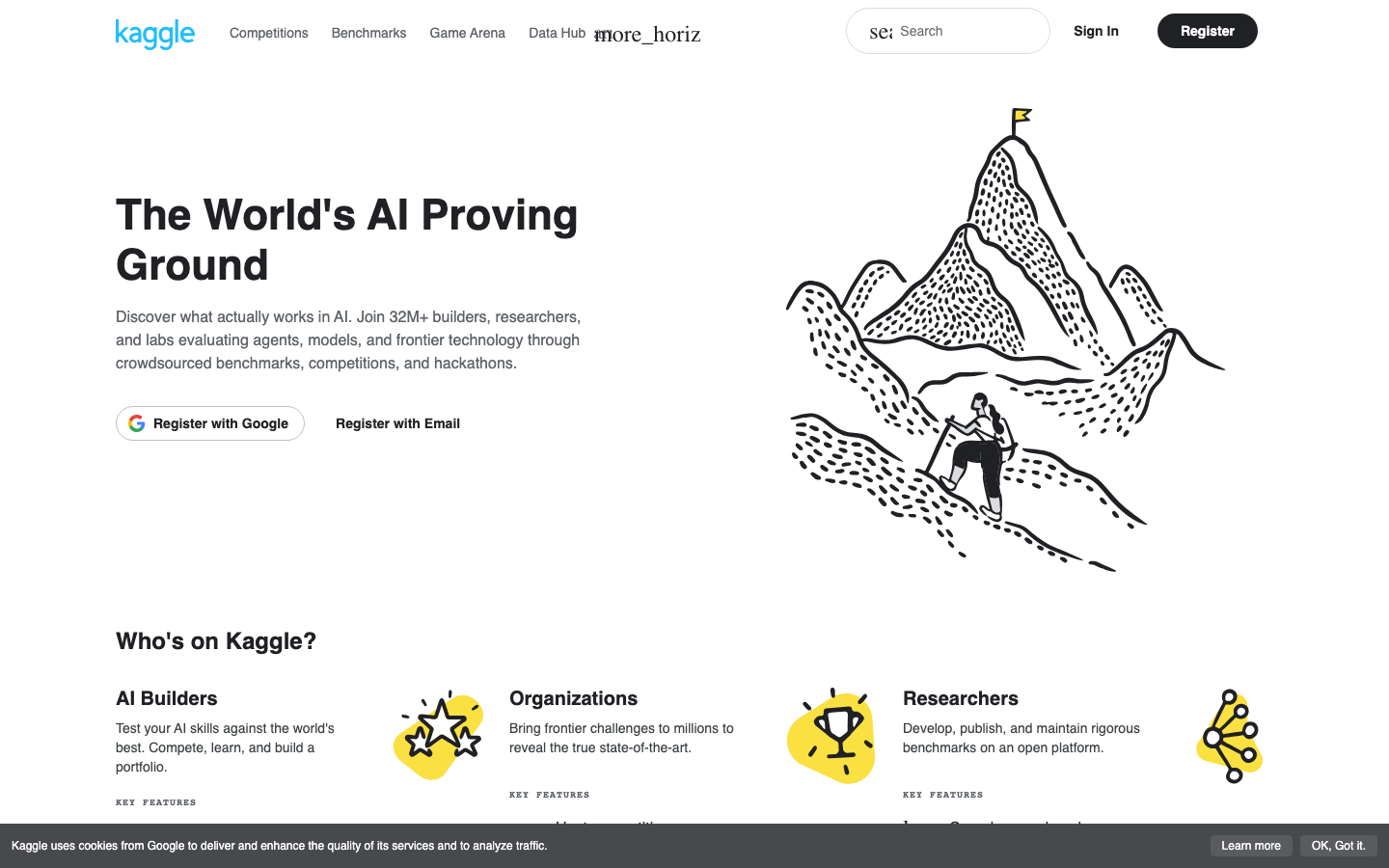
Kaggle is a data science community platform owned by Google that provides ML competitions, free data set GPU Notebooks and complete AI learning paths.
Kaggle
Core parameters and statistics
Kaggle is a "business card-level platform" in the global data science field - when corporate HR recruits data scientists, "Kaggle competition rankings" are a high-frequency reference indicator in resume screening. For learners, Kaggle provides a complete link from zero-based courses to GPU notebooks to actual competitions, all for free. Its real difference is that it plays the three roles of "learning classroom", "arena" and "talent market" at the same time, allowing the same group of users to get what they need at different stages.
| Projects | Public Information |
|---|---|
| Official positioning | The world's largest data science community and ML competition platform |
| Registered users | 20 million+ |
| Total number of competitions | Accumulated 10,000+ games (including history and ongoing ones) |
| Open Datasets | 50,000+ |
| Notebook runs in context | Online Jupyter, free GPU (Tesla T4/P100), 30-40 hours per week |
| Pre-installed libraries | Pandas, NumPy, Scikit-learn, PyTorch, TensorFlow, XGBoost, LightGBM, etc. |
| Learning courses | Kaggle Learn, 50+ free micro courses |
| Deployment method | Web (SaaS), supports API |
| Business Model | Free C-side + Enterprise Competition Hosting + Recruitment Services |
| Place of Residence | United States (US) |
| Owned Company | Google (acquired in 2017) |
Core difference: The irreplaceability of Kaggle lies in the five-dimensional integration of "competition - data set - notebook - course - community". Most data science platforms either only provide courses (such as DataCamp), competitions (such as DrivenData), or communities. Kaggle is the only product that integrates all five sections, and the quality of each section has reached the top level in the industry. This means that users can complete the entire process from entry to job hunting by registering in one place, without having to switch between multiple tools.
Efficiency comparison: For a zero-based user, the typical path from registering on Kaggle to completing the first ML competition submission is about 2-4 weeks (including Kaggle Learn course + introductory competition practice). Compared with the traditional route (2 months of reading → 1 week of installing Youjing → 1 week of finding data sets → 2 weeks of writing code → submitting), Kaggle has compressed the time from "zero to first submission" by about 60%-70%. The core compression points are: no need for Youbian configuration (pre-installed GPU Notebook), no need to collect data sets (built-in to the platform), and no need to reinvent the wheel (community code can be reused as baseline).
Kaggle’s users and market recognition
Kaggle's market recognition matches its "world's largest" positioning, but the sources of recognition vary between different groups - the C-side is mainly based on word-of-mouth and branding, the B-side is based on recruitment and competition hosting, and the academic community uses it indirectly through public data sets and competition benchmarks.
C-side user volume: 20 million+ registered users is the largest known scale among global data science platforms. The reference background for this data is: According to Kaggle's 2022 annual survey (about 24,000 valid respondents), the average age of users is about 30 years old, about 50% have a master's degree or above, and about 35% are full-time data scientists or engineers. This means that Kaggle’s user pool is concentrated among highly educated and highly skilled digital labor groups, and its platform reputation has a direct brand premium in the technical recruitment market.
Google Endorsement and Resource Integration: After Google’s acquisition in 2017, Kaggle’s GPU quota, cloud infrastructure, and brand credibility have been significantly improved. Google Cloud points TPU support (part of the competition) and the in-depth participation of the TensorFlow team enable Kaggle to stay ahead in the speed of technology iteration. But at the same time, the acquisition also brought about an adjustment in the strategic direction of the platform - Kaggle has gradually transformed from an independent competition platform into one of the entrances to the Google Cloud ecosystem. Some old users have complained about the platform's "over-Googleization".
Enterprise-side adoption: A significant proportion of the world's top 100 technology companies have posted competitions or recruitment through Kaggle, including Google, Microsoft, NASA, CERN, Walmart, Airbnb, etc. The value of companies using Kaggle is that a competition with a total prize of one million US dollars can attract thousands of participating teams and obtain model solutions at a price far lower than internal R&D costs. For recruitment scenarios, employers can directly screen candidates through competition rankings without going through the traditional resume screening process.
Industry Benchmark Impact: Multiple categories of classic competitions (such as Titanic, House Prices, Digit Recognizer) have become standard practice data sets for entry-level ML and are widely cited in training courses by universities and enterprises around the world. Kaggle's "Kernel" (Notebook) ecosystem has produced a large amount of high-quality open source ML code, which is forked and cited on GitHub.
The cost advantage of Kaggle
Kaggle's cost structure is very special - it is completely free for C-end users, and its revenue mainly comes from competition hosting and recruitment services on the enterprise side. This model of "burning money on the C side to acquire customers and monetizing it on the B side" is almost unique in the field of data science.
C-side/individual users: completely free, but there is an implicit threshold
- Competition participation, data set downloading, notebook running, and course learning are all free without any paid subscription.
- Free GPU 30-40 hours per week (subject to official real-time policy). This quota is usually sufficient for daily learning and competition experiments; but for deep learning competitions that require a large number of training rounds (such as medical imaging, large-scale NLP tasks), the quota will be significantly insufficient. Workarounds include: use with Google Colab (free GPU credit independent), or purchase Google Cloud Credits to expand quota.
- Hidden Cost: Kaggle's Notebook has limited network access and persistent storage, making it unsuitable for deployment tasks. Users need to build additional environments locally or in the cloud to complete production-level model deployment and inference pipelines, which will bring additional learning migration costs.
API/Developer: Kaggle API Free
- Kaggle provides an official Python API (
kagglehub), which supports operations such as data set download, competition submission, ranking query, etc. The API call itself is free, but there is a rate limit (subject to the official documentation). - The main value of the API lies in the automated workflow: automatically pulling the latest data sets in the CI/CD pipeline, submitting competition results in batches, and automatically uploading after training in the local IDE. For teams with high frequency calls, you need to pay attention to whether the API quota is sufficient to support the automated process.
Enterprise/competition publisher: Pricing is not disclosed and needs business confirmation
- Enterprises need to pay for publishing private competitions and hosted competitions. The specific pricing is not disclosed and is subject to the official sales page.
- Enterprise recruitment service (Kaggle Recruit) also requires contacting the sales team, and the price depends on the recruitment scale and degree of customization.
- Cost and Benefit Deduction: A typical enterprise data competition, the enterprise needs to pay platform hosting fees + bonus pool. Taking a $50,000 competition as an example, companies can gain access to thousands of participating teams, hundreds of independent modeling solutions, and in-depth community exploration of data sets - these results, if completed with an in-house team, may require 3-5 data scientists to work for 3-6 months, and indirect labor costs are usually in the range of $200,000-500,000. From the perspective of input-output ratio, competition hosting is a cost-effective channel for enterprises to obtain ML solutions. However, when the goal of the competition is "finding solutions" rather than "finding talents", you need to pay attention: the competition solutions are usually not engineering verified, and the migration cost from the winning code to the production environment requires additional budget.
| Cost Dimension | C-side/Individual | API/Developer | Enterprise/Competition Publisher |
|---|---|---|---|
| Platform usage fee | Completely free | Free (rate limited) | Undisclosed (required for business) |
| Main explicit costs | None | None | Competition bonus + platform hosting fee |
| Main hidden costs | Colab needs to be plugged in when GPU quota is insufficient | Rate limit affects automation frequency | Engineering migration cost of the winning solution |
| Key constraints | 30-40h GPU per week | API call frequency control | The gap between the solution from Notebook to production deployment |
Main functions of Kaggle
The function of Kaggle is not a scattered "set of tools", but a closed system designed around the "complete life cycle of a data science project" - from data acquisition (Datasets) to learning (Learn) to experiments (Notebooks) to competitions (Competitions) to communication (Discussions), the output of each section can be directly input to the next section.
-
ML Competitions: Enterprises and institutions publish real business problems, accompanied by desensitized original data sets and clear evaluation indicators (such as AUC, RMSE, F1-score). Global contestants submit models, and the system automatically scores and updates the rankings in real time. Expert View: The greatest value of the competition is not the prize money, but the combination of "problem definition + evaluation indicators + public rankings". What enterprises get is a pool of model solutions with clear measurement standards; what participants get is the opportunity to compare their capabilities with the world's top peers on the same benchmark. This mechanism is almost non-existent in traditional learning paths. Competition types include Learning Competitions, Featured Competitions, Research Competitions and In-Class Competitions.
-
Open Datasets: More than 50,000 data sets, covering almost all ML subfields such as housing price prediction, medical imaging, natural language processing, time series, genomics, etc. Each dataset comes with a data dictionary, exploratory analysis notebook, and community discussion. Expert opinion: The value of Kaggle Datasets is not in the "large quantity", but in the context-related ability of "can be loaded directly in Notebook with one click, and the data set is bound to a specific competition or course". This means the dataset is much more "understandable" than the original CSV file on GitHub. A hidden linkage is: after the competition, the winner's notebook will be made public, which contains in-depth analysis of the data set - subsequent learners can directly see "how the top players analyzed this data" on the same data set, which is difficult to replicate in traditional education scenarios.
-
Kaggle Notebooks (Kernels): Online Jupyter Notebook context, no configuration, free GPU support. It is pre-installed with 200+ mainstream data science libraries and supports one-click fork of community code. Expert view: The strongest ability of Notebook is not to run code, but the "social attribute" - users can fork any public Notebook, modify, run, and submit on this basis to form a versioned collaboration tree. For learners who are just getting started, finding a highly praised competition notebook, forking it, understanding it line by line, and fine-tuning it is the fastest way to advance. The learning efficiency of this kind of "reading competition codes of top players → reproducing → fine-tuning and improving" is much higher than reading textbooks or papers. However, in a production environment, Notebook's interactive execution method is not suitable for engineering deployment, and this needs to be clearly distinguished.
-
Kaggle Learn (course): 50+ free micro-courses, each taking 2-5 hours to complete, covering Python, Pandas, data visualization ML basics, deep learning SQL, feature engineering, etc. Interactive exercises are included at the end of the class and can be completed directly in Notebook. Expert perspective: Kaggle Learn's course positioning is not a "systematic deep learning tutorial", but a "quick start tool". A course that takes 3 hours to complete can be immediately applied in competitions. Its audience is learners who "want to get started quickly" rather than researchers who need a complete theoretical system. Compared with Coursera or DeepLearning.AI courses, Kaggle Learn lacks mathematical derivation and theoretical depth, but the efficiency advantage of "use it as soon as you learn it" is very obvious.
-
Community Discussions: After the competition, the winners will release detailed technical solutions ("Winner's Solution"), including data preprocessing techniques, feature engineering ideas, model selection and integration strategies, and pitfall records of the training process. Expert View: Discussions are an underestimated "tacit knowledge base". A typical competition winning proposal includes: how to design verification strategies, iterative ideas in feature engineering, and specific solutions for model fusion (such as parameter settings for weighted average stacking)—these contents are rarely seen in textbooks and papers, but are extremely valuable to data scientists in actual combat. In addition, the community is also active with a large number of novice help posts and guidance replies from experienced users, forming a self-driven learning ecosystem.
-
Kaggle API (kagglehub): The official Python library supports automated data set downloading, competition submission, ranking query and other operations through the command line or Python code, and is suitable for integration into CI/CD workflows.
Kaggle’s model and version evolution
Continuous iterative updates, the latest version introduces performance optimization and new features. Historical version information can be viewed through the official release page. There is currently no complete public version evolution timeline.
Kaggle’s technical advantages
Kaggle's technical advantage is not "a certain algorithm is better", but an engineering system built around the two core goals of "large-scale distributed evaluation" and "low-threshold ML experiments".
Large-scale competition evaluation infrastructure: Kaggle's core technical challenge is - how to automatically evaluate thousands of submissions at the same time and update the rankings within seconds? Behind this is a set of distributed evaluation pipelines: submission triggering → containerized isolation running (each submission executes the evaluation script in an independent sandbox) → result aggregation → ranking refresh. For computationally intensive competitions (such as medical image segmentation, protein structure prediction), Kaggle will dynamically allocate GPU/TPU resources on Google Cloud to handle evaluation tasks. The engineering complexity of this system lies in the fact that the evaluation script must ensure reproducibility and fairness (the same model has consistent output under different operating conditions), and at the same time prevent resource abuse from malicious submissions.
Configuration-free GPU Notebook architecture: Behind Kaggle Notebook is Google Cloud’s containerized infrastructure. Every time a user starts a Notebook, the system dynamically allocates a Docker container with 200+ pre-installed libraries, mounts the personal working directory and competition dataset, enables GPU passthrough, and provides a JupyterLab interface. The entire boot process usually completes within 10-30 seconds. The key technical difficulty lies in multi-tenant isolation—how to ensure fair distribution of GPU memory, user code not interfering with each other, and read-only access security to data sets when thousands of Notebooks are running simultaneously. Kaggle's strategy is to run each Notebook in an independent Kubernetes Pod, use NVIDIA MPS or time slicing technology to share the GPU, and limit the CPU/memory usage limit through Cgroups.
Dataset versioning and storage: Kaggle Datasets adopts an architecture of distributed object storage (Google Cloud Storage) + metadata indexing. Each data set is stored as an immutable version (versioned). Every time the user updates the data set, a new version is generated instead of overwriting the old version, ensuring the reproducibility of competitions and notebooks based on specific data sets. Behind the "one-click loading" of data sets and Notebooks is the FUSE mounting or symbolic link mechanism - the data sets are mounted into the container as a read-only file system when the Notebook is running, and do not occupy the container image layer space.
Community code collaboration and reproduction mechanism: Notebook’s fork function is essentially a lightweight versioning system. Each Notebook generates a version snapshot when saved, containing code, output and dependency context information. Other users can fork this version, modify it and create new version trees based on it. The key design decision of this mechanism is to "encourage public over private" - all notebooks are public by default, and only those explicitly marked as private are invisible, which directly promotes community knowledge sharing.
Deep integration with the Google Cloud ecosystem: Kaggle's technology stack is deeply bound to Google Cloud - the computing layer runs on GKE (Google Kubernetes Engine), the data layer uses Cloud Storage, and the ML layer provides enterprise-level data pipeline docking through BigQuery and Vertex AI. For enterprise users, this means a relatively smooth migration path from Kaggle competition prototypes to Vertex AI production deployments—models can be trained and exported in Kaggle Notebooks and then deployed directly to Vertex AI Prediction. However, during the actual migration process, there are still contextual differences (the Python package version of Kaggle Notebook is not completely consistent with Vertex AI) and the cost of reconstructing the data processing pipeline.
How to use Kaggle
Kaggle provides two entrances, Web and API, covering different levels of needs from starting from scratch to automated workflow integration.
| How to use | Suitable for the crowd | Features | Cost |
|---|---|---|---|
| Web browser | All users (including beginners) | Visit kaggle.com to register, all competitions/datasets/notebooks/courses are available | Completely free |
| API (kagglehub) | Developers, automation scenarios | Python library, supports data download, competition submission, ranking query | Free (with rate limit) |
| Kaggle Notebook | Competition participants, learners | Online Jupyter context, pre-installed 200+ libraries, free GPU | Completely free |
| Enterprise hosting competitions | Enterprises in need of external ML solutions | Publish private competitions through Kaggle Enterprise Service | Business confirmation required |
Typical usage path - zero-based entry:
- Visit kaggle.com and register using your Google account or email.
- Enter Kaggle Learn and start from the "Python" micro-course (approximately 3 hours to complete).
- Complete the two courses "Intro to Machine Learning" and "Intermediate Machine Learning" in sequence.
- Enter the "Titanic" entry competition - this is Kaggle's classic "Hello World" competition, with a simple data set and rich community solutions.
- Browse the highly praised public notebooks on the competition page, fork one of them and run it (free GPU is automatically allocated).
- After understanding the code logic, modify the parameters, re-run and submit the prediction results, and get on the leaderboard for the first time.
- Enter "Discussions" to read the public proposals of competition winners, and compare them with your own proposals to find directions for improvement.
Typical Usage Path - Enterprise Competition Release:
- Contact Kaggle sales team or access through Google Cloud channel.
- Determine the competition type (Public/Private/Kaggle-managed).
- Provide desensitized data sets and evaluation indicators (RMSE/AUC/F1, etc.).
- The Kaggle team helps package the competition page and configure the evaluation environment.
- After the competition is launched, participants will complete model development and submission on the platform.
- After the competition, the company will receive the winning model solution, participant rankings and optional talent contact services.
API usage example (install kagglehub library):
# Installation: pip install kagglehub
import kagglehub

# Download competition data set
# kagglehub.competition_download("titanic")

# Download the specified data set
# kagglehub.dataset_download("datasets/uciml/iris")

# Get the latest version path of the data set
path = kagglehub.dataset_download("datasets/uciml/iris")
print("Dataset path:", path)
For detailed API usage, please refer to the official documentation of kagglehub.
Kaggle product pricing
Kaggle's pricing structure is a typical "C-side free + B-side fee" dual-track model. The core logic is to maintain the scale and activity of the community (which is the core asset of the platform) by opening it to all C-end users for free, and then provide services to enterprises that need to "connect to the community" to earn revenue.
C client/individual users: completely free
- Contest participation: all free, no registration or entrance fees.
- Data sets: All are open for download, with no limit on the number of downloads.
- Notebook running: Free GPU quota 30-40 hours per week. Once the quota is exhausted, you need to wait for reset next week or purchase additional quota through Google Cloud points.
- Kaggle Learn courses: All free, no completion certificate charges (but the certificate does not have official credit certification effect).
- Community discussions: all free to read and post.
Developer/API calls: Free but frequency controlled
- Kaggle API calls are free, but subject to rate limits (specific frequency limit values are subject to the official API documentation).
- High-frequency calls (such as batch data set synchronization) need to plan the call rhythm appropriately to avoid being temporarily limited.
Corporate/Contest Publisher: Pricing Undisclosed
- Enterprise Hosting Competition: Fees depend on competition type (Public/Private), dataset size, prize pool and additional services (talent matching, branding, etc.). Unpublished, subject to official Sales quotation.
- Kaggle Recruit (recruitment service): Helps companies find data science talents through competition rankings. Pricing depends on recruitment scale and service depth. Not published.
- Google Cloud integration: Some enterprises may purchase Kaggle as part of the Google Cloud ecosystem and package it with products such as Vertex AI for pricing.
Key Free vs. Paid Comparison:
| Dimensions | Free version | Enterprise services |
|---|---|---|
| Contest Participation | All Free | — |
| Dataset | 50,000+ all available | — |
| GPU quota | 30-40h per week | Scalable |
| Publish Contest | ❌ | ✅(Paid required) |
| Recruitment Services | ❌ | ✅ (fee required) |
| API access | ✅ (with frequency control) | ✅ (higher quota can be negotiated) |
| SLA Guarantee | ❌ | ✅ (need to be agreed in contract) |
Kaggle application scenarios
Kaggle's application scenarios cover multiple levels from personal learning to corporate innovation, but the value and efficiency vary greatly in different scenarios. The following is a breakdown of four typical scenarios from the perspective of "quantitative cost reduction and efficiency improvement".
-
Introduction to Data Science and ML (zero-based career change): For a zero-based user, following the typical path of "Learn course → Entry competition Titanic → Intermediate competition → Reading winning proposal", the time from registration to independently completing a regression competition is about 3-6 weeks. Compared with the traditional path (2 months of reading + 2 months of online courses + local environment + finding projects), the Kaggle path compresses the "getting started time" from about 4-6 months to 1-2 months, with a compression ratio of about 60%-75%. Key deduction: The core bottleneck in the entry stage is not computing power or data, but "the lack of standardized problem definition and evaluation feedback." Kaggle solves this problem through the competition mechanism - each competition has defined target variables and evaluation indicators. Users do not need to think about "what to do" and "how to calculate it well", and can focus on "how to do it". This is where learning efficiency improvements come from. However, it should be noted that the problem definition in the competition has been completed by the organizer, and the ability to "define problems" in real business still needs to be cultivated in actual combat.
-
Competition-driven ability advancement (intermediate data scientist): For data scientists with 1-3 years of experience, the value of participating in medium-to-high-difficulty competitions is mainly reflected in three aspects: first, exposure to diverse data distribution and problem types that are not encountered in daily work (such as audio and video, genomics, adversarial verification); second, learning the feature engineering and model integration ideas of top players in the community (especially the Winner's Solution that was made public after the competition); third, establishing a personal brand (Kaggle competition rankings on LinkedIn and high recognition in recruitment). Efficiency Deduction: By participating in 3-5 difficult competitions, an intermediate data scientist can be exposed to technical accumulation equivalent to 1-2 years of work (measured by feature engineering skills and model tuning experience). However, techniques in competitions (such as stacking, blending, and adversarial verification) often need to be greatly simplified in production environments to adapt to engineering constraints and cannot be directly copied.
-
Enterprise Talent Screening and Recruitment (HR and Data Team Leader): Using Kaggle competition rankings as a recruitment filter can filter out the "top 90% noise" of candidate evaluation. Quantitative deduction: Assume that 100 data scientist resumes are received. The traditional method relies on resume keyword screening, which requires an average of about 20-30 hours of preliminary screening + 40-50 hours of interviews. In the end, 1-2 qualified candidates may be found. If the top 10% of the Kaggle competition rankings are required in JD (or a link to the competition notebook is provided), the candidate pool is reduced by 80%-90%, but the skill matching of the remaining candidates is significantly improved - because the competition rankings directly verify the ML modeling ability. But it should be noted that strong competitors do not necessarily equal strong engineers (competitions do not require writing production-level code), so competition rankings should be used as a screening tool rather than the only recruitment criterion.
-
Enterprise Data Competition (Crowdsourcing of Innovation Solutions): Enterprises publish internal problems as Kaggle competitions to win modeling solutions from data scientists around the world with prizes of $5,000-100,000. Quantitative deduction: For a problem that takes an internal team 3 months to solve (about 150,000 yuan in labor costs), through the competition it is possible to obtain a solution with equal or better results within 2-3 months at a cost of 50,000 to 100,000 yuan (bonus + platform fee). However, the engineering migration cost of the winning solution needs to be budgeted separately - usually migrating a competition solution to production requires 1-3 engineers and 1-2 months of work. Therefore, the total cost of the enterprise competition should be calculated as "bonus + platform fee + engineering migration cost".
Kaggle’s applicable audience
Kaggle's "five-in-one" platform model determines that it can serve a wide range of roles, but the real benefits of different roles vary significantly.
-
Zero-Based Learners and Career Changers: Kaggle is currently the most efficient platform for getting started with "from zero to one" data science. Adaptation value: No need for context configuration, no need for data collection, built-in standardized problem definition and evaluation mechanism. Implementation Tips: It is recommended to proceed in the order of "Learn courses (3-5 courses) → entry competition (Titanic or House Prices) → read high praise Notebook → independently complete the intermediate competition". It is expected that the jump from zero to independent modeling can be completed in 1-2 months. Unfit Boundary: Kaggle is not suitable to replace systematic theoretical learning - if you need to deeply understand the mathematical derivation of the loss function, the convergence proof of the optimizer, or the interpretability theory of the model, Kaggle's learning path cannot satisfy it, and you need to study in parallel with a textbook (such as ESL, ISLR, or Pattern Recognition and ML).
-
Intermediate/Senior Data Scientist: Kaggle is an effective platform to continuously improve practical capabilities and establish industry influence. Adaptation Value: Get exposed to diverse data and problem types through difficult competitions, learn advanced skills by reading award-winning solutions, and build a personal brand through rankings. Implementation Tips: It is recommended to choose a competition type that matches the actual work direction (such as time series prediction, NLP classification, computer vision), and transfer the feature engineering and verification strategies learned in the competition to work. Unsuitable Boundary: Ranking in the top 10% of competitions requires a lot of time investment (some top players invest 100-300 hours in each competition). For busy mid-level engineers, "participation frequency x investment per competition" requires rational planning to avoid occupying time for their own work or system learning.
-
Corporate Recruiters and HR: Kaggle’s competition rankings and public notebooks provide direct evidence of candidates’ ML abilities. Adaptation value: Ranking the top 10% of the competition or providing a public notebook link as a filtering condition can greatly improve the efficiency of resume screening. Implementation Tips: It is recommended to use Kaggle rankings in conjunction with engineering ability assessments (such as code reviews, system design interviews) - strong competition ability does not mean strong engineering ability, and candidates need to demonstrate production-level coding capabilities at the same time. Misfit Boundary: For non-ML technical positions (such as back-end development, infrastructure engineers), Kaggle competition ranking is not a valid evaluation metric.
-
Enterprise & Innovation Team Leader: Get high-quality models at a fraction of the cost of in-house R&D by crowdsourcing ML solutions through Kaggle competitions. Adaptation value: Suitable for data science problems with clear evaluation indicators (such as model accuracy, classification accuracy), and the problem can be made public or limited. Implementation Tips: Before launching a competition, companies should prepare desensitized data sets, clear evaluation indicators and a reasonable bonus budget (it is recommended to refer to the bonus scale of similar competitions). After the competition ends, allow additional time and budget for the engineered migration of the winning solution. Unsuitable Boundary: Not suitable for problems involving highly sensitive data (such as medical patient privacy, financial transaction details) that cannot be adequately desensitized; not suitable for non-standard ML systems that require long-term iterative maintenance (the competition only delivers model solutions, and does not include an engineering framework for continuous monitoring and model updates).
Kaggle’s human-machine collaboration boundary
The Kaggle platform itself is a highly automated SaaS, but in the user's AI/ML workflow, the boundaries of human-machine collaboration need to be clearly defined.
Automable features: Data set download and synchronization (regularly pulling the latest data through the API), competition submission (submitting experimental results in batches through the API), leaderboard tracking (automatically obtaining the latest rankings and scores through the API), Notebook scheduled running (regularly executing and outputting results through Kaggle's scheduling function).
Somethings that require manual confirmation: competition strategy selection (choose which competition to participate in, how much time to invest), feature engineering decisions (which features to add to the model, how to deal with missing values), model architecture selection (what model family to choose, hyperparameter search range), production decision-making of the winning solution (whether to migrate the competition solution to the production environment, whether the cost of engineering transformation is reasonable). For corporate competition publishers, data set desensitization, evaluation indicator setting and result acceptance also require manual judgment and cannot be left to the platform.
Summary and outlook of Kaggle
Kaggle has a de facto monopoly on the data science community track - it is not the model with the most parameters, nor the platform with the strongest computing power, but the only product that combines the five dimensions of "learning - data - experiment - competition - job hunting". Google's acquisition provides it with stable infrastructure investment and cloud ecological synergy, making free GPU Notebok possible.
Current core advantages: 20 million+ registered users and 50,000+ data sets form a data moat - any new entrant cannot replicate the same scale of community and data assets overnight, even if they copy the functions. The combination of competition + ranking + job search creates a network effect: data scientists come because they want to compete on Kaggle, stay because they get a good ranking, and continue to invest because employers recognize the ranking. The connection between Kaggle Learn courses and competitions is extremely efficient - users can complete a course in 3 hours and use it immediately in the competition. This kind of "use it immediately after learning" feedback is something that traditional education platforms cannot achieve.
Current main limitations: There is a systematic gap between the competition context and the real production context - the competition data has been cleaned and desensitized, the evaluation indicators have been clearly set, and participants do not need to consider model deployment and continuous operation and maintenance. This means that candidates with excellent performance in competitions may not perform as well as expected due to insufficient engineering capabilities under production conditions. The free GPU quota (30-40 hours per week) is not enough for heavy participants in deep learning and large NLP competitions, and expanding the quota requires binding a paid Google Cloud account. As the community expands, the quality of discussions becomes polarized—high-level Winner's Solutions and low-quality repeated questions coexist, and the cost of information screening increases.
Follow-up observation points: Whether Kaggle will achieve deeper GPU quota connection with Google Colab (such as shared quota or login-free association), whether it will open the AutoML competition mode (allowing contestants to participate in the competition by describing the problem instead of writing code), and the degree of integration of AI Agent auxiliary programming tools (such as GitHub Copilot, Cursor) in the Notebook environment. These changes may redefine the participation methods and thresholds of "data science competitions".
Purchasing and Adoption Risk Assessment: There is no real risk for individual learners - register for free and get a complete learning and practice environment with zero cost investment. It is recommended that all AI/ML learners and practitioners register for a Kaggle account and use it as a basic tool for daily learning, practice, and community communication. For corporate recruitment teams, Kaggle rankings should be used as an effective signal for talent screening rather than the only criterion - it is recommended to rank in the top 10% or provide high-quality Notebook links as one of the interview screening conditions, but it is still necessary to evaluate engineering delivery capabilities through coding ability interviews and system design interviews. For companies considering obtaining ML solutions through Kaggle competitions, it is recommended to include the bonus, platform fee, and engineering migration cost of the winning solution (usually 2-5 times the bonus) in the total budget, and clearly specify the migration cycle and acceptance criteria in the contract or project planning. For industries with extremely high data sensitivity (such as medical and financial core systems), it is recommended to first evaluate the feasibility of desensitization and confirm that the release of the competition will not cause the risk of data leakage before initiating cooperation.
Related tools:  Hugging Face, replicate
How to use Kaggle
- Web client: You can use it by visiting the official website and registering an account. Most functions do not require installation.
- API access: Provides RESTful API, developers can obtain the API Key and integrate it into their own applications.
Version Info
- Kaggle Platform 2026 :There is no official precise date yet. Continuously optimize the competition platform and notebook experience.
- Kaggle Platform 2026 Feb :There is no official precise date yet. Enhanced GPU Notebook quota and dataset search capabilities.
User Reviews