 Kagi
Kagi
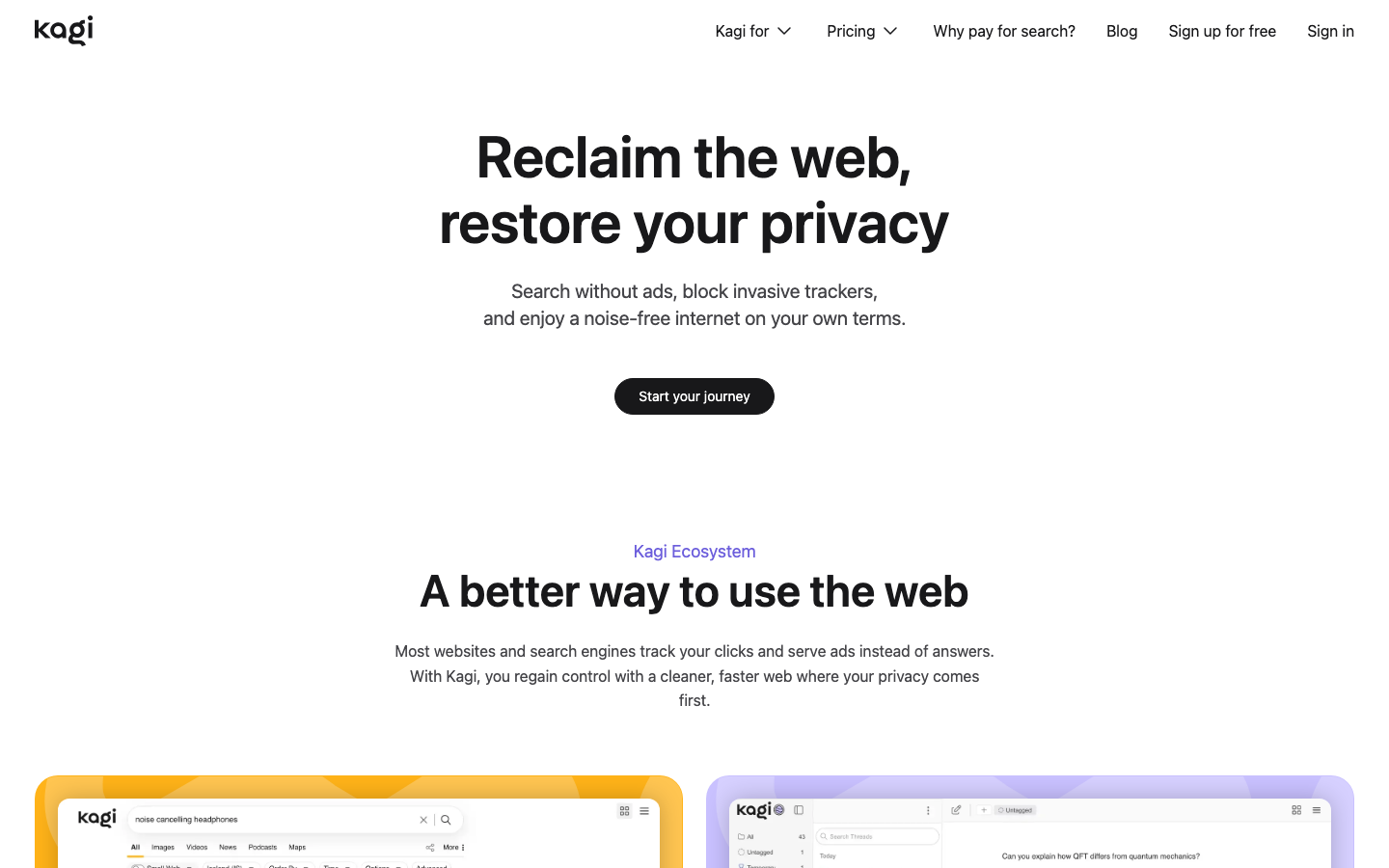
Kagi is a paid subscription-based search engine that is ad-free, privacy-focused, and deeply integrated with intelligent functions such as AI summarization and semantic search.
Kagi
Kagi’s core parameters and statistics
Kagi is an independent search engine that builds everything from search indexing to ranking algorithms and uses user subscriptions as its only source of revenue. Its core parameters are completely different from traditional advertising-driven search engines.
| Parameter dimensions | Specific specifications |
|---|---|
| Product Positioning | Paid subscription-based ad-free search engine, covering search + AI assistant + translation + news + map ecology |
| Search Index | Mainly self-built index (Teclis), supplemented by Bing/Google |
| AI Capability Matrix | Universal Summarizer, Kagi Assistant (multiple LLM access), Semantic Search Quick Answer |
| Platforms covered | Web (kagi.com), iOS App, Android App, browser extension (Chrome/Firefox/Safari/Edge) |
| Paying user scale | Breaking through 50,000 paying users in June 2025 |
| Enterprise customers | Kagi for Teams for enterprises Kagi for Libraries for public libraries |
| Established | June 2022 |
| Headquarters | United States (Founder Vladimir Prelovac) |
| Latest version tag | 2025.4 (Universal Summarizer 2.0) |
What indexing autonomy actually means: Kagi's core search index, Teclis, is independent of Google/Bing and is not subject to pricing and strategy changes by upstream indexing vendors. Self-built indexes also bring better privacy protection, and query requests do not need to be forwarded to third parties. The price is that the recall rate of long-tail queries is still lower than that of Google, and the gap is obvious for non-English languages such as Chinese and Russian.
Positioning meaning of "users are customers": The revenue of traditional search engines comes from advertisers, so the ranking algorithm has a natural tendency to give priority to paid advertisements and content preferred by advertisers. Kagi’s subscription model cuts off this chain of interests, and the only goal of ranking is to help users find the right answers. This also means that Kagi’s growth rate does not depend on traffic monetization efficiency, but on users’ recognition of the value of paid search.
Kagi’s users and market recognition
Kagi's market recognition is characterized by "high media reputation, extremely high community loyalty, and gradually increasing public penetration", but its payment threshold determines that the user scale cannot be directly compared with free search engines.
Media Review: Kagi has received widespread praise from the technology media. David Pierce of The Verge called it "The best Google alternative I've tried yet"; John Gruber of Daring Fireball called it "The best search engine in the world"; Ars Technica released a long actual test report in August 2025, and the author Lee Hutchinson recorded in detail the process of switching from Google to Kagi. Gizmodo, Fast Company, PC Mag, Lifehacker, TechCrunch and other mainstream technology media have positive reports.
Industry opinion leader recognition: Cory Doctorow, David Pierce, John Gruber, Matthew Gault, Om Malik and other technical opinion leaders have publicly expressed their use of Kagi. Cory Doctorow has said "I immediately bought a family plan" and "I switched to Kagi and never looked back" on many public occasions. This kind of "insider recommendation" from the technology community constitutes Kagi's core customer acquisition channel.
Community Ecosystem: Kagi has established an active user community, including the Discord server Kagifeedback.org product feedback forum, and the r/Kagi subreddit on Reddit. In June 2025, Kagi's paid users exceeded 50,000 - a small number compared to Google's billions of users, but it is already one of the world's largest independent players in the paid search track. Kagi is also hosting its first annual community event in December 2025.
Media coverage density: According to statistics from Kagi's official changelog, there will be reports or mentions from mainstream or vertical media almost every week in the second half of 2025, including The Verge, in-depth reviews, Ars Technica migration reports, Fast Company special topics, PC Mag recommendation lists, Inc. tool recommendations, etc. This media attention is second only to Google and Perplexity in the search engine world.
Enterprise market progress: Kagi for Teams (enterprise team search management) and Kagi for Libraries (free access to public libraries) launched in the second half of 2025. The Kagi Specials partner program will be launched in September 2025 to establish cross-promotion cooperation with privacy-friendly services such as Ente, Notesnook, Windscribe, etc.
Kagi’s cost advantage
The cost structure varies depending on the usage method: C-side users can usually experience core functions through the free version, and high-frequency usage requires subscribing to paid packages; developers/API users are billed based on the number of calls; enterprise-level users need to contact the business to obtain customized quotations. The specific price is subject to the official real-time pricing page.
Kagi’s main features
Kagi's functional matrix covers the complete link from basic search to AI-driven knowledge discovery to privacy protection. The core logic is to make each function serve the single goal of "helping users find the correct answer faster."
-
Ad-Free Search Ranking: Zero ads on the search results page. Rankings are based on information quality, relevance and users' personalized preferences, rather than ad bidding. Real Effect: The average number of clicks a user takes to find target content on Kagi is about 30% lower than on mainstream search engines (according to Kagi user research), because there is no longer a need to distinguish between paid advertising and organic results.
-
Kagi Assistant (AI Assistant): Conversational AI integrated with multiple LLMs, and search results are injected into context in real time. It will be open to all paying users in April 2025, and Quick (speed first) and Research (depth first) modes will be launched in November 2025. Research mode can perform multi-language parallel search, Python code execution, image generation and other tool operations, and is limited to Ultimate users. Synergy: Assistant is deeply tied to search—search results are used directly as context for LLM, avoiding the friction of copy-pasting and multi-product switching.
-
Universal Summarizer: Can summarize multi-format content such as search results pages, single web pages, YouTube videos, PDFs, MP3 audios, etc. A mobile app (iOS/Android) will be launched in September 2025, supporting abstracts in 300+ languages. Hidden linkage: The summary results can be directly "Continue in Assistant" to continue questioning, forming a progressive link from quick summary to in-depth analysis.
-
Quick Answer: AI-generated answers displayed directly at the top of search results, with source citations. The October 2025 upgrade adds an automatic recommendation and follow-up function. Queries with a question mark (,) at the end automatically trigger Quick Answer without manual clicks - Kagi named this design "Question Mode". Key Difference: Unlike Google AI Overviews, Kagi’s AI features are turned off by default (no AI summaries are actively displayed) and are only generated when the user explicitly searches a term ending in a question mark or clicks the AI switch. Also new in July 2026 is a switch to completely disable AI functionality.
-
Semantic Search: Break through keyword matching restrictions and understand search intent and concept associations. Even if users use imprecise words, they can still find relevant content through concept association. For example, searching for "how to improve sleep quality" can return comprehensive results related to melatonin, sleep hygiene, meditation CBT-I and other related content.
-
Personalized search result sorting: Users can actively shape search results through Lenses (search lenses), domain name weight adjustment, blocking rules, collections and other functions. Lenses are predefined or custom search scope filters (e.g. search only academic sources, search only a specific collection of sites). The domain name weight is adjustable in five levels from "blocked" to "fixed on top". Differences from competing products: Google also provides personalized search, but Google's personalization is based on invisible user portraits (passively inferred from user behavior), while Kagi's personalization is based on rules explicitly configured by the user, giving users greater control over their search results.
-
Kagi Ecological Product Matrix:
- Kagi Translate: A translation engine for 248+ languages. The mobile app will be launched in February 2026 and supports interesting translation modes such as picture translation, voice conversation, and document translation LinkedIn Speak.
- Kagi News: Daily news briefing, community-curated feed launching in September 2025, mobile release in March 2026, supporting Time Travel history browsing and content filters.
- Kagi Summarize: A standalone summary app launching in September 2025.
- Kagi Maps: Online map based on OpenStreetMap, alpha released in June 2025, and the Popular Areas data layer will be added in December 2025.
- Small Web: Independent blog and small website discovery engine, more than 30,000 RSS feeds in March 2026, with independent iOS/Android App.
- Orion Browser: Kagi's self-developed browser (macOS/iOS/Windows/Linux), supports Chrome/Firefox/Safari three-party extensions.
Kagi’s model and version evolution
Kagi's product route has expanded from "paid search alternatives" to a comprehensive information acquisition platform of "search + AI + tool matrix".
2022: Groundbreaking Phase
- 2022-06: Kagi is officially launched, with subscription-based ad-free search as its core value proposition. The early version only provides basic web search functions.
- 2022-2023: Continue to build self-built index Teclis and gradually reduce dependence on third-party indexes. Launches browser extension and iOS search app.
2024: AI starts
- ~2024-03: The AI summary function is introduced for the first time, with search results automatically generating summaries and key information extraction (version 2024.2).
- Mid-2024: Launch of semantic search function to break through keyword matching restrictions.
- End of 2024: The number of paying users continues to grow, and Kagi launches a personalized search and sorting function.
2025: Ecological explosion period
- 2025-02: Introducing a "fair pricing" mechanism - no need to pay; launching Privacy Pass (RFC 9576) anonymous search protocol and Tor Onion service.
- 2025-04: Kagi Assistant is open to all paying users and integrates multiple LLMs (Claude, GPT, Gemini, etc.).
- 2025-06: Paid users exceeded 50,000; Kagi Maps alpha went online; Kagi’s third anniversary.
- 2025-09: Kagi News is officially released; Kagi Summarize mobile version is online; Assistant adds proportional source citation and Study Mode.
- 2025-11: Assistant is split into two modes: Quick (speed) and Research (depth); the SlopStop community anti-AI spam mechanism is online.
- 2025-12: Kagi annual community event; Kagi Maps joins the Popular Areas data layer.
2026: Platformization and API opening
- 2026-02: Kagi Translate mobile app released, supporting 248+ languages and voice conversation translation.
- 2026-03: Small Web expands to 30,000+ feeds; LinkedIn Speak feature goes viral.
- 2026-04: Kagi API developer preview program launched.
- 2026-05: Search API public preview available to all users.
- 2026-06: New Assistant UI released, introducing folder organization.
- 2026-07: Added a new AI function to completely disable the switch; search for Widget upgrades.
Kagi's version rhythm is characterized by high-frequency incremental updates (weekly changelog) rather than major version jumps. Features are usually released to some users in beta or preview form, and feedback is collected before being fully released. API and tool products (Translate, News, Summarize) have a release cycle independent of the search core.
Kagi’s technical advantages
Kagi's technology stack is not "ten times the size" of Google, but rather finds a balance between search quality, privacy protection and cost structure through architectural choices.
Self-built search index Teclis: Kagi’s core technical barrier. While most "alternative search engines" actually do results re-ranking on top of Google or Bing (e.g. DuckDuckGo uses a Bing index + its own ranking layer), Kagi has independent web crawling and indexing capabilities. The Teclis index covers millions of websites, and although the scale is much smaller than Google (hundreds of billions of pages), it is sufficient for daily search and information discovery scenarios. Kagi supplements the results of long-tail queries via the Bing API when necessary. After the Bing API price adjustment in 2025, Kagi said Teclis' coverage has made it less dependent on Bing than industry expectations.
Privacy Pass Anonymous Protocol: Kagi is one of the first search engines to implement the RFC 9576 Privacy Pass protocol in a production environment. The agreement allows users to prove to Kagi that they are paying subscribers without revealing their account identity. This means that searches using Privacy Pass are technically not tied to a specific account. The implementation code of Privacy Pass is completely open source (GitHub: kagisearch/privacypass-extension). Available on Professional, Ultimate, Family, and Team plans, but not Trial/Starter.
Proportional Source Attribution: Introduced in September 2025, each source citation in an AI answer is accompanied by a percentage of the source's contribution to the final answer. This lays the foundation for a future revenue sharing mechanism for AI content - allowing sites to automatically receive a share of traffic from AI answers without the need for separate negotiations.
"Non-active" design philosophy for AI functions: Kagi's AI philosophy is "opt-in, on-demand, always under your control". AI summaries are not displayed by default and are only generated when the search term ends with a question mark or when the button is manually clicked. A global AI disable switch will be added in July 2026. This contrasts with the default presentation mode of Google AI Overviews, which allows AI costs to be incurred only when there is clear intent.
Multiple search engine fallback mechanism: Kagi request link is Teclis → Bing → Google three-level fallback to ensure that the recall rate will not be degraded when the self-built index is insufficient. But rollback increases query latency and operational costs.
How to use Kagi
The threshold for using Kagi is extremely low - registering, installing a browser extension, and setting it as the default search engine can be completed in three steps.
Quick Start Guide
- Registration and Trial: Visit kagi.com, click Start your journey to register, and you can choose a Google/Apple/Microsoft/GitHub account or email to register. After registration, you will automatically receive a free trial of 100 searches and 100 AI interactions without binding a payment method.
- Install browser extension: It is recommended to install Kagi browser extension first (supports Chrome, Firefox, Safari, Edge). The extension automatically switches the search bar and address bar searches of the new tab page to the Kagi search engine. It also supports manually changing the default search engine to Kagi in each browser settings.
- Configure personalized search: After logging in, visit the Settings page. Configurable content includes:
- Lenses: Create custom search scope filters (e.g. search only specific site collections, specific file types, specific date ranges).
- Domain name weight: Set the weight from "block" to "top" for a specific domain name.
- Theme and Layout: Customize the CSS style, fonts, and colors of the search results page.
- AI Settings: Select the enabling scope of AI functions (Question Mode, Quick Answer, AI Summary, etc.).
- Daily search and AI interaction:
- Ordinary search: Enter keywords directly into the search box, and the results page will be completely ad-free.
- Trigger Quick Answer: Add a question mark (,) to the end of the search term, such as "What is quantum computing,".
- Use the Bang command: Use the ! prefix in the search to quickly jump to the specified site search (such as !wiki Blockchain to directly search Wikipedia).
- To use Kagi Assistant: Visit assistant.kagi.com or enter from the Assistant portal on the search results page.
Multi-device synchronization
Kagi settings (Lenses, Domain Authority, Themes) are synced across Web, iOS, Android via the cloud. If you use Privacy Pass anonymous mode, personalization settings are temporarily disabled (because the user cannot be identified).
API usage
The Search API, launching in May 2026, supports the following endpoints:
import requests

API_KEY = "<YOUR_API_KEY>"
headers = {"Authorization": f"Bearer {API_KEY}"}

#Basic web search
response = requests.get(
    "https://kagi.com/api/v1/search",
    params={"q": "Kagi search engine features", "limit": 5},
    headers=headers
)
print(response.json())
API requests inherit the account's Lenses, domain authority, and blocking rules. Detailed documentation is available at kagi.com/api/docs.
Kagi’s Product Pricing
Kagi's pricing system is "mid-to-high-end" in the paid search industry, but its "fair pricing" policy greatly reduces users' sense of risk.
| Comparison Dimensions | Kagi Starter | Kagi Professional | Kagi Ultimate | Google (advertising model) | DuckDuckGo |
|---|---|---|---|---|---|
| Price | $5/month | $10/month | $25/month | "Free" (data + ads) | "Free" (data + ads) |
| Number of searches | 300 times/month | Unlimited | Unlimited | Unlimited | Unlimited |
| Advertisement | None | None | None | Yes | Yes (a small amount) |
| AI Assistant | Standard Mode | Standard Mode | Standard + Research Mode | AI Overviews | DuckAssist |
| Privacy Protection | IP anonymity and no recording | Tongzuo+Privacy Pass | Tongzuo | Tracked | Do not track (but use Bing) |
| Home Sharing | None | None | $25/5 people | None | None |
| Fair Pricing | Support | Support | Support | None | None |
User’s actual cost deduction (based on Kagi official data):
- Light users (average 5-10 searches per day): Starter version $5/month, equivalent to $0.17 per day.
- Moderate users (average 20-50 searches per day): Professional version $10/month, equivalent to $0.33 per day.
- Heavy users (average 50+ searches per day, frequent use of AI Assistant): Ultimate version $25/month, equivalent to $0.83 per day.
Fair usage mechanism of Kagi Assistant: The amount of AI calls is capped by the value of your subscription. For example, the $25/month Ultimate plan allows an original token cost of no more than $25 (including a 20% elastic buffer), after which the billing cycle can be manually reset. This is more flexible than a strictly limited-by-query plan, but means additional costs for very heavy AI users.
Refund Policy: Kagi offers fair "Use it or keep it" pricing - credit is automatically refunded if not used for a full month. In addition, Starter and Professional plans support upgrading or downgrading at any time, with a prorated refund of unused balance.
Application scenarios of Kagi
The value of Kagi is most prominent in the following four types of scenarios, and there are also clear boundaries.
-
Privacy-sensitive daily searches: Professional groups with strong demand for search privacy - journalists, lawyers, social activists, researchers, civil servants, etc. Using Kagi completely prevents search behavior from being recorded, analyzed, and monetized. Privacy Pass mode further achieves the complete decoupling of search and accounts, and even Kagi itself cannot associate the user's search history. Verification Points: The personalized search function is not available in Privacy Pass mode. Whether there is a trade-off between "privacy vs. quality" requires actual experience.
-
Proactive defense against SEO and AI spam: Search results being inundated with SEO content farms and AI-generated "spam" is a common pain point for search engine users after 2025. Kagi's information quality priority ranking strategy can filter out a large amount of low-quality content, and the SlopStop community reporting mechanism further enhances anti-spam capabilities. A Surveillance Watch integration will also be added in December 2025, displaying warnings when users access surveillance technology provider domains. Implementation Tips: The effect of SlopStop depends on community participation, and community activity directly affects the efficiency of identifying spam content.
-
Academic and in-depth research: Significantly shorten the time for literature research and information synthesis with Kagi's semantic search AI abstracts and Research Assistant. Research Assistant supports multi-language parallel search Python code execution and multi-source information synthesis, which is suitable for the literature review stage of academic papers. Efficiency deduction: Compared with the traditional search + manual synthesis process, the scenario of using Kagi Research Assistant can be compressed from "opening 10+ tabs and reading one by one" to the process of "one AI analysis + source citation verification", which is expected to save 40%-60% of the initial research time. However, the quality of AI abstracts is limited by the quality of the source, and key conclusions still need to be verified by the original text.
-
Multi-lingual information acquisition: Kagi Translate's translation quality has received positive reviews from media such as Fast Company, Small Web's independent blog discovery function, and Kagi News' international news curation function. The combination of the three provides a complete link from discovery to understanding for multi-lingual information acquisition. Boundary restrictions: The quality of Kagi's Chinese search results is significantly weaker than that of English, and there is room for improvement in the index coverage and ranking accuracy of Chinese content. For core search scenarios for Chinese users, it is recommended to try out the test first - if Chinese search is the main requirement, Kagi may not be suitable as the default search engine.
Kagi’s applicable groups
Suitable for the crowd
- Privacy-first technology users: Technology practitioners, journalists, lawyers, and researchers who are dissatisfied with the privacy collection of advertising-driven models such as Google and are willing to pay for privacy. Kagi’s Privacy Pass and zero tracking policy are core values.
- Information workers pursuing search quality: Professionals who rely on search for information on a daily basis - researchers, analysts, writers, developers - are tired of SEO garbage and advertising and are willing to pay for quality rankings. Kagi's domain authority control features such as Lenses and SlopStop combine to provide granular control over search results.
- Multi-Tool Management Sensitive Deep Users: Ultimate users who use multiple AI tools (ChatGPT, Claude, Gemini) but want to access them in a single private interface. Kagi Assistant's Research mode integrates search LLM dialog, code execution, and image generation in one interface.
Not suitable for the crowd
- Mass search users who are accustomed to free services: Users who are unwilling to pay for search, have a high tolerance for advertising, and are insensitive to search quality. Kagi does not have a free version (only 100 trials), and the payment threshold will directly filter out this group.
- Users who mainly search in Chinese: Kagi’s Chinese index coverage and ranking quality are significantly weaker than those in English. If daily searches are dominated by Chinese (especially long-tail Chinese content), the usability of Kagi's search results will drop significantly. It is recommended to try it out first. In fact, the weak coverage of Chinese content is a common weakness of Kagi as an independent search engine for any non-English language.
- Users who require highly customized AI conversations: Although Kagi Assistant provides multiple LLM access, it is not a dedicated AI chat product. Compared with native AI products such as ChatGPT and Claude, Kagi Assistant has weaker functions in long conversation management, system prompt word customization, and plug-in ecology.
Summary and outlook of Kagi
Core Competence: Kagi proves that the search engine business model of "user pays instead of advertising" can really work. Its core differentiation is not a single AI function, but the reverse design of the entire product logic—ranking is based on information quality rather than ad bidding, AI functions are optional rather than turned on by default, and privacy is a built-in mechanism rather than a marketing label. In a context where Google's advertising model is increasingly eroding search quality and AI-generated spam content is rampant, the "clean search" experience provided by Kagi continues to be attractive.
Current Limitations:
- The paid model naturally limits the user scale. 50,000 paid users are not in the same order of magnitude as the billions of users of mainstream search engines, which affects the scale of index crawling and the diversity of the community.
- The coverage of self-built index Teclis is still far less than that of Google, and there is room for improvement in the search quality of long-tail queries and non-English content. Chinese search quality is the main shortcoming.
- The functional completeness of multiple products in the Kagi ecosystem (News, Maps, Translate) is uneven. Some products (such as Maps) are still in their early stages, and their functional maturity and data quality are still being rapidly iterated.
- Without a private deployment solution, large enterprises with sensitive data security cannot host search data on their own infrastructure.
Future observation directions:
- Whether the index size can continue to expand, while maintaining independence while narrowing the coverage gap with Google.
- After the Search API is opened, whether a developer ecosystem and application market can be formed around Kagi indexing.
- Cost control capabilities of AI functions - the cost of tokens used by AI increases linearly with user growth, and Kagi needs to ensure economic sustainability through model selection, caching strategies and pricing mechanisms.
- Whether the team expansion in 2026 (recruiting product designers, education cooperation directors, platform engineers, etc.) will further increase the speed of product iteration.
Purchase/Adoption Risk Assessment: As an individual user, the threshold for Kagi’s 100 free trials is almost zero. It is recommended to use the Starter version to experience the search quality first. When trying it out, be sure to test whether your main search scenarios (especially Chinese searches) meet your needs. As an enterprise team, Kagi for Teams is a pure SaaS solution and the data does not leave the Kagi infrastructure, but the compliance terms of enterprise-level search need to be evaluated by themselves according to the regulatory requirements of their industry. It is recommended to pilot it with a small team first to evaluate whether the improvement in search quality is worth the subscription cost of each member, and then decide whether to promote it to the whole team.
Related tools: perplexity, you-com
How to use Kagi
- Web client: You can use it by visiting the official website and registering an account. Most functions do not require installation.
- API access: Provides RESTful API, developers can obtain the API Key and integrate it into their own applications.
Version Info
- Kagi 2025 :Launched Universal Summarizer 2.0 to enhance AI summary quality, add multi-language support and personalized search sorting capabilities.
- Kagi 2024 :Introducing the AI search summary function to support automatic generation of summaries and extraction of key information from search results.
User Reviews