 Keyla AI
Free
Keyla AI
Free
Keyla AI is an AI-driven UGC video advertising creation platform that uses AI avatar technology to allow virtual characters to hold and wear real products, generating more than 100 UGC-style static and video advertising materials in minutes.
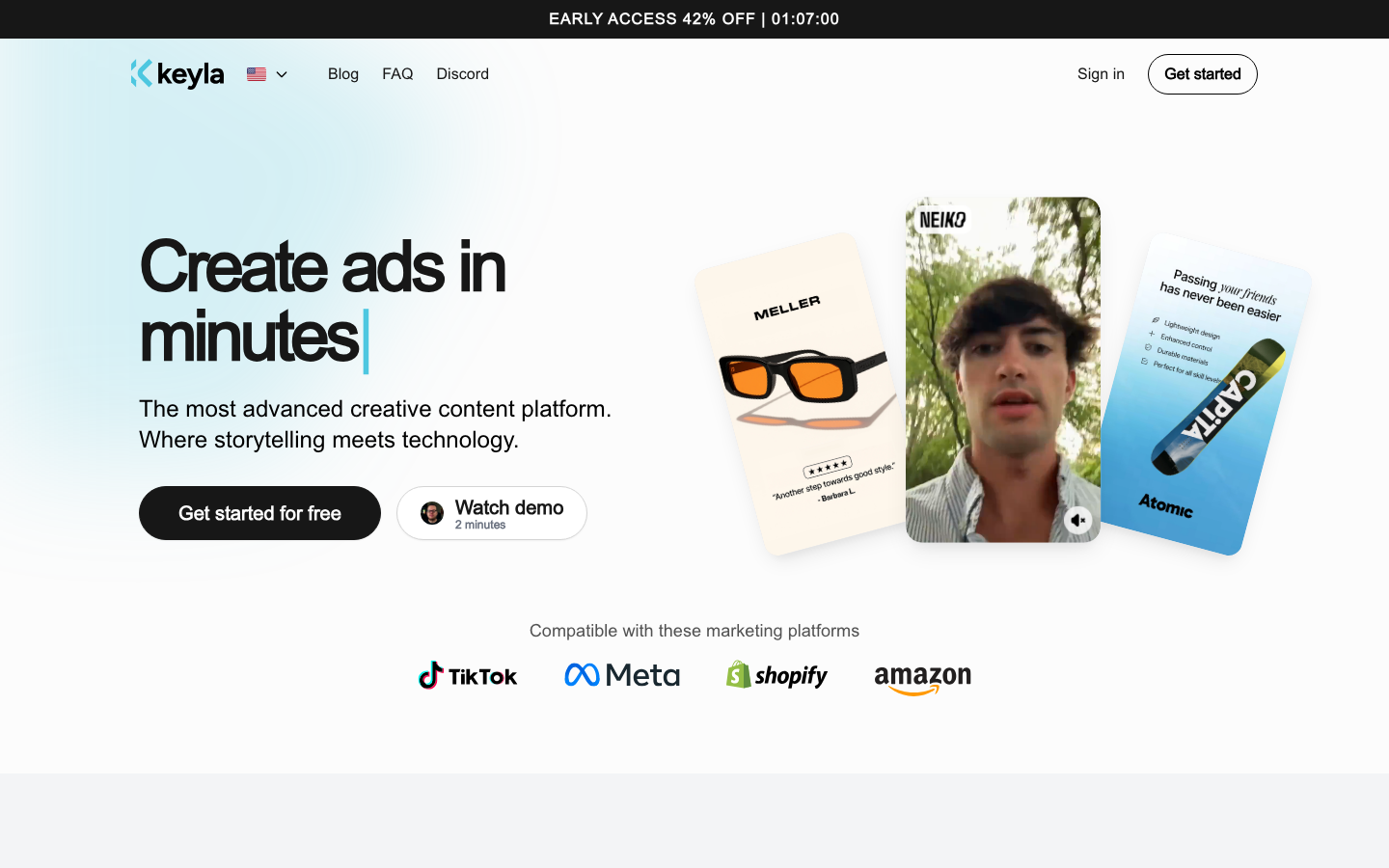
KeylaAI
Core parameters and statistics of Keyla AI
Keyla AI is an AI video advertising creation platform (Type D - productivity/business application) focusing on UGC (User Generated Content) style, operated by Everlo, MB. Its core positioning is not general-purpose video generation (such as Runway, Pika), but an "AI material factory specially designed for advertising scenarios" - input product information and brand materials, and AI will generate realistic UGC advertising videos and static images of virtual characters holding products in a few minutes.
| Projects | Public Information |
|---|---|
| Product positioning | AI-driven UGC style advertising creation platform |
| Core Competencies | AI avatar spoken video, product real-life display, batch advertising material generation |
| Product Form | Web (Cloud SaaS) |
| Business model | Free trial + subscription payment |
| Current Stage | Early Access (42% OFF for a limited time) |
| Place of ownership | US (operated by Everlo, MB) |
| Supported platforms | Web browsers |
| Language support | en-US |
Brief review in one sentence: Keyla AI is not another general-purpose video tool (such as Synthesia). Its difference lies in the fact that "AI avatars can directly hold and wear your products" - this ability allows brands to produce advertising materials that look like real UGC without hiring real models, studios and post-production teams. It is especially suitable for e-commerce live streaming, social media streaming and independent website promotion scenarios.
Type determination: Keyla AI belongs to Type D (productivity/business-side application) because its delivery form is a directly available SaaS application for the marketing team, rather than the underlying API or middleware. Users do not need to write code and can complete creative generation in three steps through the web interface.
Users and market recognition of Keyla AI
Keyla AI is in the Early Access stage, and the official has not disclosed precise user numbers and revenue data, but user reviews and brand cooperation cases from the official website provide side verification.
User reputation: The official website displays video testimonials and five-star ratings from multiple paying users. Brendon J. commented on YouTube that "Keyla allows us to complete the work much faster and at a much lower cost than hiring real people to shoot"; Andrew S. commented that "AI-driven video creation is amazing"; Kale D. said that "I have tried all AI video generators and only like Keyla AI." The core value these testimonials point to is speed and cost - not absolute video quality.
Brand Cooperation: Customer brands displayed on the official website include Neiko, Atomic, H23, etc., but the specific depth of cooperation has not been disclosed.
Competitive positioning: The main competing products in the AI advertising creative track where Keyla AI is located include:
| Competing products | Core differences | Differences from Keyla AI |
|---|---|---|
| Synthesia | AI digital human broadcasts videos, focusing on corporate training and demonstrations | Keyla focuses more on advertising scenarios, and the avatar can hold products instead of simply speaking |
| AdCreative.ai | AI advertising graphics and text material generation, focusing on static Banner | Keyla covers both video and static advertising, and has virtual image interaction capabilities |
| Pencil | AI creative and delivery optimization | Keyla emphasizes UGC realism rather than pure AI-generated texture |
| HeyGen | AI digital human video, supports multi-language spoken broadcast | Keyla limits digital human to "advertising product display" scenarios instead of general spoken broadcast |
The core differentiation of Keyla AI is not in "the highest quality of production" - the image quality in the Early Access stage is still not as good as real-person shooting - but in "the rapid output of real-life UGC creators with AI avatars". This value proposition is particularly prominent for e-commerce and DTC brands that require a large amount of advertising materials for A/B testing.
Keyla AI’s cost advantage
The cost advantage of Keyla AI needs to be broken down from the three levels of C-side API and enterprise. Public pricing information is limited, and the following analysis is based on the Early Access price displayed on the official website and market comparison.
C client/individual users:
- The official website provides a free trial quota (the specific maximum number of generated materials is not disclosed), and users can fully experience the entire process of "uploading brand materials → selecting templates → generating ads" without paying.
- A 42% OFF limited-time discount is provided during Early Access, indicating that the current pricing is still in the "early user subsidy" stage, and the price of the official version may increase.
- Based on the analogy of similar products in the market (for example, AdCreative.ai is about $29-$99/month), it is estimated that the monthly fee for the official version of Keyla AI may be $20-$50/month, which is subject to the official real-time pricing page.
API/Developer:
- Keyla AI does not disclose independent API or SDK access solutions. The current product form is purely web-side SaaS and does not provide programmatic access to developers. If the team needs to integrate creative generation into its own system, there is currently no official path.
Business/Team:
- The official website shows cooperation with brand customers such as Neiko and Atomic, indicating that there are enterprise-level solutions, but specific team seats, material quotas, brand white-labels (White-label) and customization terms need to be confirmed by contacting the business.
- The "hidden cost" on the enterprise side is: if the team needs to produce 100+ creatives per week, Keyla AI's free/basic plan will most likely not be able to cover it, and a higher-end subscription will need to be purchased.
【Free Truth】: Free trials usually limit the number of materials and output resolution generated at a time, and the generated videos may have Keyla AI brand watermarks (removal is required for a fee). It is recommended to use the free trial to run a complete creative and evaluate whether the generated quality meets Facebook/TikTok delivery standards before deciding whether to pay. Whether the 42% OFF in the Early Access phase is a one-time discount or a continuing offer, please confirm with the official before purchasing.
[One of the Hidden Costs: Material Homogenization]: Since Keyla AI provides a limited template library (despite claiming 5000+ variations), multiple users using the same template + avatar combination may lead to material style convergence. For high-end brands that require strong brand identity, this is a risk that needs to be evaluated. It is recommended to perform artificial secondary differentiation based on AI generation (replacing background music, superimposing brand stickers, adjusting the editing rhythm).
[Hidden Cost 2: Learning and Tuning Costs]: Although the official claims "three-step generation", it still requires certain rounds of debugging to find the best combination between the naturalness of the avatar's expression, the angle of the product being held, and the intonation of the spoken word copy. It is estimated that it will take 2-3 hours of exploration from the first time you get started to produce "ready" materials.
Keyla AI’s main features
The function of Keyla AI is designed around the core mission of "enabling brands to mass-produce UGC-style advertisements without real-life UGC creators." The following is expanded according to ability lines:
- AI avatar mouth broadcast video: Select an actor from 5000+ avatar variations, enter the copy, and then AI generates a video of the avatar mouth broadcast product. Applicable tasks: Substitute for "unboxing review", "usage experience", and "Amway planting" videos by real-life UGC creators. Acceptance focus: Whether lip-sync accuracy, natural expression, and background context are consistent with the brand tone.
- Product handheld/wearable display: Keyla AI's core differentiated function - the avatar can be directly held, worn or interacted with the product (such as holding skin care products for smearing actions, wearing jewelry for display, and operating handheld electronic devices). Applicable tasks: E-commerce product display videos, especially categories that require "real-person display" to enhance trust (beauty, jewelry 3C, clothing). Project value: The traditional path requires hiring models + photographers + post-production (single cost $50-$200+). Keyla compresses this to a few minutes to generate, and can batch produce multi-angle product display versions.
- Static advertising and video mixed generation: Simultaneously output static images and video materials suitable for Facebook, Instagram, TikTok, LinkedIn and other platforms. Applicable tasks: A set of product materials can automatically generate advertising formats for multiple platforms. Implementation Tips: Different platforms have different requirements for video duration and ratio (9:16/1:1/16:9). Keyla claims that it can automatically adapt, but it is recommended to manually verify the preview effect of each platform before actual delivery.
- Ad examples library: Provides a collection of advertising cases curated by experts, which can be used as a reference for advertising creativity of competing products or similar brands. Applicable tasks: Obtaining creative inspiration and analyzing competitive product advertising strategies. Note: The content timeliness and update frequency of the case library have not been disclosed. It is recommended to use it for reference only rather than copy it directly.
- Background music and B-roll material library: Built-in music library and B-roll video material, supporting brand style
grid selection. Applicable tasks: Provide soundtracks and supplement picture-in-picture materials for advertising videos without involving music copyright disputes.
[Expert View]: The function chain of Keyla AI forms a complete relationship of "selecting virtual actors → inputting products and copywriting → generating spoken videos → multi-platform adaptation and output". Compared with the traditional multi-tool workflow of "writing scripts with ChatGPT + generating spoken broadcasts with Synthesis/HeyGen + subtitles with Canva", Keyla compresses 3-4 tool switches into continuous operations within a single interface. However, its functional coverage is limited to "advertising UGC scenarios" - it is not suitable for long videos, documentaries, film and television special effects or general content creation for non-advertising purposes.
Version evolution of Keyla AI
Keyla AI is currently in Early Access, with limited publicly verifiable version information available until July 2026.
Early Access Phase
- Keyla AI Early Access (~2026-07): Officially launched the Early Access version, offering a limited-time 42% OFF discount. This is the only verifiable version of the product. The feature set includes core AI avatar speaking, product demonstrations, ad templates, and music library. The stability, output resolution limit and batch generation quota of the current version are not fully disclosed on the public page.
Follow-up expectations
- Keyla AI is in the rapid iteration period of a typical early SaaS product, and is expected to cover more avatar styles, higher output resolutions, and deeper integration with advertising platforms (such as publishing directly to Facebook Ads Manager). The specific roadmap is subject to the official announcement.
Since the product has not officially released version 1.0, multi-version node comparison cannot be provided. It is recommended to continue to pay attention to keyla.ai's update log or blog for version changes.
Keyla AI’s technical advantages
Keyla AI's technical advantage does not lie in the parameter magnitude of the underlying model, but in "integrating multiple AI capabilities (avatar synthesis, lip synchronization, product-virtual human interactive rendering, advertising template engine) into an end-to-end product for advertising scenarios"**.
AI avatar + product interaction: This is the core difference between Keyla and general digital human tools. Technical links include: ① 2D/3D virtual image generation; ② spatio-temporal alignment of product materials and virtual images (such as hand position, occlusion relationship); ③ lip synchronization synthesis (audio-to-lip sync). Compared with tools such as Synthesia and HeyGen, Keyla additionally solves the rendering problem of "virtual human interaction with real products", which requires more sophisticated front and rear scene segmentation and hand gesture generation capabilities.
Batch generation pipeline: For ad delivery scenarios, Keyla has designed a batch rendering pipeline, which claims to be able to generate "100s of ads" in minutes. This means that its rendering engine is optimized for short video specifications (15-60 seconds) rather than pursuing the ultimate image quality of a single video. For a delivery team that needs to produce 20-50 A/B test versions, this batching capability is more important than the pixel-level perfection of a single video.
Scaling of the template engine: The official claim of "5000+ variations" indicates that its template system adopts a parametric architecture (rather than a fixed template) and produces diversity through the combination of avatars, backgrounds, spoken word copywriting, props, and camera movements. The advantage of this architecture is that users do not need to configure it from scratch, but the disadvantage is that visual differences between templates are limited - a large number of combinations may look "déjà vu".
Data flow architecture:
Users upload brand materials + select templates + enter copywriting
        ↓
Keyla AI rendering engine
  ├─ AI virtual image synthesis (image + lip sync)
  ├─ Product-virtual human spatial alignment (handheld/wearable/placement)
  ├─ Background composition (select from template library or user upload)
  └─ Multi-format output (video + static image + multi-platform size adaptation)
        ↓
Preview → Download / Publish directly to advertising platform
In the current Early Access stage, Keyla does not yet support publishing directly to Facebook Ads Manager or TikTok Ads, and manual upload after downloading is still the main path.
How to use Keyla AI
The product entrance of Keyla AI is a web browser, and there is no need to install a client. The typical usage process is as follows:
Step One: Registration and Brand Configuration
Visit keyla.ai → click Get started → register an account → upload brand logo and product photos. It is recommended to prepare 3-5 high-definition product images (white background is preferred to facilitate hand-held avatar rendering), as well as brand tone and font information.
Step 2: Select advertising template and avatar
Select the advertising style (recommendation/unboxing/tutorial/planting, etc.) from the template library, and select the AI avatar (age, gender, style can be filtered). Currently, "5000+ variations" are provided, which are actually a combination of avatar + clothing + background. It is recommended to browse the competitive product advertising case library first and determine the target advertising style before selecting a template.
Step 3: Enter copywriting and generate
Enter the product description and spoken word copy (recommended length is 30-60 seconds), select background music → click Generate. The generation time depends on the length of the video and the number of outputs. It is estimated that a single 15-second video will take about 2-5 minutes. Only one suggestion will be created for the first time. After verifying the naturalness of the avatar's movements and the product display effect, it will be generated in batches.
Step 4: Preview and Export
Preview the generated video/still image to confirm the clarity of the spoken word, lip synchronization accuracy, and product display angle. Supports downloading as MP4 (video) and PNG/JPEG (still images), and can export multi-platform versions (Facebook 9:16, Instagram 1:1, LinkedIn 16:9) respectively.
Use entry summary:
| Entrance | Access method | Suitable scenarios | Restrictions |
|---|---|---|---|
| Web | Browser access keyla.ai | Direct hands-on experience, mass production of e-commerce advertising materials | Internet connection required, functions may not be complete during Early Access |
Quick Start Tips: Start with the most common "product display + virtual spoken word" template, upload 1 product, select 1 avatar, enter a short copy (20-30 words), generate a 15-second preview, check the core interaction effect, and then expand the generation scale. If the position of the product held by the avatar is obviously shifted, try changing the angle of the product image (flat shot instead of overhead shot).
Product Pricing for Keyla AI
Keyla AI is in the Early Access stage, and the official website homepage displays the "EARLY ACCESS 42% OFF" limited-time discount, but the full pricing page is not displayed (/pricing returns 404). The following is a reference framework based on comparison between public information and similar products:
Free Tier: Provides free trial quota, users can experience the core functions of the product under restricted conditions. The specific number of free materials generated, the upper limit of output resolution, whether it contains brand watermarks and other details are subject to the official page.
Paid Subscription: The discounted price of Early Access is not directly displayed on the page. Benchmark with the market—— AdCreative.ai Starter plan $29/month includes 10 material generation Pro plans $99/month includes 50 - Keyla AI’s video generation costs are higher (computing resources > static images). It is estimated that its Starter plan may fall in the range of $20-$40/month, and the advanced plan is $50-$100+/month.
Enterprise Customization: Supports contacting business to obtain enterprise-level functions such as team seats, white label output, customized avatars, etc. For prices, please contact [email protected].
Explicit costs vs. implicit costs: In addition to subscription fees, the following expenses need to be included in the budget:
- Uncertainty in the quality of AI generation: Some generated results may not meet the delivery standards and require manual screening and redoing. The "effective cost" of a single piece of material is higher than the subscription fee/number of items generated.
- Time cost: It is estimated that it will take 2-3 hours from registration to the production of the first "ready" material (including configuring brand information, testing avatars, adjusting copywriting and oral broadcast effects).
- Material Management Cost: Keyla currently does not provide material management/version control functions. Material archiving and A/B test tags after batch export need to be maintained by the team themselves.
Keyla AI application scenarios
Keyla AI's applicable scenarios focus on marketing scenarios that require batch, speed, and low cost to produce UGC-style ads. The following three categories are typical adaptation scenarios:
- E-commerce multi-product batch advertising production: Batch generate product display videos for 50-100 SKUs in the store. Traditional path: Hire UGC creators to shoot one by one, $50-$200 per item, total cost $2500-$10000 for 50 SKUs, takes 2-4 weeks. Keyla path: Upload product images → Select 3 avatars → Generate 200 videos in batches, which takes 2-3 days and the subscription cost is $20-$100. Key points of verification: Whether the product display of virtual images can cover up the visual differences of "non-real people", and whether the conversion rate of low-customer unit price categories (<$50) is negatively affected by AI videos.
- Social Media Advertising A/B Test Material Matrix: Create 10-20 A/B test combinations of different copywriting + images for Facebook/TikTok ads. Traditional path: Producing 5 versions of materials is the limit. Keyla can generate 20+ versions with one click, greatly improving testing efficiency. Deduction: The amount of A/B test materials is increased from 3-5 versions to 15-20 versions, the probability of finding "winner material" is increased, and the material cost of a single test is reduced from $200+ to $5-10 after the subscription fee is evenly divided. Note: The key variables of each version (image, copywriting, background, music) need to be manually marked, otherwise the test results will be difficult to attribute.
- DTC Brand Social Media Content Matrix Operation: Daily content updates of DTC brands on Instagram/TikTok/YouTube Shorts. Traditional Path: Publishing 3-5 UGC videos per week requires hiring 1-2 full-time creators. Keyla path: Operations staff spend 2-4 hours every week using Keyla to generate 20+ videos and schedule them for release. Key points of verification: Whether the completion rate and interaction rate of AI UGC videos are close to that of real-person UGC - there is currently no public benchmark for this data, and brands need to self-test.
Summary of Dimensionality Reduction Attack Scenarios: For e-commerce/DTC brands that need to produce 20+ pieces of advertising materials per week, but have insufficient budget to support a team of real-person UGC creators - Keyla's core value is not "video quality surpassing real people", but "at an explicit cost of $20-50/month, allowing a small team to have the material production capacity of a large team".
Human-machine collaboration boundary:
- Can be 100% automated: product image upload, multi-template batch generation, multi-platform format adaptation, material download and archiving.
- Manual intervention is required: virtual image selection and effect review, compliance inspection of AI-generated materials to polish the oral copywriting with a "real-life feel" (marking of AI-generated content for false publicity risks), and pixel-level quality control of the final delivery materials. It is recommended to set up a "two-person review system" - one person operates the generation, and one person accepts the materials from the "audience perspective" to avoid "too much AI flavor" affecting conversion.
Applicable groups of Keyla AI
Keyla AI is delivered in the form of Web SaaS and is targeted at non-technical roles in the marketing and e-commerce fields. It is also suitable for use by some technical teams in specific scenarios.
- E-commerce operation and delivery team: the most direct target group. Product display videos need to be produced in batches for Facebook/TikTok advertising. Keyla AI's "upload product images → select avatar → generate" process greatly reduces reliance on designers and video creators. Operators can independently complete the batch creation of basic advertising materials, and designers only need to intervene in the post-optimization of high-precision materials.
- DTC Brand Marketing Team: Independent website brands (Shopify, Shopkeeper, etc.) need to continue to produce social media content. Keyla AI helps the team maintain an update rhythm of 1-2 product demonstration videos per day without a full-time video creator. Prerequisites: The team has established clear brand visual specifications (tone, font, tone), otherwise the AI-generated materials may drift in brand consistency.
- UGC Creators and Agencies: Interesting reverse scenario - real-person UGC creators can also use Keyla for "proposal presentation": use avatars to generate demo videos to show customers the creative direction before accepting orders, and then film in real people after confirmation. Advertising agencies can use Keyla to conduct preliminary screening of batch materials, and only invest in precision shooting resources for those plans that pass the preliminary screening.
Not suitable for crowds and scenes:
- High-end brands and luxury goods industry: The ultimate visual quality and original creativity are required. The "non-real person feeling" of AI virtual images may reduce the brand tone in categories such as high-end skin care, luxury watches, and automobiles. These scenes are more suitable for live-action shooting + professional post-production.
- Regulated industries requiring strict compliance review: Medical, financial, and pharmaceutical advertising have strict advertising compliance requirements in most countries (such as disclaimers must be included, efficacy promises are not allowed, etc.), and AI-generated materials require manual review one by one, which may offset the efficiency advantage.
- Brands pursuing "completely no traces of AI": The essence of KOL/KOC marketing is "recommendations from real people". If the brand's core strategy is to "look nothing like AI-generated", then any AI UGC tool (including Keyla) cannot replace real creators.
Summary and Outlook of Keyla AI
The core value of Keyla AI is to use AI avatar technology to reduce the production cost of UGC-style advertising materials to a level that even small and medium-sized teams can afford**. It is not a "smarter video editor", but an "AI material production pipeline specialized for advertising scenes" - users no longer need to hire real UGC creators, rent studios, and manage post-processing processes. They only need to prepare product images and copywriting, and AI completes most of the remaining work.
In the current Early Access stage, Keyla AI’s competitive advantages are already clear:
- Significant cost advantage: Under the subscription model, the unit price of materials is much lower than that of traditional production methods.
- Batch production capacity: A single operation can produce 100+ materials, suitable for A/B testing and multi-platform distribution.
- Product Interaction Innovation: The ability of avatars to hold products is differentiated among similar tools.
But there are also clear current limitations:
- Picture quality and realism upper limit: The picture quality of AI avatars after enlargement (such as details above 1080p) is still far from that of real people. It is not recommended to use it in brand films that require extremely high picture quality.
- Insufficient depth of platform integration: Currently, direct publishing to the advertising platform is not supported. You need to download and upload manually, which affects end-to-end efficiency.
- Low pricing transparency: The complete pricing page is missing, and corporate procurement needs to contact the business office, which increases the evaluation cost.
- Limited Case Availability: The selection of demo avatars is limited. Although the official claims "5000+ variations", whether the actual style diversity is enough to cover different brands and categories requires users to verify by themselves.
- Copyright issues: In AI-generated videos, you need to read the Terms of Service one by one to confirm the ownership of the portrait rights of the avatar, the scope of authorization of the background music, and whether the generated materials can be used for commercial release.
Procurement/Adoption Risk Assessment: For teams considering Keyla AI, it is recommended to evaluate according to the following steps: ① Generate 3-5 creatives during the free trial period, run them on Facebook/TikTok with a small budget to test the conversion rate, and compare the effects with existing creatives; ② Confirm whether the lip synchronization accuracy of the virtual image and the product holding position meet the delivery standards; ③ Contact the official to confirm Early Access 42% OFF The applicable conditions, cancellation policy, and official version price expectations; ④ For corporate teams, additional confirmation is required of multi-seat management, material data isolation (to avoid cross-brand material confusion), and whether there are AI training data usage terms (that is, whether the product images uploaded by the brand will be used to improve the model). If Keyla AI can pass verification in the above four aspects, it will be an early adoption option that meets ROI expectations for e-commerce and DTC brands that require high-frequency batch UGC materials.
Related tools: runway, pika
Keyla AI model and version evolution
Continuous iterative updates, the latest version introduces performance optimization and new features. Historical version information can be viewed through the official release page. There is currently no complete public version evolution timeline.
How to use Keyla AI
- Web client: You can use it by visiting the official website and registering an account. Most functions do not require installation.
- API access: Provides RESTful API, developers can obtain the API Key and integrate it into their own applications.
Version Info
- Keyla AI :There is no official precise date yet. The product is in the Early Access stage, and the official website shows an Early Access 42% OFF limited-time discount.
- Keyla AI :There is no official precise date yet. The product is in the Early Access stage, and the official website shows an Early Access 42% OFF limited-time discount.
User Reviews