 Keywords AI
Free
Keywords AI
Free
Keywords AI (currently operating brand Respan) is an LLM platform for AI engineering teams. It puts production link tracking, monitoring indicators, online/offline evaluation Prompt version management and unified LLM Gateway into the same workflow. It is suitable for teams that need to manage cost, quality and model routing.
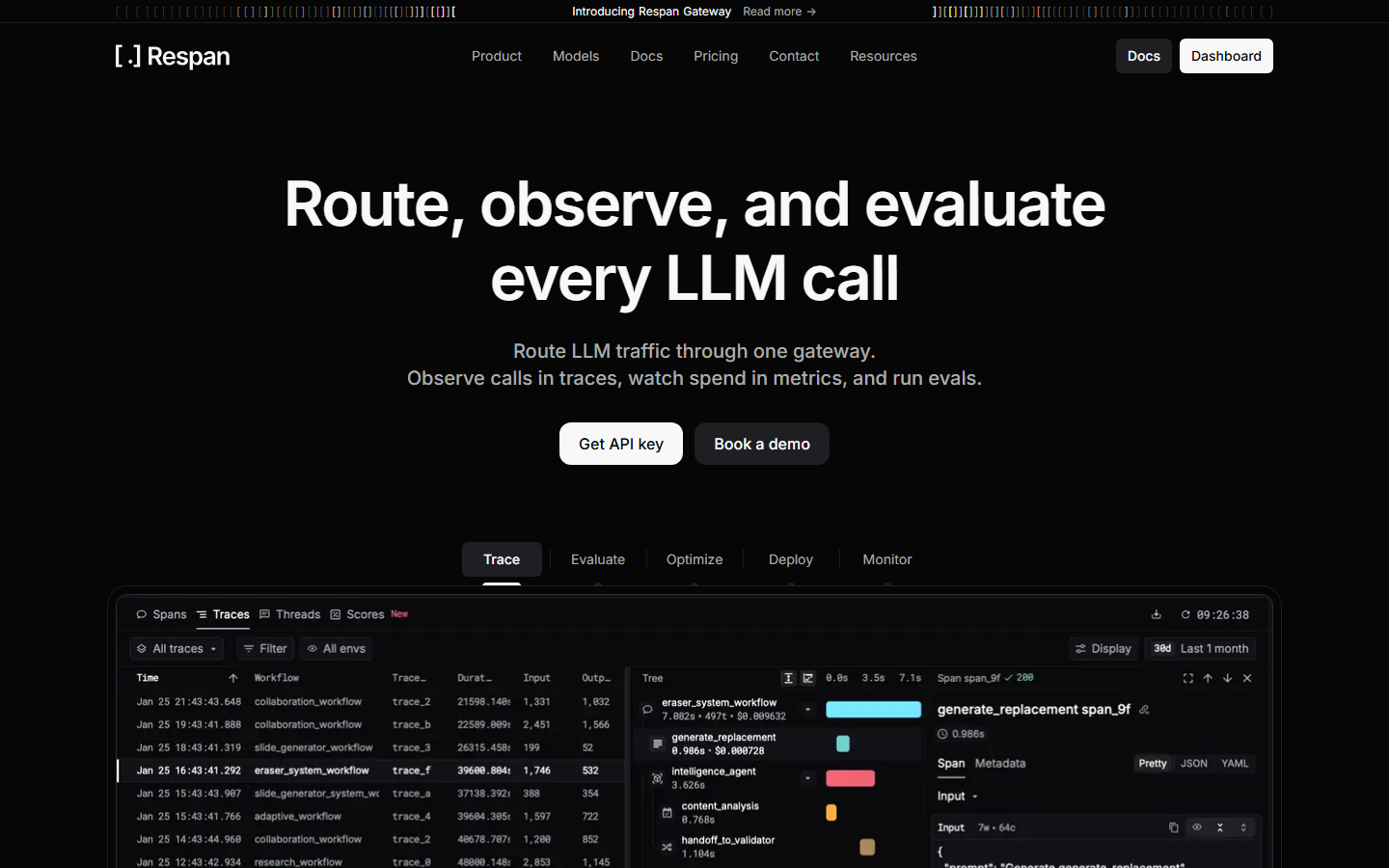
Keywords AI tool text
Core parameters and statistics
Keywords AI’s current external operating brand is Respan. The official brand page states that its legal entity is Keywords AI, Inc., and the brand and product use Respan uniformly; therefore, this tool entry retains the historical tool name Keywords AI, and uses Keywords AI (Respan) in the text to refer to the current product. The official website structured data describes the product as an AI engineering platform that unifies LLM observability, evals, prompt optimization and LLM gateway. The documentation page further defines the core data structure as span.
| Project | Current Public Information |
|---|---|
| Product positioning | AI engineering platform for LLM and Agent products |
| Core data structure | span, holds input, output, model, metrics and metadata |
| Main workflow | Trace & monitor, Evaluate & optimize, Prompt & gateway, Iterate |
| Gateway coverage | Official document annotation supports 250+ models |
| Integration ecology | changelog annotation 95+ integrations overview |
| SDK and access | Python SDK, TypeScript SDK, API, OTLP/JSON ingestion, framework integration |
| Companies & Brands | Legal Entity Keywords AI, Inc., operating brand Respan |
| Founding information | Official structured data lists foundingDate 2024, founder Hendrix Liu |
| Platform entrance | Web console and API |
Boundary positioning: Keywords AI (Respan) is not a simple chatbot or prompt generator, but puts the routing, logs, evaluation and prompt deployment of LLM calls into the same project. It is more suitable for teams that are already running LLM/Agent traffic in production; individual users with only a few manual prompt experiments usually have difficulty in using its monitoring and evaluation capabilities immediately.
User and market recognition
YC Endorsement: Respan is included on the Y Combinator company page and mutually verified with the company information on the official website and brand page. For procurement or technology evaluation, the value of this type of public company page is not to prove the effectiveness of the product, but to confirm the team identity, company existence and external accelerator background.
Engineering team orientation: The official document directly states that the goal is teams shipping LLM and agent products, and puts developers and PMs in the same workflow. This means that its core users are not individual Prompt authors, but product engineering teams that need to jointly manage quality, cost, releases, and rollout risks.
Ecological Approval Signal: 2026-03-26 changelog public 95+ integrations overview, covering Agent Frameworks, LLM SDKs, Coding Agents, Vector Databases and Model Providers. This number shows that it has expanded from a single logging tool to a more complete AI engineering access layer, but the number of enterprise customers, number of paying customers, and revenue scale have not been disclosed, and commercial penetration cannot be inferred based on this.
Cost advantage
The cost advantage of Keywords AI (Respan) is not the “lowest unit price”, but the reduction of data transfer between multiple sets of tools. After span carries input, output, model, indicator and metadata at the same time, monitoring, evaluation Prompt version and Gateway routing can reuse the same production data, reducing the maintenance cost of the engineering team to build separate tables for logs, evaluation sets, alarms and deployments.
C-side/Individual: Pricing page title and description display support starts from the free plan, but if individual users do not have real LLM traffic, data sets or Agent traces, they can mainly experience console prompts and a small amount of call logs, and the profit margin is narrow. The free quota, specific limits and overage billing are subject to the official real-time page.
Developers/API: Gateway supports routing 250+ models through a single API and provides fallbacks, retries, load balancing, and caching. Development costs mainly come from accessing the SDK, replacing the base URL, setting up metadata, maintaining evaluators, and handling additional gateway delays; the documentation clearly states that the Gateway will add about 50-150ms of delay, and extremely low-latency links need to be evaluated separately.
Enterprise / Privatized: Enterprise, Book a demo, support and compliance pages show that it is for enterprise procurement, but details such as enterprise terms SSO, auditing, data retention HIPAA BAA, regional hosting and other details require business confirmation. For enterprises, hidden costs usually focus on data governance, model supplier bill collection, online approval and evaluation standard development, rather than single platform subscription fees.
Main functions
- LLM Observability: Displays Agent execution tree, model call, input and output, delay, cost token, error rate and other indicators through traces, spans, threads and scores, which is suitable for troubleshooting quality fluctuations and abnormal calls in production.
- Monitoring Views and Alerts: Document description: The dashboard can display requests, tokens, latency, cost, error rates, and supports saving Views and setting up Slack/Email monitors, which is used to convert daily troubleshooting from manual log checking to subscribed monitoring views.
- Online / Offline Evals: Evaluation supports two modes: online production traffic and offline test set. LLM judge, code inspection or manual review can be used to generate scores, which is suitable for comparing prompt versions, models and configuration combinations.
- Prompt Management: Supports template commit versions with
{{variables}}, playground testing and codeless change deployment. It is suitable for removing Prompt from the code warehouse and handing it over to products and projects for joint maintenance. - LLM Gateway: Access multiple models through a single API and provide automatic log fallbacks, retries, load balancing and caching, suitable for multi-model routing, supplier switching and cost/stability management.
- Framework and SDK access: The official document lists the integration of OpenAI Agents SDK, Vercel AI, Mastra, LangGraph and other frameworks, and provides Python, TypeScript SDK and manual ingestion paths, which is suitable for gradual integration from existing code.
What these capabilities have in common is around "production data reflow." If the team only compares several prompts offline, a separate table or notebook is enough; when the prompt version, online performance, model cost and user feedback need to be closed, the platform value of Keywords AI (Respan) will be more obvious.
Model and version evolution
Keywords AI (Respan) is a continuously iterative cloud product that does not have the semantic large version number of traditional desktop software. The current verifiable version context mainly comes from the official changelog and brand page.
Mainline release
- 2026-06-14 / Prompt bulk updates: The latest public changelog node, new Prompt batch updates, support for editing multiple Prompts at the same time, and with model configuration and commit message support; while improving Prompt and Playground data loading performance.
- 2026-03-26 / Respan CLI with 95+ integrations overview: Exposed
@respan/cliv0.6.0,respan integrate, and launched an integration overview covering Agent Frameworks, LLM SDKs, Coding Agents, Vector Databases and Model Providers. - 2026-03-13 / OpenAI SDK TypeScript integration: Added OpenAI SDK TypeScript automatic instrumentation, covering streaming, tool calls, multi-turn, structured output and batch API examples.
- 2026-03-06 / Unified Python & TypeScript SDKs: The release of unified Python and TypeScript SDKs, as well as Pydantic AI integration, indicates that the product is beginning to be more systematically oriented towards Agent framework tracking.
Brand and Product Line
Brand Relationship: The brand page clearly states that the legal entity is Keywords AI, Inc. and the operating brand is Respan. External display, documents, consoles and brand materials are all based on Respan; the continued use of Keywords AI in the tool directory is to inherit the historical names and user search habits.
Product line changes: The top banner of the official website displays Introducing Respan Gateway, and the main title of the homepage emphasizes Route, observe, and evaluate every LLM call, indicating that the product has expanded from "LLM monitoring/evaluation" to the complete LLMOps workflow of "gateway + observability + evaluation + prompt management".
Technical advantages
span unified data model: All LLM interactions are stored in span, including input, output, model, metrics and metadata. The benefit from the mechanism is that traces, threads, scores, dashboard, evals and prompt/gateway data can be aligned, reducing the break of "monitoring one set of IDs, evaluating one set of IDs, and prompting versions and another set of IDs"; it is suitable for products with long agent workflows and many tool calls.
Production Data Driven Evaluations: The documentation states that datasets can be built from production spans or CSV imports, and online evals can be run on live production traffic. In this way, the evaluation is not limited to a static sample set, but can incorporate real user traffic into regression checks; the cost is that the team needs to first define an interpretable evaluator and a manual review process.
Gateway and observation linkage: Gateway traffic will be automatically recorded and flowed back to tracing, and Prompt variables can also appear in spans. The mechanical effect is that the engineering actions of "model routing/retry/caching" can be viewed together with the observation results of "cost/delay/output quality", which is suitable for teams using multiple model suppliers in parallel.
Multi-entry access: SDK, framework integrations, OTLP, JSON API and Gateway coexist, allowing teams to split access paths according to risk: for low intrusion, trace can be connected first; gateway can be switched when unified routing is required; and corresponding instrumentation can be used when there is a complex Agent framework. The boundary of this advantage is: the deeper the access, the higher the governance responsibility, and the metadata specification and permission model must be designed simultaneously.
How to use
The typical implementation path of Keywords AI (Respan) is to first create observable data, and then use evaluation and Prompt/Gateway to optimize it.
| Entrance | Suitable for the scene | Key actions |
|---|---|---|
| Web console | View traces, metrics, views, evals, prompts | Create account, generate API key, view dashboard |
| SDK / Framework integrations | Existing LLM or Agent application | Install Python/TypeScript SDK, access OpenAI Agents SDK, Vercel AI, Mastra, LangGraph, etc. |
| Manual ingestion | Existing logging system or custom link | Send traces / spans via OTLP or JSON API |
| LLM Gateway | Requires multi-model routing and automatic logging | Replace base URL, configure model fallback, retry, load balancing, caching |
| Prompt management | Prompt requires versioning and codeless deployment | Create templates, submit versions, test in playground and go live |
Recommended order: First use tracing to capture a real business link and confirm that input/output, latency, cost, and metadata can be fully recorded; then sample the production spans to form a dataset, and add LLM judge, code inspection or manual review; finally, include the stable Prompt version and Gateway routing into the deployment. This avoids premature discussion of model routing strategies when there is no data baseline.
Product Pricing
The Pricing page openly displays the Free, Pro, and Enterprise tiers, and emphasizes in the page description that you can start with the free plan and upgrade when you need dedicated support. The public page does not steadily provide all enterprise contract terms. The specific quota, seats, usage, retention period and support level should be subject to official real-time pricing and business confirmation.
| Hierarchy | Public Positioning | Cost Focus |
|---|---|---|
| Free | Used to start access and verification | Free quota, call volume, team members, and data retention period are subject to the real-time page |
| Pro | For growing product/engineering teams | Focus on spans / traces / evals usage, member permissions, alerts and Prompt/Gateway functional boundaries |
| Enterprise | For scaling and compliance teams | Need to confirm SSO, auditing, data retention HIPAA BAA, support SLA, region and contract terms |
| LLM supplier fees | Not equivalent to platform subscriptions | Model calling fees for OpenAI, Anthropic, Google, Azure, etc. still need to be accounted for separately |
Cost accounting method: Platform subscription, model invocation fee, additional Gateway delay, log retention, evaluator invocation fee and manual review time should be calculated together when evaluating the total cost. In particular, online evals and LLM judge will add new model calls. Without a sampling strategy, the evaluation cost may increase rapidly with production traffic.
Application scenarios
- AI Customer Service and Intelligent Assistant Monitoring: Trace multiple rounds of sessions, tool calls, and response quality, and combine user-dimensional metrics and alerts to discover cost anomalies, increased delays, or failed responses.
- Agent Workflow Troubleshooting: Display Agent step, tool call, and LLM call according to parent-child spans, which is suitable for locating which step of the tool call times out and which sub-task causes error output.
- Prompt version iteration: Product managers and engineers compare version differences through Prompt templates, commit versions, playgrounds, and experiments to reduce the risk of discovering quality regressions after going online.
- Multi-model routing and supplier governance: Manage the call entry of 250+ models through Gateway, and set fallback, retry, load balancing and caching between different suppliers. It is suitable for teams that want to reduce dependence on a single model.
- AI Applications in Compliance-Sensitive Industries: The official website displays compliance instructions related to GDPR and HIPAA, and mentions that healthcare organizations can use the Business Associate Agreement; industries such as medical and finance still need to review the data processing terms according to their own compliance processes.
These scenarios all rely on "sufficiently complete online data." Without stable metadata, customer_identifier, Prompt version and business tags, the platform can record calls, but it is difficult to form interpretable quality and cost analysis.
Applicable people
- AI Product Engineering Team: There is already LLM/Agent traffic, and calls, costs, delays, errors, quality evaluation and Prompt releases need to be managed uniformly.
- Platform and Infrastructure Team: Hope to use Gateway to manage multi-model supplier fallback, retry, cache and routing policies while retaining a unified observation surface.
- Product Manager and Prompt Leader: Need to manage Prompt templates, versions, experiments and launches without frequent code changes.
- Quality and Compliance Team: Need to form auditable records of output quality, manual review, evaluation scores, data retention and alarm links.
The boundaries of unsuitability are also clear: only one-time Prompt tests, no production calls, no engineering access capabilities, or low-latency links that are unacceptable for the new 50-150ms Gateway delay are usually not suitable as the first choice. This kind of scenario is more suitable to use lightweight logs, offline evaluation tables or direct SDK tracing first, and then introduce the complete platform when the business enters the continuous iteration stage.
Summary and Outlook
The core competitiveness of Keywords AI (Respan) lies in splitting the LLM call life cycle into one entity: production trace records facts, monitoring identifies cost and stability issues, evals measures output quality, prompt management manages versions, and gateway is responsible for multi-model routing and deployment reflow. Compared with tools that only do observability or prompt management, it is more like the engineering control surface of AI products.
There are three main categories of current limitations: First, the brand has shifted from Keywords AI to Respan, and historical names and current official websites need to be uniformly mapped in the internal knowledge base; second, enterprise-level prices, usage caps, data retention, and SLA are not fully disclosed and require business confirmation; third, Gateway's additional 50-150ms delay and LLM judge evaluation costs will affect high-throughput, low-latency, or cost-sensitive businesses.
Directions worthy of observation in the future include: whether the model coverage of Respan Gateway continues to expand, whether online evals precipitates a more standard evaluation template, and whether the 95+ integrations continue to increase the adaptation of mainstream Agent frameworks and vector databases. A more prudent approach during implementation is to first select a representative LLM business link for a small-scale pilot, and use one to two weeks to verify the trace completeness rate, key indicator coverage, evaluation cost, and alarm effectiveness, and then decide whether to expand to enterprise-level Prompt and Gateway governance.
Version Info
- Prompt bulk updates :The latest public node of the official changelog, adds Prompt batch update, and improves the loading performance of Prompt and Playground.
- Respan CLI and integrations overview :The official changelog exposes Respan CLI, 95+ integrations overview, and covers integration categories such as Agent Frameworks, LLM SDKs, Coding Agents, Vector Databases and Model Providers.
- Unified Python and TypeScript SDKs :The official changelog publicly unifies the Python and TypeScript SDKs, and adds Pydantic AI integration to track Agent operations.
User Reviews