 Kling AI
Free
Kling AI
Free
Kling AI is a new generation AI video and image generation platform produced by Kuaishou. It is equipped with the VIDEO 3.0 series model and supports text/picture/video generation of high-quality videos. It has native audio, lip synchronization, multi-lens narrative, motion control 4K output and digital human capabilities, covering the entire creative process from creative inspiration to commercial films.
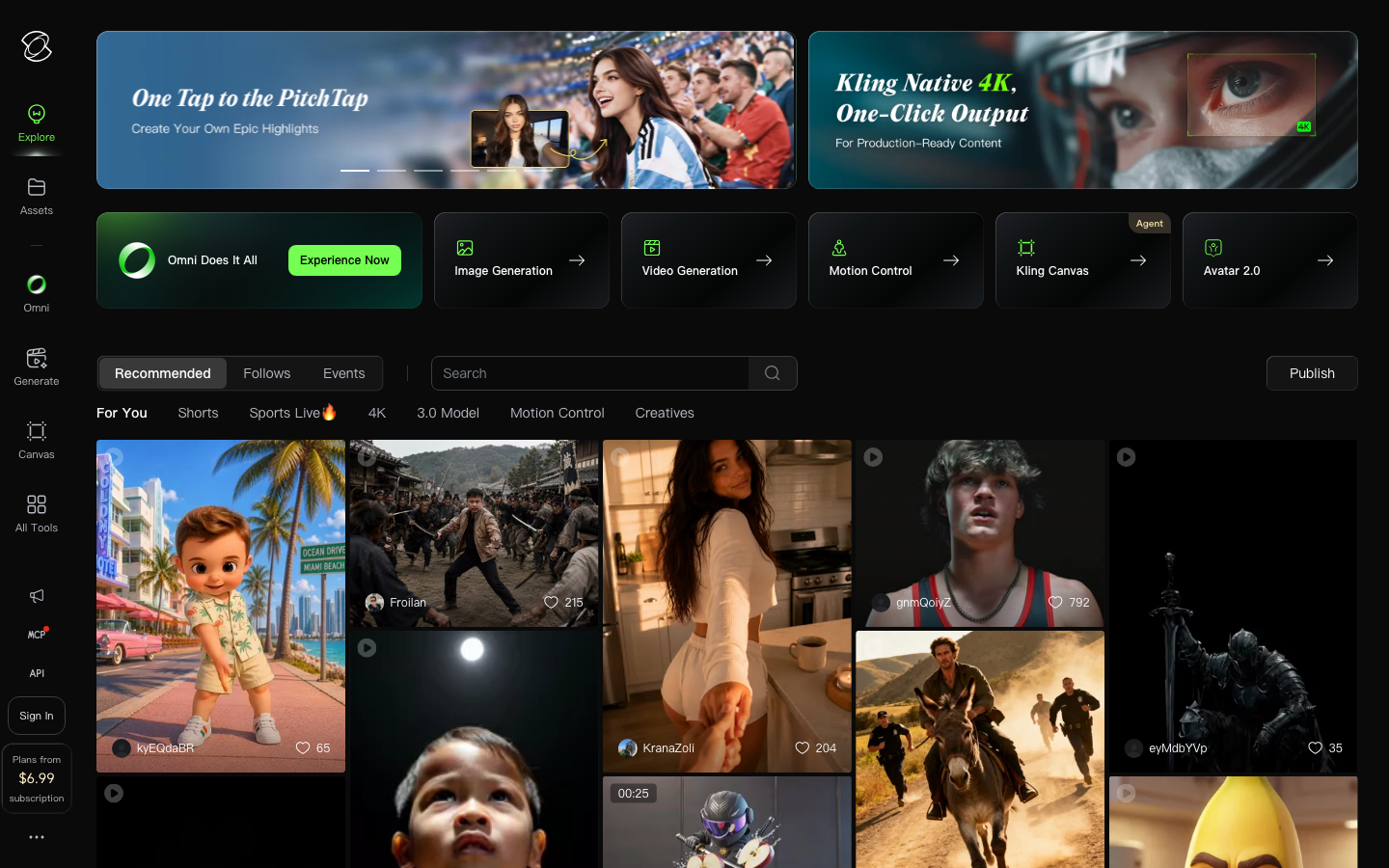
KlingAI
Kling AI’s core parameters and statistics
Kling AI is an AI video and image generation platform launched globally by Kuaishou Technology (type determination: Type D - productivity/business-side application, supplemented by Type B - platform-side API infrastructure). It is equipped with the VIDEO 3.0 series model, covering text/image/video to video generation, native audio, motion control, digital people, style transfer and other creative links. It belongs to the first echelon of AI video generation with OpenAI Sora, Runway Gen-3, Pika, and Keling AI (both Kuaishou series), but it has differentiated advantages in Chinese semantic understanding, Asian aesthetic preferences, and multi-language dubbing support.
| Projects | Public Information |
|---|---|
| Product positioning | AI video and image generation creation platform |
| Core Model | VIDEO 3.0 / VIDEO 3.0 Omni |
| Input method | Text → video, picture → video, video → video, multi-picture reference |
| Output resolution | Up to 4K (30 points/second), 1080p (members) |
| Maximum generation time | 3-15 seconds, supports multi-shot splicing narrative |
| Native audio | Supports multi-language dialogue, lip sync, and ambient sound effects |
| Supported platforms | Web, iOS, Android, macOS, Windows |
| Place of Belonging | CN (Kuaishou Technology) |
| Supported languages | Chinese, English, Japanese, Korean, Spanish and dialects |
| Cumulative users | 60 million+ (official claim) |
| Cumulative generated videos | 600 million+ (official claim) |
| App Store Rating | 4.7★ |
| Commercial use | Paid membership supports commercial use authorization |
Brief review in one sentence: Kling AI is not a video editing tool, but an AI creation engine that "generates video segments directly with a sentence or a picture" - enter "a cyberpunk city under the neon lights on a rainy night, push the camera," and you can get a 4K video clip in a few minutes.
Users and market recognition of Kling AI
Kling AI is one of the AI video generation platforms with the largest user base in the world. Official data shows that its cumulative registered users have exceeded 60 million, the total number of AI videos generated by the platform has exceeded 600 million, and its App Store rating is 4.7★. These data are in a leading position in the AI video generation track, exceeding the scale disclosed by most competing products during the same period.
Market position: In the critical cycle of AI video generation from laboratory to commercialization from 2024 to 2026, Kling AI, OpenAI Sora, and Runway constitute the representatives of the "three technical routes" - Sora emphasizes physical world simulation, Runway focuses on professional creator tool chains, and Kling AI follows the route of "mass creation + ultimate image quality + audio integration". Kling AI has the highest recognition in the Chinese market, and has also established a considerable user base overseas (especially in Japan, South Korea, Southeast Asia, and European and American creator communities).
Industry Adoption: Kling AI has been incorporated into the daily workflow of a large number of short video creators, advertising agencies, e-commerce operations teams and film and television pre-production studios. The official blog shows multiple cooperation cases, including the AI-assisted production of Portugal’s World Cup promotional video “Vai Dar Portugal” and the AI preview of multiple brand advertisements. The product has a high degree of active discussion in the creator community (Discord, X/Twitter, TikTok).
Third-party evaluation: The official page includes five-star reviews from many overseas creators. The core points of approval focus on "the balance between image quality and motion coherence", "control accuracy of character consistency" and "naturalness of native audio and image synchronization". However, it should be noted that these reviews are derived from official selections, and full coverage needs to be judged based on community feedback.
Kling AI’s cost advantage: Points-based membership covers individuals to teams in different layers
Kling AI adopts a hybrid charging model of "free trial + points subscription", which consumes points based on factors such as model, resolution, audio, and duration. Points, prices, benefits and access rules will be adjusted with product iterations. The following data is based on the official blog and membership page in July 2026.
C-side/personal creator
| Member level | Monthly fee (first month discount/renewal price) | Monthly points | Core benefits |
|---|---|---|---|
| Basic | Free | 0 (per-view consumption) | 30 creative elements, including watermark, not for commercial use |
| Standard | $6.99 / $8.8 | 660 points | Watermarkless 1080p video, expedited generation, commercial authorization |
| Pro | $25.99 / $32.56 | 3000 points | 4K output, priority to experience new features 150 creative elements |
| Premier | $64.99 / $80.96 | 8000 points | Same as above, large point pool |
| Ultra | $127.99 / $159.99 | 26,000 points | Beta test invitation 500 creative elements, about $0.62/100 points |
The truth about free quota: The Basic plan provides 30 creative elements (non-fixed number of videos). The generated videos come with Kling AI watermarks and cannot be used for commercial purposes. It is suitable for single experience and functional testing, but cannot support daily content production.
Point consumption reference: Standard 720p video consumes approximately 20 points/second; after turning on 4K mode, it is billed at 30 points/second; Native Audio, Multi-Shot and Omni reference workflows will consume additional points.
API/Developer
Kling AI provides a developer platform (kling.ai/dev) and supports API access. For specific pricing, frequency control, model list and SLA, you need to register through the developer platform and check the latest documents. Compared with pure C-side platforms, API access provides more flexible integration capabilities and is suitable for medium and large teams that embed video generation into their own production pipelines.
Enterprise/Privatization
Detailed terms for enterprise-level solutions and privatized deployments have not been disclosed. Customers with high-frequency and large-volume usage or special requirements for data compliance need to contact the official business team to customize a plan. Considering Kuaishou Technology's domestic compliance system, privatized deployment is feasible in the mainland Chinese market, but overseas data residency policies need to be confirmed separately.
Hidden benefits and costs: The biggest hidden benefit of AI video generation is "compressing the preparation-shooting-post-production link of traditional video production from hours to days to a single generation in minutes." But its hidden costs are equally significant - the uncontrollability of the generated results requires multiple iterations of trial and error, and a single generation waits from several minutes to more than ten minutes. The accumulated waiting and screening time may offset part of the efficiency gains. In addition, access latency and availability for overseas users (especially non-Asia Pacific regions) need to be factored into the assessment.
Kling AI’s main features
With the VIDEO 3.0 series model as the core, Kling AI has built a creative platform covering seven functional modules "from idea to finished film":
- Text-to-Video: Enter prompt words to describe the scene, characters, movement, light and shadow, and lens language, and AI will directly generate a matching video. Suitable for creative expression from scratch without any material input. Synergy effect: Cooperating with prompt word engineering (clear subject description + lens direction + atmosphere keywords) can significantly improve the first generation efficiency and reduce the number of iterations.
- Image-to-Video: Upload a static picture (character photo, product picture, concept design draft) as the starting frame, and AI will complete the subsequent movement and narrative. This is currently the most practical function - first use Midjourney/Stable Diffusion to generate concept maps, and then use Kling to convert them into dynamic previews. Synergy effect: Combined with AI image tools to form a production line of "image generation concept → image change animation", bypassing the uncertainty of pure text generation.
- Video 3.0 Omni (Reference Driven): Upload a reference video or element map, and AI extracts the character characteristics, action patterns, and sound qualities in it to maintain a consistent visual and auditory identity in new scenes. Suitable for the creation of brand IP, serialized content and recurring characters. Project Tips: The image quality of the reference material directly determines the output upper limit. It is recommended to use clean and accurately focused source material.
- Motion Control: Lock the character's facial expressions and body movements by referring to the video, supporting multi-angle consistency, occlusion scenes and complex emotional migration. It is currently one of the most mature solutions for character facial consistency control in the industry. Focus: Traditional AI videos are prone to facial distortion (AI morphing) when "turning head/occluding/far-view switching". This feature introduced in Kling 2.6 has been further stabilized in 3.0.
- Native Audio & Lip-Sync: Generate matching dialogue, narration and ambient sounds while generating videos, supporting multiple languages (Chinese/English/Japanese/Korean/Spanish)
) and dialects, and automatically aligns lip movements. Cross-functional collaboration: Audio is no longer an independent track added later, but is deeply coupled with the picture and expression logic generated by the video, solving the traditional pain point of "post-production dubbing not matching the mouth shape".
- Multi-Shot: In a generation task, multi-shot clips are generated by customizing storyboard parameters (duration, composition, perspective, narrative content, camera movement), and AI automatically maintains the consistency of characters and scenes. Efficiency Index: Traditional storyboards need to be generated separately and then edited and spliced shot by shot. Multi-Shot compresses this process into one submission.
- Digital Human & Restyle: Generate realistic virtual characters and drive them to speak/act, or convert the style of existing videos to a specified aesthetic style. Adapt to scenarios: Live virtual anchoring, rapid production of corporate training videos, and artistic style experiments.
[Expert View]: The core "hidden linkage" of Kling AI's functional matrix design lies in "using reference data to bridge the uncertainty of generation" - Omni's motion control + element reference + audio binding constitute a "reference aircraft", and creators provide more accurate source materials in exchange for more controllable output, rather than relying on random card drawing. This design is closer to the actual needs of industrial-level workflow than a purely prompt-driven solution.
Kling AI model and version evolution
Kling AI has experienced rapid iteration from "available" to "commercially available" from its debut in mid-2024 to mid-2026:
Main model version line
| Version | Time | Key Changes |
|---|---|---|
| VIDEO 1.0 | ~2024-09 | Initial release, supports basic text to video generation, output in about 5-10 seconds |
| VIDEO 2.0 | ~2025-12 | Introducing the picture to video function, significantly improving motion coherence and picture consistency |
| VIDEO 2.6 | ~2026-03 | Motion Control is online, supporting reference video driver static images |
| VIDEO 3.0 | ~2026-06 | Comprehensive architecture upgrade, 4K output, native audio, multi-camera narration, multi-language lip sync |
| VIDEO 3.0 Omni | ~2026-06 (same period as 3.0) | Add video element reference and element voice control based on 3.0 to strengthen reference-driven workflow |
Version selection comparison
| Comparison Dimensions | VIDEO 3.0 | VIDEO 3.0 Omni |
|---|---|---|
| Core workflow | Prompt driver (starting from text/image) | Reference driver (centered on material consistency) |
| Input method | Text, picture, start/end frame | Text, picture, multi-picture reference, element reference, video reference |
| Character Consistency | Multi-Character Core Reference (3+ Characters) | Element Reference + Video Reference + Voice Control |
| Audio Capabilities | Native Audio + Multilingual + Lip Sync | Above + Element Level Voice Control |
| Recommended scenarios | Rapid creative exploration, multi-character narrative scenarios | Brand advertising, serialized content, product consistency requirements |
Technical advantages of Kling AI
The technical advantages of Kling AI can be broken down from three levels: model architecture, engineering implementation and creative control:
Architecture Upgrade (3.0 Core): The VIDEO 3.0 series has upgraded its underlying architecture from the single-path diffusion of 2.0 to a hybrid architecture that supports "deep multi-modal instruction parsing" and "cross-task integration". This means that the same model instance can process text prompts, understand visual features and audio features in the reference material, and maintain multi-modal signal coordination during the generation process. Mechanically, the temporal attention module (Temporal Attention) is used to ensure the continuity of motion between frames, and the optical flow constraint (Optical Flow Guidance) is used to reduce picture drift. Effect implementation: The direct benefit of this architecture is native output of 4K resolution - no need for post-production super-scoring, and a single coherent narrative of up to 15 seconds.
Reference Consistency Control (Omni Differentiation): The key technical capability that distinguishes Kling from most competing products is the implementation of "Subject Binding". Through Element Reference and Video Element Reference, the system can lock the visual characteristics, movement patterns and sound characteristics of the character/product, and maintain identity consistency during multi-shot switching. At the technical level, this involves the joint optimization of face feature embedding (Face Embedding), pose estimation (Pose Estimation) and voiceprint binding (Voiceprint Binding). Applicable scenarios: The core value of this mechanism is to move AI videos from "one-time generation" to "reusable character/product-level production".
Audio-video native coupling: Kling's Native Audio is not the automation of post-dubbing - it generates audio as part of the video generation pipeline, outputs the picture and corresponding voice/sound effects simultaneously during the model inference stage, and automatically aligns lip movements. This design avoids the lip misalignment problem of the traditional "picture first, dubbing later" problem, and controls the pronunciation mouth shape through language tokens in multi-language scenarios. Limitations: Currently, Native Audio may still cause channel confusion in complex multi-character dialogue scenarios. It is recommended to clearly mark the speaker's identity in the prompt.
Project pitfall tips:
- Dead-end loop with Token control: When the prompt semantics are ambiguous or contain contradictory instructions, the model may perform excessive "self-correction" during the inference phase, resulting in extended generation time. It is recommended to write prompts with a clear three-level structure of subject-action-situation and avoid compound negative sentences.
- Amplification effect of reference material on quality: The clarity, lighting and composition defects of the reference video/picture will be amplified by the model into the output results. It is recommended to do a basic image quality check before loading in materials.
- 4K power consumption and waiting time: The amount of inference calculation in 4K mode is about 4-6 times that of 720p, and the single generation time extends from tens of seconds to several minutes. A good time budget needs to be planned during mass production.
How to use Kling AI
Kling AI provides multiple access methods, covering different usage habits and scenarios:
Official entrance
| Entrance | Address | Applicable Scenarios |
|---|---|---|
| Web main site (overseas) | https://kling.ai |
Full-featured access, recommended |
| Web main site (domestic) | https://app.klingai.com/global/ |
Optimized access to mainland China |
| iOS App | App Store Search Kling AI | Mobile Creation and Browsing |
| Android App | Official channel download | Mobile creation |
| macOS Desktop | Download the DMG installation package from the official website | Desktop workflow |
| Windows Desktop | Download the EXE installation package from the official website | Desktop workflow |
| Developer Platform | https://kling.ai/dev |
API integration and developer tools |
Typical usage steps
- Register an account: Register via email or Google/Apple account, and the free plan will take effect immediately.
- Select model: Select VIDEO 3.0 (Prompt driver) or VIDEO 3.0 Omni (reference driver) in the creation interface.
- Prepare to input: Write a text prompt (50-200 characters recommended, including subject, action, context, light and camera direction) or upload reference pictures/videos.
- Configuration Parameters: Select the generation time (3-15 seconds), resolution (720p/1080p/4K), whether to enable Native Audio and multi-camera mode.
- Submit Generation: Click Generate and wait from tens of seconds to minutes (depending on the resolution and model complexity).
- Download/Iteration: Preview the result. If you are satisfied, download it (no membership plan includes Kling watermark). If you are not satisfied, adjust the prompt or regenerate with reference to the material.
API Developer: Visit kling.ai/dev to register a developer account, obtain the API Key and generate capabilities through standard REST API calls. For detailed access documents, please refer to the latest version of the developer platform.
Product Pricing for Kling AI
Kling AI's pricing system is a "point-based subscription". Different membership levels receive a fixed pool of points every month, and various generation tasks consume points according to standards. The following is a summary of public information in July 2026:
Subscription plan details
| Plan | Monthly fee | Points/month | Converted unit price | Reference number of videos (720p) | Key benefits |
|---|---|---|---|---|---|
| Basic | Free | 0 | — | 2-3 experiences | Contains Kling watermark, not for commercial use 30 creative elements |
| Standard | $8.8/month | 660 | $1.33/100 points | ~33 items | Watermark removal 1080p, expedited generation, commercial authorization |
| Pro | $32.56/month | 3000 | $1.09/100 points | ~150 items | 4K output, priority experience of new features |
| Premier | $80.96/month | 8000 | $1.01/100 points | ~400 items | Large point pool, priority support |
| Ultra | $159.99/month | 26000 | $0.62/100 points | ~1300 items | Beta test invitation, best value for money |
First month discount: Standard/Pro/Premier/Ultra can enjoy about 20-30% discount in the first month ($6.99/$25.99/$64.99/$127.99 respectively), and the original price will be restored upon renewal. The discount intensity and validity period are subject to the real-time display on the official website.
Point consumption key value:
- 720p video generation: ~20 points/time
- 1080p video generation: ~40 points/time
- 4K video generation: 30 points/second
- Native Audio Overlay: Extra 30-50%
- Multi-Shot: accumulated according to total duration
Commercial authorization instructions: The Basic plan does not support commercial use; the content generated by the Standard and above plans can be used for commercial projects, including social media content, advertising, product display, etc. The specific terms are subject to kling.ai/docs/user-policy.
Application scenarios of Kling AI
Kling AI's capability boundaries cover multiple scenarios from "casual creativity" to "semi-industrial production":
- Batch production of short videos and social media content: Short video platforms such as Douyin/TikTok, Instagram Reels, and YouTube Shorts have a huge demand for "daily updates". Kling AI can batch generate multiple shots from a popular prompt for operators to filter, replacing traditional material library searches and basic editing. Key points to check: The aspect ratio adaptability of the output video (whether it supports 9:16 vertical screen), and whether the single generation duration covers the standard short video rhythm of 15-60 seconds (the current maximum length of a single segment is 15 seconds, which needs to rely on Multi-Shot combination or post-editing).
- One-click generation of e-commerce product videos: Upload the main image of the product, and use I2V and Motion Control to make the product "move" - rotating display, scene-based interpretation, and preview of the model's wearing effect. Reduce the cost of product video production that originally required a studio from hundreds of yuan per video to almost marginal cost. Quantitative deduction: Traditional e-commerce product videos take about 2-4 hours per video from shooting to post-production (including lighting, multi-angle shooting, editing, and soundtrack). Kling AI assistance can compress the time to 5-15 minutes per video, but it requires additional time for selection and reproduction.
- Advertising Proposal and Storyboard Preview: Advertising companies use Kling AI to generate dynamic versions of key images during the creative proposal stage, replacing the traditional static storyboard. Customers can intuitively feel the lens movement, rhythm and visual style before shooting, greatly reducing the cognitive gap between "static plan vs. finished film effect". Human-machine collaboration boundary: This scenario recommends positioning AI output as an "internal proposal tool", with final delivery still relying on traditional shooting or high-end VFX - AI video is not yet sufficient for direct commercial use in terms of physical accuracy, actor performance, and brand safety.
- Virtual Digital Human and Live Broadcast Assistance: Use the digital human function and Native Audio to quickly generate a conversational virtual image, which is suitable for corporate training videos, product introductions, 24-hour online customer service front pages, and other scenarios. **hidden
Sex cost**: The lip synchronization of digital people may have timing drift in long conversations. It is recommended to generate it in segments and splice it later.
- Pre-production concept visualization for film and television: Directors and directors of photography use Kling AI to transform scene descriptions, atmosphere maps, and character settings into dynamic visual previews in the early preparation stage to assist the team in unifying the visual language. Cost reduction and efficiency enhancement: Traditional concept preview requires hiring a concept designer to draw key frames (about $200-500/frame). Kling AI can reduce the exploration cost to the intellectual cost of prompt writing, but the visual quality is not enough to replace the sophistication of the final design.
Applicable groups of Kling AI
- Short video creators and social media operators: A large amount of video material is needed daily to maintain the update rhythm. The core requirements are "fast" and "enough". Kling AI’s free plan and Standard plan cover basic scenarios. Prerequisites: You need to master basic prompt writing skills, and a certain degree of "result filtering tolerance" - only 2-3 out of 10 generations may be used directly.
- E-commerce operations and product content team: Convert product pictures into dynamic display videos to reduce shooting outsourcing costs. The Pro plan (4K output + commercial license) is the minimum entry threshold. Key points of verification: It is necessary to confirm whether the generated video accurately presents the product material, color and details to avoid customer complaints due to AI distortion.
- Advertising Creative and Brand Agency Team: Reduce communication costs using AI video during the proposal stage. It is recommended that at least one person in the team has prompt engineering capabilities, otherwise low-quality output may actually reduce the professional feel of the proposal.
- Independent film and television creators and AI artists: Use Kling AI as a "rapid prototyping tool" for style experiments and inspiration verification. Motion Control and Omni Reference Control are core value points. Not suitable for the boundary: The emotional depth of character performance, precise control of lens rhythm and extreme requirements of picture resolution still require traditional film and television processes.
- Corporate Training/HR Department: Use the digital human function to quickly generate internal training videos and SOP demonstrations, significantly reducing recording and post-production costs. The high point pool of the Ultra plan is suitable for team sharing.
Not suitable for the crowd: Industrial-level production teams that require accurate physical simulation and in-camera special effects (such as car advertisements, high-precision product rendering); brands that cannot accept the "one-eye AI" of AI videos; individual users with extremely limited budgets and do not accept watermarks.
Summary and Outlook of Kling AI
Kling AI will grow from "a chaser in AI video generation" to "one of the largest and most complete products" between 2024-2026. Its core competitive barrier does not lie in a single technical parameter, but in the degree of productization supported by the "Kuaishou system" engineering capabilities - integrating text generation, image reference, video reference, motion control, multi-language native audio and 4K output into a unified creation platform, while maintaining a consistent user experience and acceptable generation waiting time.
Current Core Limitations:
- The maximum generation time for a single segment is 15 seconds. For long video scenes that require continuous narrative, external editing tools are still required for splicing.
- The point consumption in 4K mode is high (30 points/second), and the cost of mass production cannot be ignored.
- The output quality of complex scenes (multi-character dialogue, fast motion, occlusion switching) is still unstable and requires multiple iterations of screening.
- There is still room for improvement in access latency and experience optimization for overseas users (especially in Europe and the United States).
- The copyright identification of AI-generated content is not uniform under the legal frameworks of various countries, and commercial users need to assess the risks themselves.
Follow-up observation points: Whether the model will be iterated to support a single generation of 30-60 seconds to cover the complete short video; whether Native Audio will further refine voice cloning and emotional expression; whether API capabilities and enterprise-level solutions will be completed to cover B-side deep integration scenarios; and whether Kuaishou will provide traffic tilt or distribution advantages for Kling-generated content within its ecosystem (Kuaishou/Douyin).
Procurement/Adoption Risk Assessment: Individual creators start testing with the Basic free plan and use actual demand scenarios (rather than official demo cases) to evaluate whether the output quality reaches acceptable thresholds. Small and medium-sized teams are recommended to apply for the one-month Pro plan ($25.99 for the first month) and run through the complete trial production process. After confirming that the production quality, waiting time and point consumption are in line with expectations, they can then decide whether to subscribe long-term or upgrade to Ultra. For enterprise customers who plan to embed Kling AI into their own production pipelines, it is recommended to first obtain the interface documents from the API developer platform to test the feasibility of the docking, and at the same time verify the data compliance terms (whether the content is used for model training, data residency policy SLA guarantee), and then decide whether to enter the business negotiation stage.
Related tools: runway, pika
Version Info
- VIDEO 3.0 :Equipped with a new upgraded architecture, it supports deep multi-modal command analysis and cross-task integration, and introduces Native Audio, 4K output, multi-lens narrative and element reference control.
- VIDEO 2.6 :Introducing the Motion Control function to support character facial consistency locking and reference video motion migration.
- VIDEO 2.0 :Supports image-to-video generation to improve video coherence and motion rationality.
- VIDEO 1.0 :The product is initially launched and supports basic text-to-video generation capabilities.
User Reviews