 lala l.AI
Free
lala l.AI
Free
LALAL.AI is an AI tool chain that focuses on audio and video sound processing. It is good at vocal removal, stem split, unvoiced voice, voice changing and API integration.
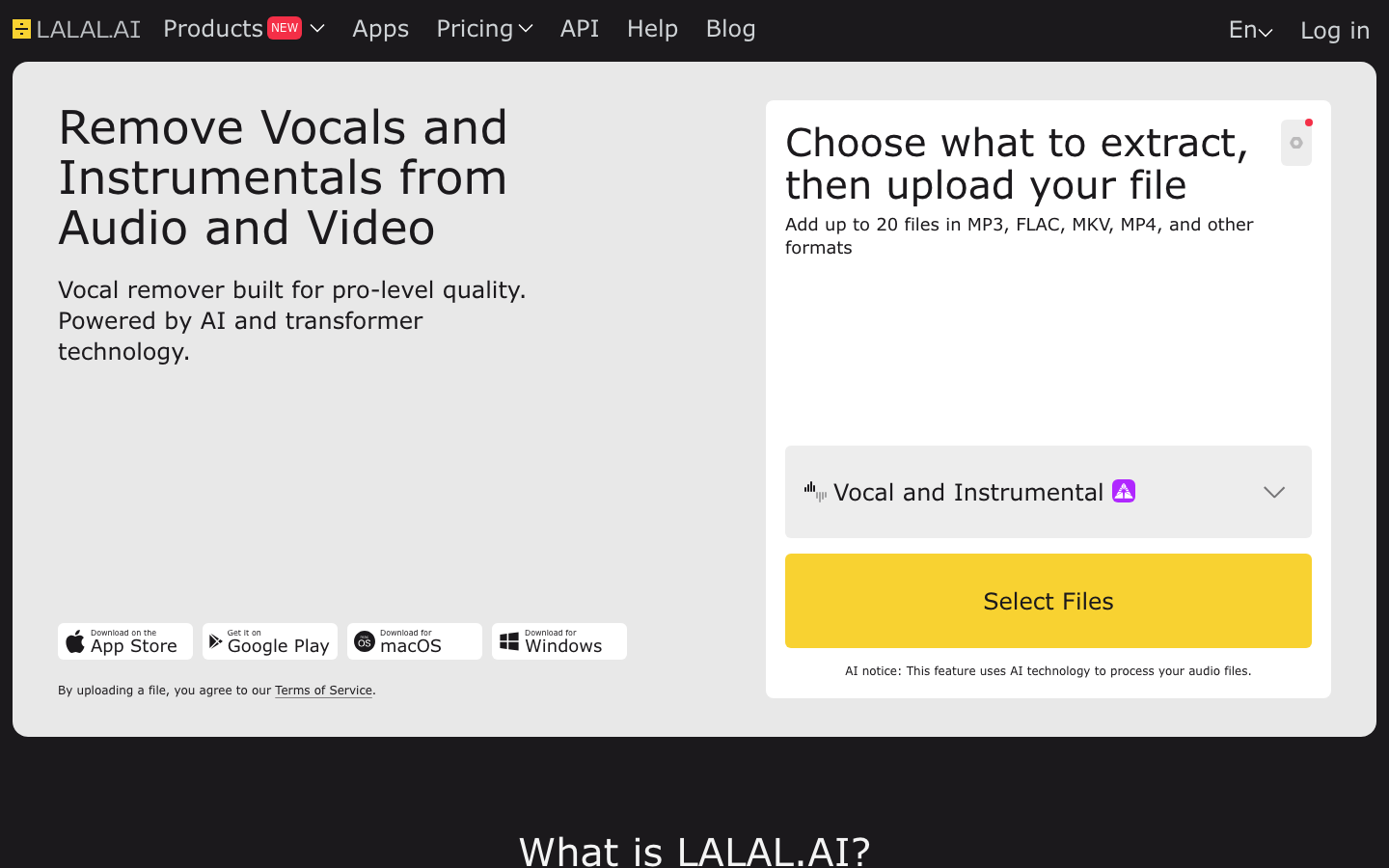
LALAL.AI
Core parameters and statistics
| Projects | Public Information |
|---|---|
| Official positioning | Remove Vocals and Instrumentals from Audio and Video |
| Main capabilities | Stem Splitter, Voice Cleaner, Voice Changer, Voice Cloner |
| Program Structure | Starter / Lite / Pro / Enterprise |
| Processing method | Web + Desktop + Mobile + VST Plugin + API |
| Latest engine signals | Andromeda, Lynx and other networks continue to iterate |
| Supported platforms | Web, Desktop, iOS, Android, API |
A brief review in one sentence: Expanded from a single de-voicing tool to a complete audio processing suite, covering stem split, noise reduction, voice changing and API.
Core Positioning and Authenticity Verification: LALAL.AI is a set of AI tool chains focusing on audio and video sound processing. It is good at vocal removal, stem split, unvoiced voice, voice changing and API integration. What really deserves attention is not a single AI capability, but whether it compresses the links that originally required multiple people, multiple software, and multiple rounds of communication into a sustainably reusable product workflow. For purchasers, this is more important than the model name, because the bottleneck of most teams is not lack of production capabilities, but too scattered processes, too much rework, and too weak standardization.
Current Limitations: If your scenario requires extremely high professional control, heavy compliance approvals, or relies heavily on senior manual judgment for each delivery, then such tools can usually only cover 60% to 80% of the process, and the remaining parts still rely on manual work or more professional vertical products.
User and market recognition
- The publicity verification of LALAL.AI is relatively straightforward: it does iterate around specific audio problems for a long time, rather than generalizing into a large and comprehensive creative assistant.
- Judging from the changelog, the official update rhythm is very dense, indicating that the competition points are sound quality, stability and payment delivery, rather than the popularity of a single launch.
- For the audio team, its value is not just to remove vocals, but to connect stems, cleansing, voice changing and API into an asset processing pipeline.
Hidden benefits: Once the team begins to centralize templates, assets, reviews, data and historical versions, the real savings are often not single production time, but cross-position communication and repeated rework. This benefit is usually not written in the official website price list, but in real organizations it is often more critical than the monthly fee.
Cost advantage
The Free Truth: The free tier is usually just enough to validate the process, not enough to support ongoing production. Many teams mistakenly think it is "cheap" when they first get started. After they start using it frequently, the cost will expand from subscription fees to quota, seats, asset management and approval link costs.
C-side perspective: The most important thing for individual users is to produce publishable results in a shorter time, so the low-threshold trial is valuable, but the free tier should not be regarded as a long-term solution.
Developer/API perspective: If the product has an open API or deeper integration, the explicit unit price may not be exaggerated, but the real cost will shift to call frequency, fault tolerance, and governance.
Enterprise Perspective: What enterprise procurement ultimately buys is not a button, but permissions, auditing, brand control, training SLA and predictable delivery.
- Starter: Free, 10-minute preview.
- Lite: $7.5/month (paid annually).
- Pro: $15/month (annual payment), includes VST, local processing API Access.
- Enterprise: business plan.
Main functions
- Stem Splitter: Split Vocal, Instrumental, Drums, Bass, Guitar, Piano and other audio tracks.
- Voice Cleaner: Removes background noise, echo and reverb.
- Voice Changer / Cloner: Incorporate voice changing and voice cloning into the same product line.
- VST and Desktop: Professional audio workflow does not have to stop at the web page.
- Developer API: Supports embedding separation and cleaning capabilities into batch processing systems.
Expert View: The most valuable thing about this type of product is not how new a function itself is, but whether multiple functions can form a coherent work chain. As long as you still have to move back and forth between five or six tools, the efficiency gains your team feels will be quickly diluted.
Model and version evolution
Latest main line: Voice Cleaner Lynx Update corresponds to the product stage publicly emphasized on the current official website. For SaaS tools, versions do not necessarily appear as traditional semantic numbers, but are more commonly named as capability routes, product stages, or important workflows.
Historical context:
- Developer API v1: Release date 2025-12-22, the official changelog records that API v1 is officially released.
- Voice Cloner Launch: Release date 2025-02-25, official changelog records the release of Voice Cloner service.
Key points to observe: What you really should look at is not “whether there is a version number”, but whether each milestone indicates that the product is developing into a deeper workflow, clearer commercialization, and stronger organizational collaboration capabilities.
Technical advantages
- Expert view: Its most valuable thing is not a single separate model, but the progressive path of web trial, desktop plug-in and API batch processing.
- The truth about free: The free tier is more of a trial effect and not enough to support stable production; the real productivity comes from Fast Queue, batch processing and API.
- Current limitation: When the source audio quality is poor, the reverberation is heavy, and the instruments and vocals are excessively superimposed, AI separation will still produce artifacts and distortion.
Why is it faster: Because it leaves the parts most suitable for automation to the model or rule system, leaving the parts most suitable for human responsibility to judgment, review and final release. Once this division of labor is reasonable, efficiency improvements will be relatively stable; if the boundaries of division of labor are unclear, rework will eat up the time saved.
How to use
| Entrance | Suitable for the crowd | Typical value |
|---|---|---|
| Web | Individuals and Teams | Fastest Verification Core Workflow |
| Team collaboration | Operations, marketing, managers | Centralize templates, assets, permissions and approvals |
| Enterprise / API | Medium and large organizations | Connect to existing systems, manage and scale |
- Choose from Stem Splitter, Voice Cleaner or Voice Changer portals.
- Upload audio or video files and listen to the preview before deciding whether to download.
- High-frequency teams then upgrade to Pro to enable VST, local processing or API.
- In enterprise scenarios, manual inspection is still required before commercial release.
Human-machine collaboration boundary: Drafting, preliminary screening, formatting, batch derivation and low-risk data collection can usually be highly automated; external commitments, key approvals, financial and legal sensitive actions, and final brand release must retain manual confirmation points. This is not conservative, but a necessary condition for long-term stable implementation.
Product Pricing
Charging logic: The public price list looks like three levels: individual, team, and enterprise, but behind it actually corresponds to three completely different value structures. What individuals buy is to complete tasks faster, what the team buys is less rework, and what the company buys is a more controllable, auditable and more sedimentable process.
- Starter: Free, 10-minute preview.
- Lite: $7.5/month (paid annually).
- Pro: $15/month (annual payment), includes VST, local processing API Access.
- Enterprise: business plan.
Purchase Suggestion: If the team has low frequency of use, weak collaboration relationships, and low standardization, it is more reasonable to start with a trial or low-end package. On the other hand, if high-frequency production, multi-person collaboration and review management already exist, looking at the public monthly fee alone will underestimate the total cost of ownership.
Application scenarios
- Podcasting and later course: The demand for noise, echo and vocal separation is stable, and the efficiency improvement is the most obvious.
- Music and Short Video Creation: Split stems and redo remixes, accompaniments or second creations.
- Enterprise Voice Asset Processing: Batch cleaning of explanation audio and marketing voiceovers.
Dimensionality reduction attack scenario: When tasks have the four characteristics of high frequency, repetition, templateability, and cross-person collaboration, the somatosensory improvement of such tools is most obvious, because they are best at handling a large number of tasks with medium and low differences, but cannot be completely done manually.
Applicable people
- Content Creators and Podcasting Team: High-frequency processing of voice and video sounds.
- Music production and post-production team: Requires stems, plug-ins and more stable batch processing capabilities.
- Development and Platform Team: The value of APIs is only truly unlocked when automated batch processing is required.
Dissuade Scenario: If the team has extremely low frequency of tasks, extremely high creative freedom, or every step involves strong professional responsibility, then it may not necessarily bring efficiency, but may just bring new governance burdens.
Summary and Outlook
The competitiveness of LALAL.AI does not lie in how dazzling a single AI function is, but in whether it can turn a work chain that was originally broken, easy to rework, and difficult to reuse into a replicable, reviewable, and scalable organizational process. For individual users, it lowers the threshold for getting started; for teams, it gradually turns hidden experience labor into structured processes; for enterprises, its value is only truly established after governance, permissions, and traceability are solidly established.
Procurement/Adoption Risk Assessment: The persuasion scenario is to regard it as a magic tool that can save any bad sound source; the hidden benefit is that manual cleaning time is significantly reduced, and the hidden cost is the download Fast Queue and API quota outside of the audition. A more reliable way to implement it is to first select a high-frequency, low-risk process with the easiest to quantify results as a pilot, and observe whether the working hours are really reduced from X to Y, whether the rework rate is reduced, and whether the manual confirmation points are clearer, and then decide whether to expand to a wider range.
Related tools:  ElevenLabs, udio
Version Info
- Voice Cleaner Lynx Update :The official changelog records the addition of Lynx neural network to Voice Cleaner.
- Developer API v1 :The official changelog records the official release of API v1.
- Voice Cloner Launch :The official changelog records the Voice Cloner service release.
User Reviews