 Langbase
Free
Langbase
Free
Langbase is a
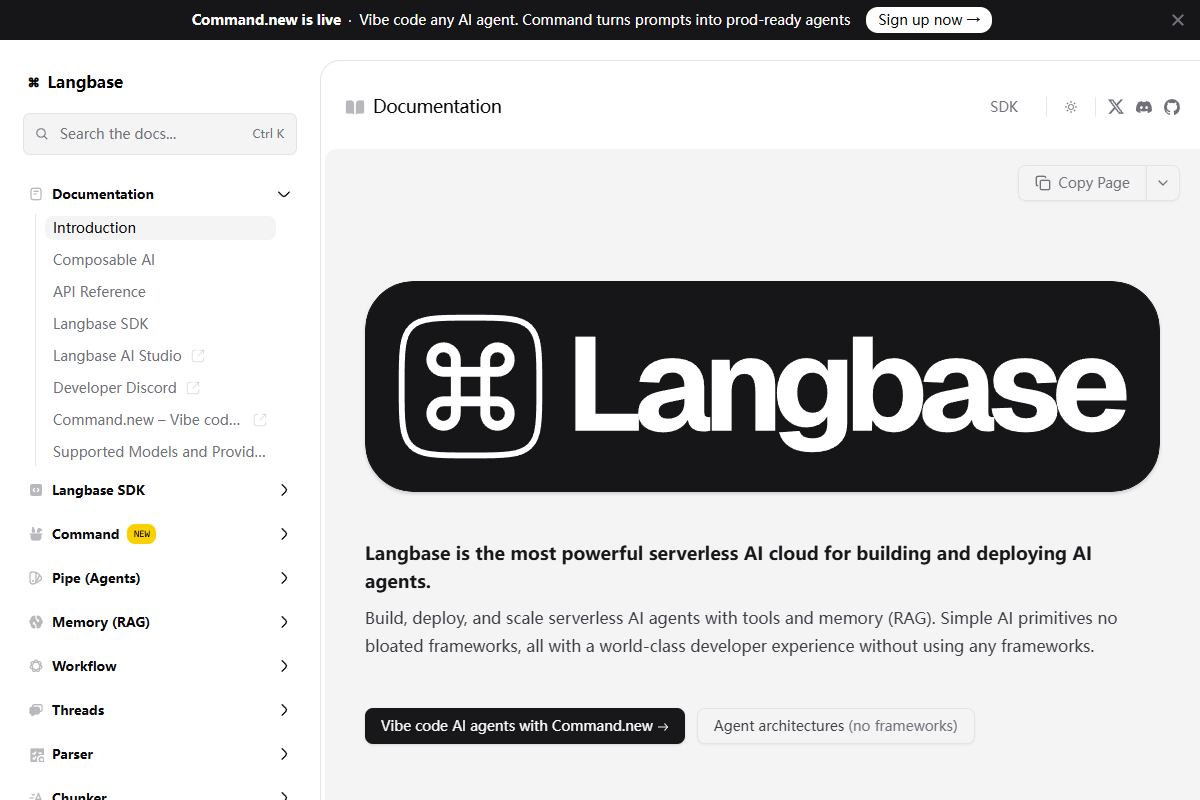
langbase
Core parameters and statistics
Langbase’s official positioning is “Serverless AI Developer Platform”. The official website explains that it is for developers to build, collaborate, and deploy AI agents, apps, and AI features; the documentation page further describes it as a platform for building composable AI agents using memory, tools, RAG, and simple AI primitives. Therefore, this entry is classified as ai-agents rather than simply ai-model-training: its core value lies in Agent application orchestration, running, memory, tool invocation and deployment, rather than training the basic model.
| Parameters | Official public information | Description |
|---|---|---|
| Product positioning | Serverless AI developer platform | Source: official website homepage and document page metadata |
| Core Objects | Pipe Agents, Memory, Workflow, Threads, Tools, Parser, Chunker, Embed, MCP Servers | Source: Official Document Navigation and API Reference |
| API entrance | /v1/pipes/run, /v1/memory/retrieve, /v1/threads, /v1/tools/web-search, etc. |
Source: official documentation API reference |
| Pricing tiers | Free, Individual, Growth, Custom | Source: Official Pricing page, the price is subject to the real-time page |
| Company entity | Langbase, Inc. | Source: official website footer and documents author metadata |
| Region | US | Source: San Francisco address disclosed in official website footer |
These parameters indicate that Langbase is more like "AI Agent back-end platform + developer experience layer": developers can encapsulate models, prompts, memories, tools, workflows and thread management into runnable Agents or APIs, rather than just splicing the framework code locally.
User and market recognition
The market evidence currently publicly displayed by Langbase mainly comes from customer and developer reviews on the official website, official document ecology, and continuous changelog, rather than audited user numbers or revenue data. The official website Pricing page displays the evaluation of Resend founder Zeno Rocha, and presents developers’ feedback on the Memory Agents/RAG visual retrieval experience in the community section; these are officially displayed adoption signals and are not equivalent to independent statistics.
| Recognition type | Official public evidence | Meaning that can be used for judgment |
|---|---|---|
| Developer Ecosystem | Official documentation provides SDK, API Reference, Agent examples, MCP Servers, Integrations | Description The platform is mainly for engineering teams and developers |
| Product iteration | Changelog continuously records feature updates from 2024-02 Pipe to 2025-06 Remote MCP Server | Description The platform is in a state of continuous iteration |
| Customer/community signals | Official website displays reviews from founders/developers such as Resend | Can be used as a word-of-mouth clue, but does not represent customer size |
| Enterprise capabilities | Custom plans publicly list SAML/SSO, RBAC, SOC 2, HIPAA, GDPR, etc. | Explain that its commercialization goals include enterprise deployment and governance |
Undisclosed information includes the number of paying customers, active developers, revenue, financing progress, and SLA details; official sales materials, contract terms, and real-time status pages should still prevail before purchasing or integration.
Cost advantage
The cost advantage of Langbase is not in the single point of "cheaper than a certain model", but in the integration of common Agent back-end components into platform capabilities: a unified LLM provider access to Memory/RAG, tool call Threads, Workflow, logs and enterprise governance can reduce the time cost of the team's self-built orchestration, vector retrieval, tool interfaces and observation links.
| Plan | Public price on official website | Main quota/capacity | Suitable stage |
|---|---|---|---|
| Free | $0/month | 500 Langbase Credits, 5 Public Pipes, 500 Agent Runs, 5 MB Memory, 2 Memory Files, Threads/Parser/tools | Personal trial and prototype verification |
| Individual | $100/month | 20K Langbase Credits, Unlimited Public Pipes, 10 Private Pipes, Unlimited Runs, 20 MB Memory, 20 Memory Files, 1 Week Logs Retention, Unlimited Memory Retrieval | Independent Developers and Small Projects |
| Growth | $250/month | 75K Langbase Credits, 30 Private Pipes, 50 MB Memory, 50 Memory Files, 5 Org Seats, 1 Week Logs Retention | Startup Team and Collaborative Development |
| Custom | Contact Sales | Unlimited Pipes/Runs/RAG Memory, High-Performance RAG, Account Analytics/Evals, SAML/SSO, RBAC, Advanced rate limiting, compliance capabilities | Enterprise deployment and high governance requirements |
The above prices are from the official Pricing page. AI model calling costs, excess usage, corporate discounts and contract terms will change. Formal purchases should be based on the official real-time page and contract.
Main functions
- Pipe Agents: Combine prompts, instructions, personalization and engine into AI agents that can be used through the API; the official Changelog describes Pipe as a custom AI agent that can use LLM, tools and knowledge data sets.
- Memory / RAG: Supports creating memory, uploading documents, retrieving similar chunks, and providing APIs such as
/v1/memory/retrievein the document. - Workflow: Appears in official documentation and 2025-05 Changelog as AI Primitive, used to organize more complex automation tasks.
- Threads: Provides APIs for session thread creation, message appending, querying, deletion, etc., suitable for maintaining multiple rounds of Agent status.
- Tools and MCP: Official documents include web search, website crawler, and MCP Servers; Remote MCP Server will be released in 2025-06, allowing external MCP clients to operate Pipes and Memory Agents.
- Parser / Chunker / Embed / Images: Document navigation displays these basic capabilities for workflows related to document parsing, text dicing, vector embedding, and image generation.
- Multi-model access: The official Changelog shows that Langbase continues to add provider or model support such as OpenAI, Anthropic, Google, Groq, Cohere, Azure OpenAI, xAI, Mistral, etc.
Model and version evolution
Langbase itself is not a basic model manufacturer, so it does not use the model weight version as the main line, but uses platform capability milestones as the version context. The official Changelog is the most reliable source of public releases.
| Date | Milestone | Summary of official description |
|---|---|---|
| 2024-02-01 | Prompt Instructions Personalization Engine (PIPE) | Pipe released as a custom AI agent callable via API |
| 2024-05-13 | Langbase Docs | Official documentation is online, covering Pipes, API, Integrations, etc. |
| 2024-07-03 | Memory & Create Pipe API Endpoint | Memory is used for RAG data storage and retrieval, and Create Pipe API supports dynamic creation of pipes |
| 2025-05-19 | Chai.new / Command.new | Public release of development experience for pushing AI Agents into production |
| 2025-05-25 | Runtime Agents | Runtime Agents enter SDK and API as AI Primitive |
| 2025-06-04 | Agent Apps on Command.new | Agent can be deployed as an application with Console and shared |
| 2025-06-21 | Langbase Remote MCP Server | Supports operating Pipes and Memory Agents from IDE, Claude and MCP compatible clients |
It should be noted that Langbase will also record third-party model access in the Changelog, such as Claude Sonnet 4/Opus 4, Gemini 2.5, Grok 3, etc.; these are available model supplier updates and should not be mistakenly written as Langbase self-developed model versions.
Technical advantages
Langbase's technical route is to split the Agent project into more stable cloud primitives: Pipe is responsible for Agent configuration and operation, Memory is responsible for RAG data and retrieval, Threads is responsible for session status, Tools/MCP is responsible for external actions and interoperation, and Workflow is responsible for task orchestration. For the development team, this is easier to unify permissions, logging, versions, retrieval and deployment boundaries than completely hand-written framework glue code.
The second advantage is "frame lightweight". The official documentation emphasizes simple AI primitives and no bloated frameworks, which is suitable for teams that do not want to be deeply bound to a local Agent framework. It provides an SDK and REST API that teams can progressively integrate into existing backends, frontend IDEs, or MCP clients.
The third advantage is corporate governance. The Custom plan publicly lists SAML/SSO, RBAC, Advanced rate limiting, SOC 2, HIPAA, GDPR and other capability directions. Specific compliance certificates, audit report availability, data retention and regional deployment are still subject to official sales materials and contracts.
How to use
| Usage portal | Official path | Typical steps | Suitable for users |
|---|---|---|---|
| Web Studio | https://studio.langbase.com |
Register/log in account, create Pipe, Memory or Agent, configure models and tools | Product prototype, non-pure code configuration |
| Docs/API | https://langbase.com/docs |
Read API Reference, create API key, call /v1/pipes/run, Memory, Threads, Tools and other interfaces |
Back-end and full-stack developers |
| SDK | Langbase SDK area of official Docs | Install SDK, click examples to access Agent, Memory, Tools, Threads | TypeScript/JavaScript project |
| MCP | https://mcp.langbase.com and official MCP documentation |
Connecting to Remote MCP Server in IDE, Claude or MCP-compatible client | Developers using MCP workflow |
| Command.new | https://command.new |
Build, debug, and deploy Agent Apps through natural language and configuration | Teams that quickly build Agent Apps |
The minimum implementation path is usually: first register an account on the official website and create an API key; then create a Pipe Agent; if a RAG is required, create a Memory and upload the document; finally, call the run interface through the API or SDK to access the return results, logs and error handling in the application.
Product Pricing
The pricing model is subject to the official real-time page. Usually a freemium or subscription system is used, and basic functions can be used for free. Advanced functions or high-frequency use require paid subscriptions, and users are advised to evaluate the optimal solution based on actual usage.
Application scenarios
- Document Q&A and Internal Knowledge Agent: Use Memory to upload product documentation API documents or operations manuals, and return traceable answers through Pipe Agent combined with RAG.
- Developer Tools and IDE Agent: Operate Pipes and Memory Agents in the IDE or MCP client through Remote MCP Server, embedding Agent capabilities into the development workflow.
- Customer Support and Automation Assistant: Use Threads to maintain conversation status, use Tools to access search, crawling, or business APIs, and use Workflow to orchestrate multi-step processing.
- Agent App Prototype to Production: Use Command.new /Agent Apps to generate a shareable, debuggable, and deployable Agent App from prompt and configuration.
- Multi-model routing and evaluation test: Based on multiple officially supported providers, test different model RAG configurations and tool calling effects on the same platform.
Applicable people
Langbase is suitable for developers, startup teams, and enterprise innovation teams who want to quickly build AI Agent backends. It is especially suitable for teams that already have application scenarios but do not want to maintain vector retrieval, tool calls, thread status, model provider access and MCP interoperability from scratch.
For pure content creators or users who only need a chat interface, Langbase may be biased toward engineering; for teams that require complete self-hosting, strongly customized model training, or local deployment, further confirmation is needed as to whether Langbase supports corresponding deployment, data isolation, and compliance requirements. If the goal is to train/fine-tune a base model, priority should be given to evaluating a dedicated training platform rather than using Langbase as a model training tool.
Summary and Outlook
It provides competitive solutions in its field, and its core value lies in lowering the threshold for AI use in this field.
Current limitations: Some advanced features require paid subscription, and the free version has function or usage restrictions; specific technical details and performance benchmarks have not yet been fully disclosed.
Related tools:  CrewAI, langchain
Version Info
- Langbase Remote MCP Server :The official Changelog released Langbase Remote MCP Server, which can operate Pipes and Memory Agents from IDE, Claude and MCP-compatible clients, including creating/updating/running pipe agents, creating memory, uploading documents and retrieving chunks, etc.
- Agent Apps on Command.new :The official Changelog releases Agent Apps, which supports building AI agents into deployable, debuggable, and shareable applications, and provides a Console to record API calls and responses.
- Runtime Agents/Threads/Workflow AI Primitives :The official Changelog will be published in 2025-05. AI primitives such as Runtime Agents, Threads, Workflow, Parser, Chunker, Embed, Tools, etc. will gradually enter the SDK and API.
- Prompt Instructions Personalization Engine (PIPE) :The official Changelog released Pipe, describing it as a custom AI agent available through API that can combine LLM, tools and knowledge data sets.
User Reviews